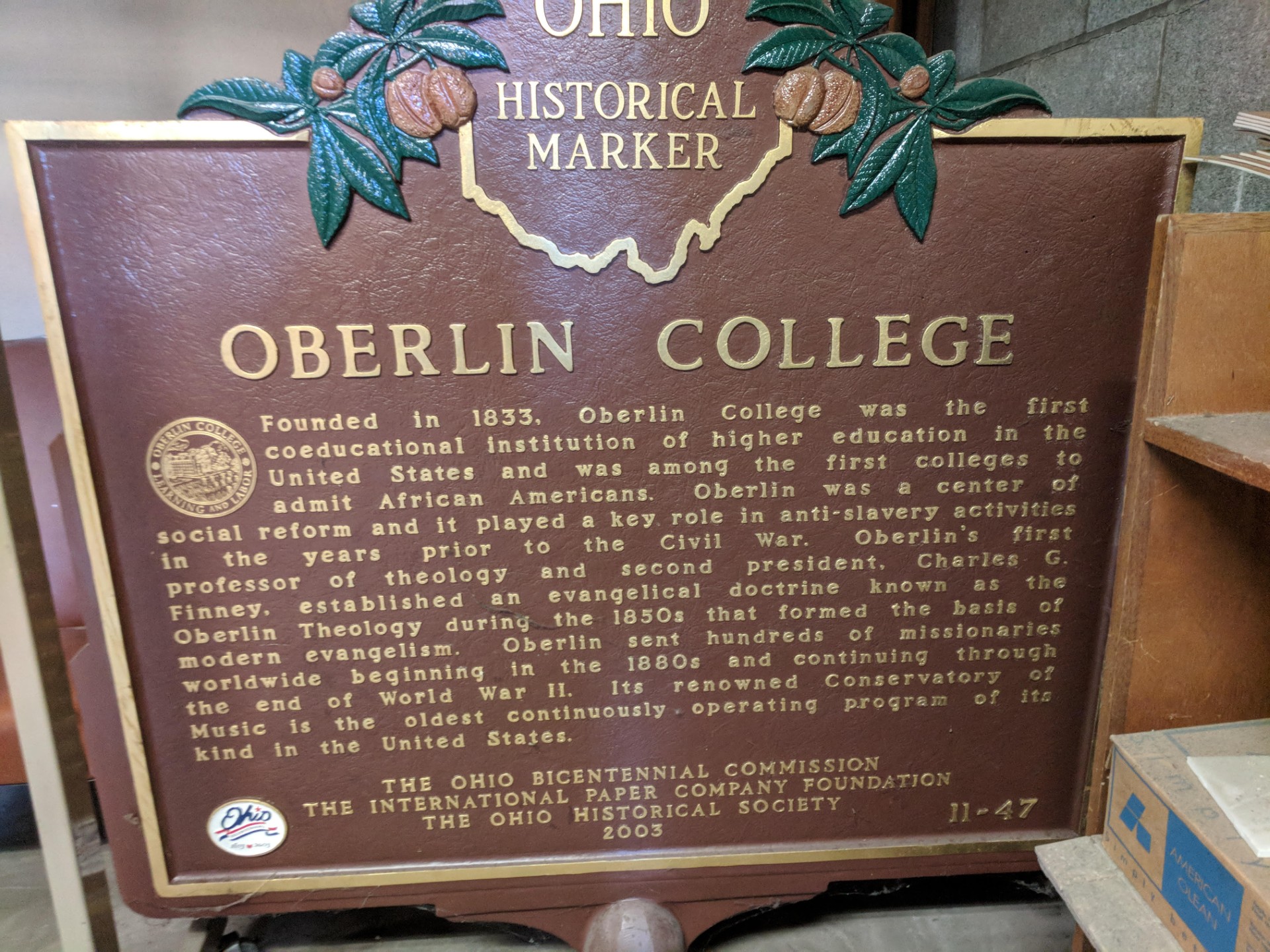
Side A: Founded in 1833, Oberlin College was the first coeducational institution of higher education in the United States and was among the first colleges to admit African Americans. Oberlin was a center of social reform and it played a key role in anti-slavery activities in the years prior to the Civil War. Oberlin’s first professor of theology and second president, Charles G. Finney, established an evangelical doctrine known as the Oberlin Theology during the 1850s that formed the basis of modern evangelism. Oberlin sent hundreds of missionaries worldwide beginning in the 1880s and continuing through the end of World War II. Its renowned Conservatory of Music is the oldest continuously operating program of its kind in the United States.
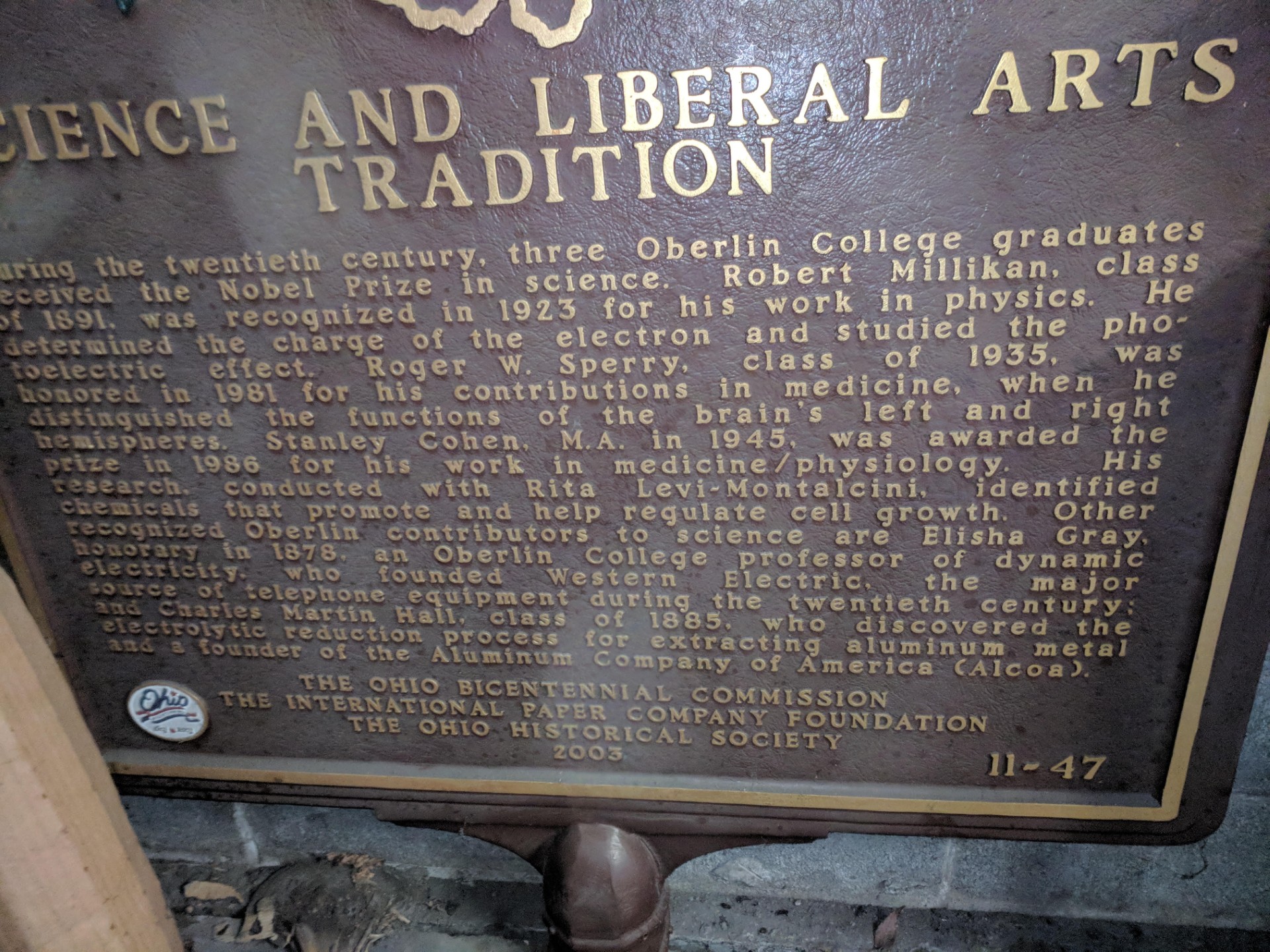
Side B: During the twentieth century, three Oberlin College graduates received the Nobel Prize in science. Robert Millikan, class of 1891, was recognized in 1923 for his work in physics. He determined the charge of the electron and studied the photoelectric effect. Roger W. Sperry, class of 1935, was honored in 1981 for his contributions in medicine, when he distinguished the functions of the brain’s left and right hemispheres. Stanley Cohen, M.A. in 1945, was awarded the prize in 1986 for his work in medicine/physiology. His research, conducted with Rita Levi-Montalcini, identified chemicals that promote and help regulate cell growth. Other recognized Oberlin contributors to science are Elisha Gray, honorary in 1878, an Oberlin College professor of dynamic electricity, who founded Western Electric, the major source of telephone equipment during the twentieth century; and Charles Martin Hall, class of 1885, who discovered the electrolytic reduction process for extracting aluminum metal and a founder of the Aluminum Company of America (Alcoa).
Sponsors: The Ohio Bicentennial Commission, The International Paper Company Foundation, The Ohio Historical Society