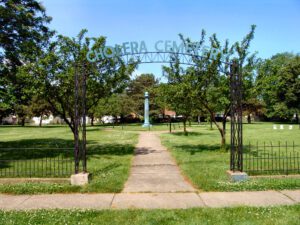
Of the city’s 5,667 people in 1849, 3,500 fled, and 400 of those remaining were victims of cholera. Most are buried here, some only in rough boxes in a common grave. The scourge came again in 1850 and 1852 but with less toll. “Dismay stalked abroad in the daytime and the drowsy night was hideous with the wailings of the disconsolate.”
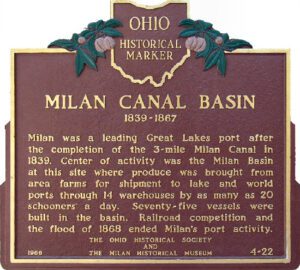
Milan was a leading Great Lakes port after the completion of the 3 mile Milan Canal in 1839. Center of activity was the Milan Basin at this site where produce was brought from area farms for shipment to lake and world ports through 14 warehouses by as many as 20 schooners a day. Seventy-five vessels were built in the basin. Railroad competition and the flood of 1868 ended Milan’s port activity.
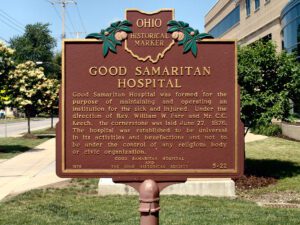
Good Samaritan Hospital was formed for the purpose of maintaining and operating an institution for the sick and injured. Under the direction of Rev. William W. Farr and Mr. C.C. Keech, the cornerstone was laid June 27, 1876. The hospital was established to be universal in its activities and benefactors and not to be under the control of any religious body or civic organization.
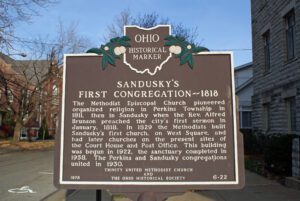
The Methodist Episcopal Church pioneered organized religion in Perkins Township in 1811, then in Sandusky when the Rev. Alfred Brunson preached the city’s first sermon in January, 1818. In 1829 the Methodists built Sandusky’s first church, on West Square, and had later churches on the present sites of the Court House and Post Office. This building was begun in 1922, the sanctuary completed in 1958. The Perkins and Sandusky congregations united in 1930.
Hector Kilbourne, a Freemason and the surveyor who make the original plat of Sandusky (as Portland) in 1816, laid out the streets to form the Masonic emblem. Huron and Central Avenue are the arms of the compass, Elm and Poplar Streets the sides of the mason’s square. The first Masonic Lodge in Sandusky was founded in 1819, with Kilbourne as Master.
This building was begun in 1835 and was completed in 1844. It is the oldest church building in continual use in Sandusky and incorporates a portion of the original structure. This marker commemorated the one hundred fiftieth anniversary of the laying of the cornerstone and the church’s sesquicentennial observance in 1985.
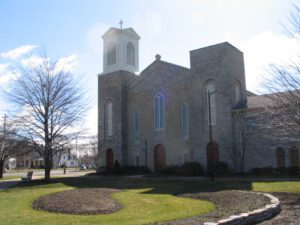
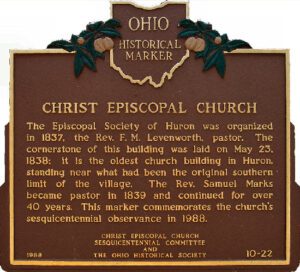
The Episcopal Society of Huron was organized in 1837, the Rev. F. M. Levenworth, pastor. The cornerstone of this building was laid May 23, 1838; it is the oldest church building in Huron, standing near what had been the original southern limit of the village. The Rev. Samuel Marks became pastor in 1839 and continued for over 40 years. This marker commemorates the church’s sesquicentennial observance in 1988.
In the early 1800s, Jabez Wright, an early Huron County judge, purchased a large tract of lakeside land on the north side of what is now Cleveland Road. There Wright built an eight-room farmhouse that later served as a “station” on the fabled Underground Railroad, playing a vital role in aiding fugitive African-American slaves to freedom. Beneath Wright’s farmhouse was a sixteen foot-wide and ninety foot-long tunnel. Escaped slaves entered the passage through a trap door in the home’s basement and exited into a corn crib located a mere one hundred feet from Lake Erie. There the slaves awaited the arrival of rowboats transporting them to vessels heading north to Canada. (Continued on side two)