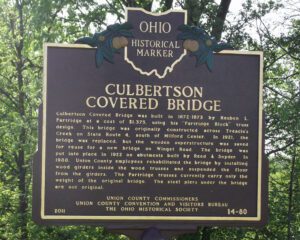
Culbertson Covered Bridge was built in 1872-1873 by Reuben L. Partridge at a cost of $1,375, using his “Partridge Block” truss design. This bridge was originally constructed across Treacle’s Creek on State Route 4, south of Milford Center. In 1921, the bridge was replaced, but the wooden superstructure was saved for reuse for a new bridge on Winget Road. The bridge was put into place in 1922 on abutments built by Reed & Snyder. In 1988, Union County employees rehabilitated the bridge by installing wood girders inside the wood trusses and suspended the floor from the girders. The Partridge trusses currently carry only the weight of the original bridge. The steel piers under the bridge are not original.
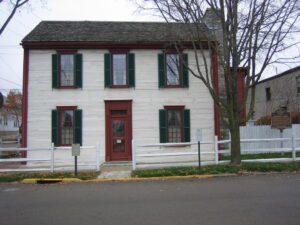
Benjamin Overfield (1774-1831), son of a Revolutionary War soldier, opened his tavern in this log house on September 13, 1808. Never moved, it is the oldest surviving building in Troy. The tavern provided food, lodging and space for business and social gatherings. Overfield agreed to let the county use a room on the second floor of the building as a temporary courtroom. Behind the tavern, Benjamin built a small log cabin that was home to his family. He prospered here until 1825 when he moved to the Public Square. Today’s structure includes the tavern, the cabin, and later additions. Used as a dwelling from 1825 until 1948, the building now houses the Overfield Tavern Museum. Benjamin Overfield and his first wife Mary are buried in Rose Hill Cemetery.
Following the Civil War, many of Ohio’s disabled and wounded veterans found inadequate provisions for their long-term needs. In response, the Grand Army of the Republic’s Department of Ohio lobbied for a state-operated veterans’ home. In 1886 Governor Joseph B. Foraker signed a bill establishing the Ohio Soldiers’ and Sailors’ Home for honorably discharged veterans. A board of trustees led by Sandusky publisher I.F. Mack selected the site, and the Sandusky community donated the tract of land, utilities, and a connection to the Baltimore and Ohio Railroad. The facility opened in November 1888. (continued on other side)
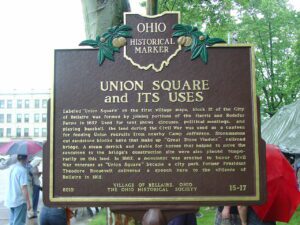
Labeled “Union Square” on the first village maps, block 12 of the City of Bellaire was formed by joining portions of the Harris and Rodefer Farms in 1857. Used for tent shows, circuses, political meetings, and playing baseball, the land during the Civil War was used as a canteen for feeding Union recruits from nearby Camp Jefferson. Stonemasons cut sandstone blocks here that make up “Great Stone Viaduct” railroad bridge. A steam derrick and stable for horses that helped to move the sandstone to the bridge’s construction site were also placed temporarily on this land. In 1882, a monument was erected to honor Civil War veterans as “Union Square” became a city park. Former President Theodore Roosevelt delivered a speech here to the citizens of Bellaire in 1912.
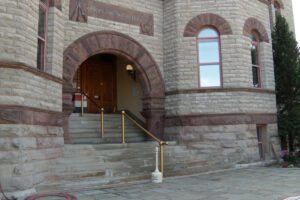
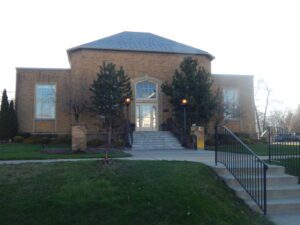
Listed on the National register of Historic Places in 1974, this building was the post office from 1940 through 1986. It is an example of the Colonial Revival style common in the 1930s and 1940s. The exterior brick work, large Palladian window, and simple design were common in the building plans for era post offices. This simplicity enabled unskilled workers to be employed in public works projects. The building’s interior still has the original portico, wood and marble-paneled walls, terrazzo floors, and mailing lobby. (Continued on other side)
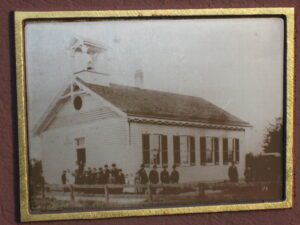
A school has stood on this site almost continuously since the late 1840s. The first school here was the Newell School, a white-frame, one-room school in use from approximately 1847 to 1939. The building was a part of the Newell Rural School District, which extended from the north border of Greenhills to present-day Interstate 275. Area schools consolidated in 1939 and the Newell district was absorbed into the Science Hall Rural School District and then into the Greenhills Rural School District (later renamed the Greenhills/Forest Park School District). The site of the old Newell School is now a part of the Winton Woods City Schools. The building directly behind this marker opened in 1968 as Forest Park High School and later became Winton Woods High School.
Oscar D. Boggess (1832-1907) was born in Virginia, the son of a slave and her master. He and his family were granted freedom in the will of his father and master. The will was contested up to the United States Supreme Court, which upheld Boggess’ freedom. Boggess moved to Pennsylvania at age 20, and during the Civil War, joined the 43rd United States Colored Troops. He earned the Butler Medal of Honor for bravery at the Battle of the Crater near Petersburg, Virginia, in July 1864. Boggess moved to Youngstown after the war, and worked as a stonemason. He was a charter member of Tod Post 29, Grand Army of the Republic, in Youngstown, and a co-founder of the Oak Hill Avenue African Methodist Episcopal Church, the city’s first African American religious congregation. The Boggess home, formerly located near this site, hosted the church’s first meetings in 1870.
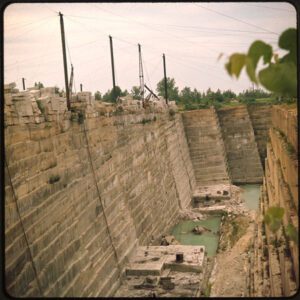
For more than ninety years, this area was the heart and soul of Berea’s sandstone quarries. In the early 1830s, John Baldwin discovered that the area’s sandstone deposits made superb grindstones and building stones. In the 1840s, thriving sandstone quarries developed and became Berea’s lifeblood. Searching for the “American Dream,” German, Irish, Italian, Hungarian, and Polish immigrants, among others, came here to work. The quarries eventually encompassed nearly 250 acres and consumed the fashionable houses of Berea’s “South Side” and the buildings of Baldwin University. The Cuyahoga County Court House, Ohio’s Capitol, and Canada’s parliament buildings are among many structures in North America and Europe constructed of Berea sandstone. Decreasing demand for sandstone and the Great Depression closed the last of Berea’s quarries in the mid-1930s.