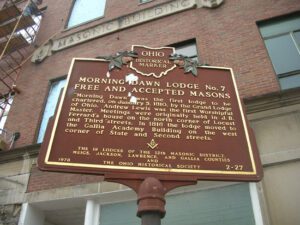
Morning Dawn was the first lodge to be chartered, on January 5, 1810, by the Grand Lodge of Ohio. Andrew Lewis was the first Worshipful Master. Meetings were originally held in J. B. Ferrard’s house on the north corner of Locust and Third Streets. In 1816 the lodge moved to the Gallia Academy building on the west corner of State and Second streets. [Masonic Emblem]
Elder Oliver Mears organized on February 8, 1862 in a tent on this spot, then a walnut grove owned by William Lovett, the Lovett’s Grove Seventh-day Adventist Church, first of this denomination in Ohio. A Frame building erected in 1864 served the congregation until 1911 when it moved to its present location in Bowling Green.
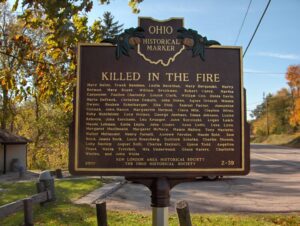
Located one mile north of Fitchville, the Golden Age Nursing Home caught fire and burned to the ground at 4:45 a.m., November 23, 1963, killing 63 of 84 patients. Fire departments from New London, Greenwich, North Fairfield, and Plymouth responded. Ignited by the arcing of overloaded wiring, the incident called for action to require sprinklers, automatic fire detection systems, and electrical wiring compliance to building codes in all nursing homes. The worst tragedy of its kind in the nation, the incident was overshadowed by the assassination of President John F. Kennedy and was not widely reported. Twenty-one unclaimed bodies were interred in a 60-foot grave in Woodlawn Cemetery in Norwalk. Those killed in the fire are listed on the reverse.
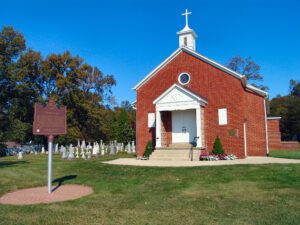
This area, known as Calmoutier, was an early French Catholic farming community founded in 1832 by Claude Druhot, who came from Calmoutier, Hte-Saône, France. Its first native, the four-month-old Claude Joseph Druhot, was baptized on 9 June 1833 by Fr. John Henni, who resided at St. John’s in Canton (and in 1854 became Milwaukee’s first bishop). In 1836 Fr. John Alleman, O.P., established St. Genevieve’s Mission (when it began to keep its own records) on land donated by the Pierson and Roussel families. The log chapel that was built (the first of four churches here) predated any Catholic church building in Cleveland, Akron, and Toledo.
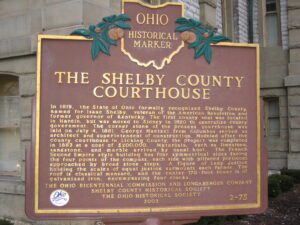
In 1819, the State of Ohio formally recognized Shelby County, named for Isaac Shelby, veteran of the American Revolution and former governor of Kentucky. The first county seat was located in Hardin, but was moved to Sidney in 1820 to centralize county government. The corner stone of the present courthouse was laid on July 4, 1881. George Maetzel from Columbus served as architect and superintendent of construction. Modeled after the county courthouse in Licking County, the project was completed in 1883 at a cost of $200,000. Materials, such as limestone, sandstone, and marble arrived by canal boat. The French Second Empire style building has four symmetrical sides facing the four points of the compass, each side with pillared porticoes approached by broad stone steps. A figure of Lady Justice holding the scales of equal justice surmounts each facade. The roof is classical mansard, and the center170-foot tower is of galvanized iron, encompassing four clocks.
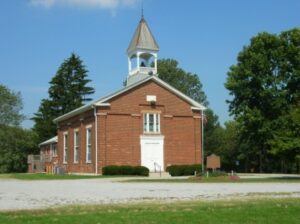
On this site in 1809, pious Christians from Virginia and North Carolina erected a Methodist Church, the first in Greene County. The church was officially organized on May 23, 1807 as the Bonner Society. Frederick Bonner, Sr. and the illustrious Rev. John Sale were the principal organizers. This Methodist Church, one of the oldest in Ohio, has been serving the area known as the Union Neighborhood uninterrupted from this site since 1809. Rev. Bennett Maxey was the first pastor. (Continued on other side)
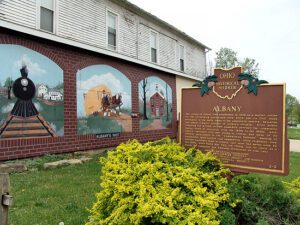
The village of Albany was established in 1838 as a market center for the surrounding agricultural area, which saw its first white settlement in the early years of the nineteenth century. Education was always a major concern of Albany’s citizens. Since public schooling was minimal, private academies provided the community various levels of education from the 1840s to the 1880s. Anti-slavery sentiment also was strong in Albany, and many of its citizens participated in the “Underground Railroad.” Because of educational opportunities and sympathetic white neighbors, free African-Americans came to Albany, but most had moved away by the 1930s. After World War Two, the village lost its status as a center for commerce and business.
Henry Simon Winzeler, founder of The Ohio Art Company, was born in 1876 in the Winzeler family home just north of this site in Burlington. As a young man, he opened a dental practice in 1900 in the Murbach Building in Archbold on the corner of North Defiance and East Holland streets. Making a dramatic career change eight years later, Winzeler, inspired by an oval mirror in his aunt’s clothing store, started a company to manufacture picture frames. Calling it The Ohio Art Company, venture capital came from Winzeler’s Hub Grocery that he opened in August 1908 located on North Defiance Street. His picture frame company was opened in the Spoerle and Baer Building, a few doors down on the same street. [Continued on other side]