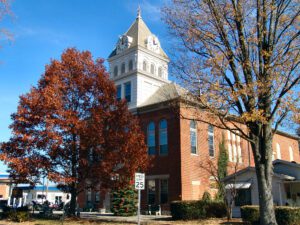
The Richwood Opera House and Town Hall was erected in 1890 as a community center designed to house the town council chambers, fire department, jail and opera house. The Richardsonian Romanesque styled building served Richwood in all these capacities for nearly 75 years. The Opera House was the site of minstrel shows, concerts, movies, lecture courses, revivals, farmers’ institutes, commencements, and community meetings. The second floor gymnasium was used for a men’s independent basketball league, dance classes, and as a teen center after World War II. Construction of an interurban railway running between Richwood and the resort town of Magnetic Springs in 1906 provided an expanded audience for the Opera House. (continued on other side)
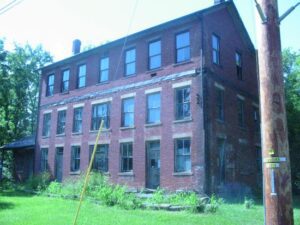
This historic inn began serving travelers on the old Portage-Columbiana stage road (now Tallmadge Road) in 1832. Two major stage lines, one from Cleveland to Wellsville (the closest Ohio River port) and the other from Cleveland to Pittsburgh, passed through Palmyra in the early 1800s. Originally a simple two-story Greek Revival-style building, it had its third story added in 1888 when it became a lodge for the Knights of Pythias fraternal organization. It served as a private residence and store for most of the 20th century. The Palmyra Center Hotel was added to the National Register of Historic Places in 1976.
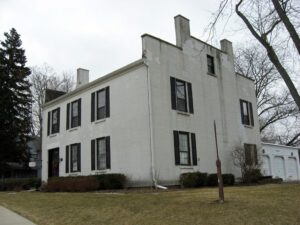
Old Wood County Jail 1847-1870. Built in 1847, during the Presidency of Polk, when Perrysburg was the County Seat, and used as the Jail and Infirmary until 1870. Continued to serve as the Perrysburg Jail until 1899, sold by the town in 1918. Acquired and restored by Mr. and Mrs. Charles W. Hoffmann in 1954. Listed in the Historic American Building Survey and National Register of Historical Landmarks, Library of Congress.
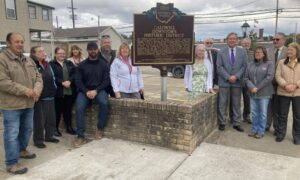
The Caldwell Downtown Historic District is the historic commercial and governmental core of the Village of Caldwell, which was founded in 1857 on farmland owned by Joseph and Samuel Caldwell. Caldwell serves as the county seat of Noble County, the last of Ohio’s 88 counties to be organized. The agricultural community prospered and by 1873 was the second-largest producer of tobacco in Ohio. The Pennsylvania Railroad arrived in 1872, and the development of salt, oil, coal, and natural gas extraction companies followed during the 1880s. Two separate fires in 1897 devastated portions of the north and south quadrants of the district. As a result, Caldwell formed a volunteer fire department and the Village Council introduced legislation prohibiting construction of wood buildings within a block of the public square. (Continued on other side)
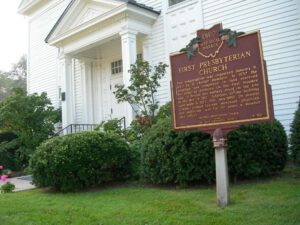
This congregation was organized January 9, 1820 by 11 charter members. In 1837 the structure was completed on land reserved for religious purposes on the first Maumee plat. A British gun battery stood on the site in the War of 1812. Additions to the building were made in 1922, 1951, and 1968. Dr. Horatio Conant, pioneer teacher, merchant, physician, and politician, was for 59 years a member and officer.
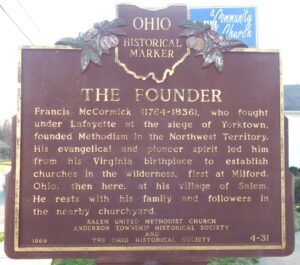
Francis McCormick (1764-1836), who fought under Lafayette at the siege of Yorktown, founded Methodism in the Northwest Territory. His evangelical and pioneer spirit led him from his Virginia birthplace to establish churches in the wilderness, first at Milford, Ohio, then here, at his village of Salem. He rests with his family and followers in the nearby churchyard.
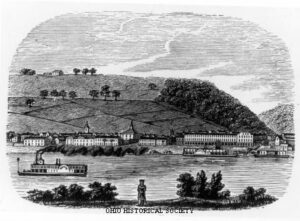
Ripley was incorporated as the village of Staunton in 1812. Its name was changed in 1816 to honor General Eleazer Wheelock Ripley, a hero of the War of 1812. In the years before railroads, Ripley was a principal Ohio River shipping center. Also important were its extensive boat-building, tobacco, pork, and timber industries. Ripley too was the home of saw and planing mills, iron foundries, and a piano factory. Such varied commerce enabled Ripley to remain vibrant throughout the nineteenth century. Although noted as a port, Ripley is best remembered as an abolitionist stronghold. Many of its citizens, including Rev. John Rankin and John P. Parker, served as conductors on the famed “Underground Railroad.” The notoriety of Ripley’s anti-slavery network perhaps eclipsed that of nearby Cincinnati, earning the town a reputation as the “Black Hole of Abolitionism.” (Continued on side two)
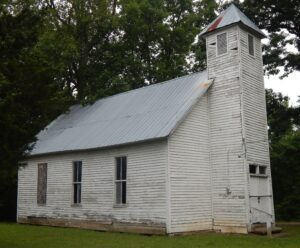
The present structure for the Macedonia Missionary Baptist Church was built in 1849 on Macedonia Ridge north of Burlington, an abolitionist sanctuary for escaped and freed slaves since 1799. It was built by the existing Baptist congregation and a group of 37 freed slaves who had arrived in Burlington from Virginia. The Baptist congregation in Macedonia had organized in 1811-1813 and practiced their faith in their homes and later in a small building with a bell tower made of sticks. The 1849 church was the religious and social focal point for the black community and became the “Mother Church” for approximately eight Baptist churches that exist in Ohio and West Virginia. The Macedonia Missionary Baptist Church was listed on the National Register of Historic Places in 1978.