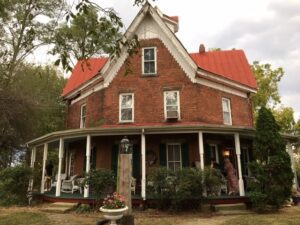
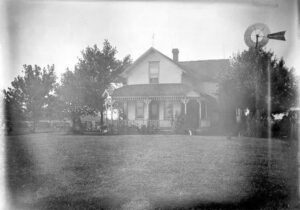
Zimmerman-Bury Octagon House. The Zimmerman-Bury Octagon House was built by Ezekiel B. Zimmerman (1843-1935) and Francis B. Hess Zimmerman (1848-1920) in 1883. Ezekiel graduated from Smithville Academy and was an avid reader. One of Ezekiel’s sons, Ernest Zimmerman (1888-1973), remembered that his father had encountered Orson Fowler’s manifesto A Home for All, or the Gravel Wall and Octagon Mode of Building (1853) and surmised that his father patterned the house after Section V of the book. The approximate 99,000 bricks comprising the house were made on the property, creating exterior walls and a center stairway which are three bricks or about 12 inches thick. Ernest noted the house’s “Russian Tin” roof, referring to its metal standing seam construction. The roof and architectural ornament make the house stand out compared to other octagon structures in Ohio. (Continued on other side)
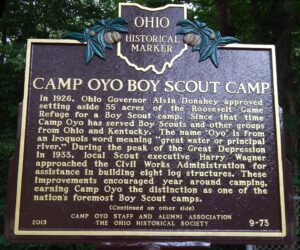
In 1926, Ohio Governor Alvin Donahey approved setting aside 55 acres of the Roosevelt Game Refuge for a Boy Scout camp. Since that time Camp Oyo has served Boy Scouts and other groups from Ohio and Kentucky. The name ‘Oyo’ is from an Iroquois word meaning “great water or principal river.” During the peak of the Great Depression in 1933, local Scout executive Harry Wagner approached the Civil Works Administration for assistance in building eight log structures. These improvements encouraged year around camping, earning Camp Oyo the distinction as one of the nation’s foremost Boy Scout camps. (Continued on other side)
Legend has it that Mogadore’s first settler, Ariel Bradley, was a spy for George Washington in October, 1776. As a nine year old boy, Ariel crossed British lines on a supposed errand to the nearest grist mill and returned with troop positions and tent counts. In 1801, Ariel left Connecticut to make his new home in what would be Ohio. In 1807, he built a log cabin on a 146 acre plot of farm land that cost $335. Until 1825 the new community had been named Bradleyville, but Ariel did not want the area named after him. Martin Kent was building a residence and a sailor, John Robinson, climbed to the top of the framework, pulled a flask of whiskey from his pocket. Breaking the flask on the last beam of construction, Robinson shouted “Three cheers for Mogador,” which is a large city in Morocco, thusly christening the area Mogadore.
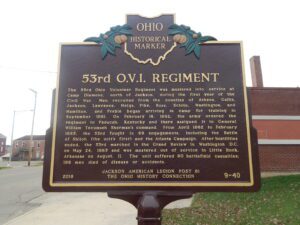
The 53rd Ohio Volunteer Regiment was mustered into service at Camp Diamond, north of Jackson, during the first year of the Civil War. Men recruited from the counties of Athens, Gallia, Jackson, Lawrence, Meigs, Pike, Ross, Scioto, Washington, and Hamilton, and Preble began arriving in camp for training in September 1861. On February 16, 1862, the army ordered the regiment to Paducah, Kentucky and there assigned it to General William Tecumseh Sherman’s command. From April 1862 to February 1865, the 53rd fought in 69 engagements, including the Battle of Shiloh (the unit’s first) and the Atlanta Campaign. After hostilities ended, the 53rd marched in the Grand Review in Washington D.C. on May 24, 1865 and was mustered out of service in Little Rock, Arkansas on August 11. The unit suffered 80 battlefield casualties; 196 men died of disease or accidents.
At the turn of the twentieth century, increased enrollment in the Combined Normal and Industrial Department at Wilberforce University (which later became Central State University) spurred construction of new teaching and dormitory facilities. Galloway Hall, which included an auditorium and a tower with chimes and a clock, was completed in 1906. Many famous personalities performed in Galloway Hall’s auditorium, including the renown opera singer Leontyne Price; Robert McFerrin, the first African American male lead with the New York Metropolitan Opera; actors Ruby Dee and Ossie Davis; comedian and civil rights activist Dick Gregory; and composer and conductor Duke Ellington. Noted authors and intellectuals addressed audiences there, including historian John Hope Franklin; writer, poet, actor, and playwright Maya Angelou; Lerone Bennett, author, historian, and editor of EBONY Magazine; and writer and essayist James Baldwin. (continued on other side)
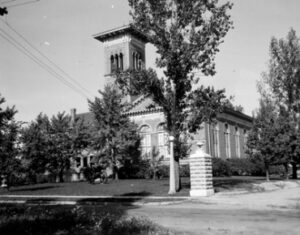
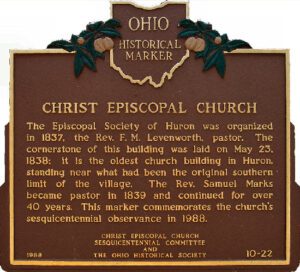
The Episcopal Society of Huron was organized in 1837, the Rev. F. M. Levenworth, pastor. The cornerstone of this building was laid May 23, 1838; it is the oldest church building in Huron, standing near what had been the original southern limit of the village. The Rev. Samuel Marks became pastor in 1839 and continued for over 40 years. This marker commemorates the church’s sesquicentennial observance in 1988.
First a farming community, later a railroad crossroads in southern Hancock County, Arlington was one of the county’s earliest settlements. Gen. William Hull opened a trail into the area during the War of 1812 as he crossed Buck Run at Eagle Creek. He led his army to the Blanchard River to establish Ft. Findlay. Robert Hurd owned extensive tracts of land in the area, and his sons were the first recorded settlers, building a log cabin near this site in 1834. The rich farmland and abundant water soon attracted other settlers to the vicinity of “Hurdtown.” The name was changed to “Arlington” when the village was formally surveyed in November, 1844.
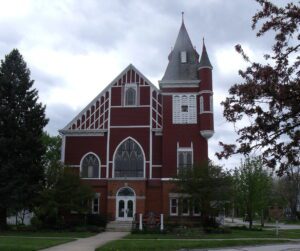
The Burton Congregational Church was organized in 1808 and met in several nearby locations before this present building was erected in 1836 at a cost of $4,000. It was originally located within the park directly opposite where it stands today, but was moved to its present location in 1850. The steeple, rising 104 feet from the ground, crowned the roof in 1875. The church building was frequently used as a public hall and for many years was also used as the main hall for the Agricultural Fair, the forerunner of the Great Geauga County Fair. A former architect referred to the church as “Steamboat Gothic” because of its unusual appearance, but to its membership and friends it is just a beautiful place to worship God.