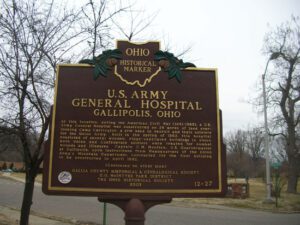
At this location, during the American Civil War (1861-1865), a U.S. Army General Hospital was constructed on 29 acres of land overlooking Camp Carrington, a site used to recruit and train soldiers for the Union Army. Built in the spring of 1862, this hospital consisted of several wooden, ridge-ventilated buildings in which both Union and Confederate soldiers were treated for combat wounds and illnesses. Captain C.M. Moulton, U.S. Quartermaster at Gallipolis, upon instructions from Headquarters of the Union Army’s Mountain Department, contracted for the first building to be constructed in April 1862. (continued on other side)
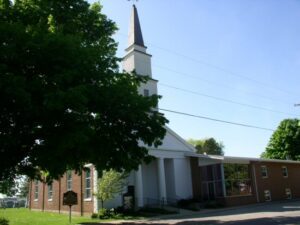
The founders of what would become the Kings Creek Baptist Church first met on June 29, 1805 in the log home of local residents James and Ann Turner. The Baptist congregation continued to meet in people’s homes until 1816 when Taylortown founder John Taylor donated an acre of land to establish a burying site and a meetinghouse. Constructed of logs, this meetinghouse is considered to be the third Baptist church built in Ohio and the Northwest Territory. The original structure was replaced by a more substantial brick building in 1832, and the present Kings Creek Baptist Church was built on the original foundation in 1849. The church features classic Greek design and a grand steeple inspired by the work of the English architect Sir Christopher Wren. An educational wing was added in 1969. (continued on other side)
The First Presbyterian Church of West Union, built in 1810, is known as the “Church of the Governors.” Although the date is uncertain, the congregation was organized circa 1800 on Thomas Kirker’s land on Eagle Creek, about three miles from West Union. Kirker, Ohio’s second governor, was influential in organizing the congregation and raising funds for the construction of the building. Stonemason, Thomas Metcalfe, Kentucky governor from 1828-1832, was awarded the contract to build the walls for $250.00; the total construction cost was $500.00. The first three regular ministers – William Williamson, Dyer Burgess, and John P. Van Dyke – all held strong anti-slavery sentiment that was felt throughout the congregation. During the Civil War, soldiers of the 70th Ohio Volunteer Infantry, a regiment of recruits from Adams County and eastern Brown County, were said to have been temporarily quartered in the church before leaving West Union in 1861.
In February 1819, seven individuals met in Isaac Barnes’ home to form a Congregational Church and entered into covenant. Reverend William Hanford of the Connecticut Missionary Society provided guidance and charged the new congregation to “walk worthy of their high vocation.” Prominent members led the way. In 1832, charter member Nira B. Northrup led the Wadsworth Presbytery in releasing Reverend John Shipherd from pastoral duties to help found what would become Oberlin College. Harrison Gray (H.G.) Blake was a committed abolitionist who, as a state senator, helped repeal the Ohio Black Laws and who was a principal “station master” on the Underground Railroad. (Continued on other side)
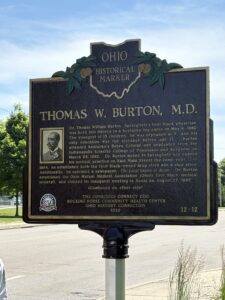
Dr. Thomas William Burton, Springfield’s first Black physician, was born into slavery in a Kentucky log cabin on May 4, 1860. The youngest of 15 children, he was orphaned at 9, and his only education was the alphabet before age 21. Burton attended Kentucky’s Berea College and graduated from the Indianapolis Eclectic College of Physicians and Surgeons on March 24, 1892. Dr. Burton moved to Springfield and opened his medical practice on East Main Street the same year. In 1894, he established both the first Black-owned drug store and a shoe store. Additionally, he operated a newspaper, The Loyal Legion of Honor. Dr. Burton established the Ohio Mutual Medical Association (Ohio’s first Black medical society), and chaired its inaugural meeting in Xenia on August 27, 1897. (Continued on other side)
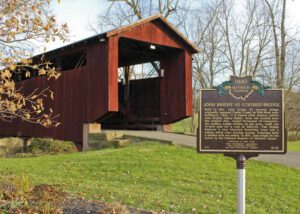
Built in 1881, John Bright #2 covered bridge originally spanned Poplar Creek on Bish Road near Baltimore, Ohio. It is named after pioneer settler John Bright, whose family farm was located near the original site. August Borneman of Lancaster, the leading bridge builder in the area, built the 70-foot span for a cost of $927.50. The bridge features a rare inverted bowstring truss and a unique metal sway bracing system. Sometime later a wooden arch was added. In 1975, John Bright #2 was listed on the National Register of Historic Places. (Continued on other side)
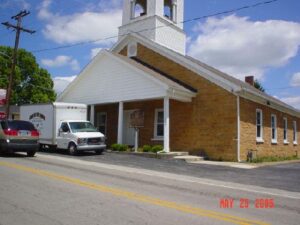
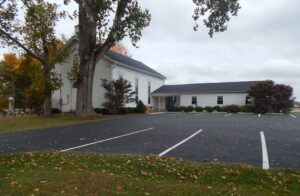
The comingling of faiths in an area settled predominantly by Quakers helps explain the origins of Jonah’s Run Baptist Church. Ministered to by a Baptist preacher, the children and neighbors of Daniel Collett (1752-1835), an Episcopalian and private in the Revolutionary War, and his wife Mary Haines Collett (1753-1826), a Quaker from Virginia, became Baptists and started the church in 1838. Levi Lukens (1767-1860), a Quaker from Pennsylvania by way of Virginia, purchased the land where the church stands in 1812 and sold it in 1839 to a founder of the congregation. Like local Quaker meetinghouses, the church had separate entrances for men and women and a partition between the two that divided the sanctuary. The congregation’s sons and daughters lived their faith. Howard McCune (1852-1923) was the Clinton Baptist Association’s moderator and president of the Ohio Baptist Convention’s state board. Anne Cossum (1894-1977) was a missionary in China from 1920-1927.
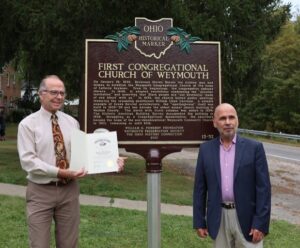
On January 19, 1835, Reverend Steven Barnes led sixteen men and women to establish the Weymouth Congregational Church at the home of Lathrop Seymour. From its beginnings, the congregation opposed slavery. In 1848, it adopted resolutions condemning the “peculiar institution” and asserting that Black people are “our brother[s] ‘made one blood’ with us.” In 1853, the church hosted public meetings featuring the crusading abolitionist William Lloyd Garrison. A notable example of Greek Revival architecture, the “meetinghouse” itself was built in 1835-’36 and has become the oldest extant church building in Medina County. The porch with Doric columns was added in 1854. The Historical American Building Survey documented the building in 1936. Struggling as a Congregational denomination, the sactuary became the home of the non-denominational Weymouth Community Church in 1920, remaining so until 2018.