

, OH
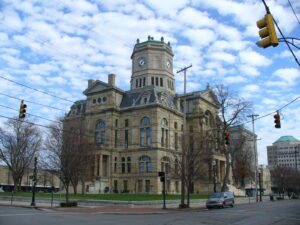
Butler County was created on March 24, 1803, about three weeks after Ohio became a state. Hamilton won the competition for the county seat, thanks to Israel Ludlow, Hamilton’s founder. Ludlow’s donation of the public square secured the county seat. The first Butler County trial court met in July 1803 in a tavern before moving to a two-story military building located at what had been Fort Hamilton (1791-1796). The county built the first courthouse on this public square in 1810. The two-story stone building contained a jail on the first floor and a courtroom on the upper level. A new brick two-story courthouse was built on this square in 1817 at a cost of $10,000. A four-sided clock was added to the top of the building in 1837. (continued on other side)
, OH
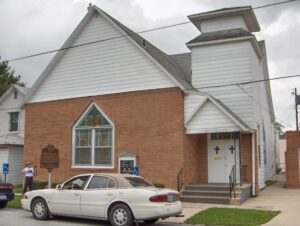
In spite of small numbers and being welcomed by the mostly white congregation of First Methodist Episcopal Church, African Americans in Findlay in the 1880s wanted to express their faith in ways that best reflected their freedoms and traditions. By the mid-1880s, the congregation was meeting in members’ homes and the Odd Fellows Hall, but began fund raising to build their own church in 1885. The congregation was admitted to the North Ohio Conference of the Third Episcopal District of the African Methodist Church in 1885, one of the first churches to be so admitted. The building on Liberty Street was well underway by the end of 1887 on a lot donated by Judge D. J. Cory. The original twenty foot by forty foot building cost $2,000 and immediately became a focal point for religion and social events for Findlay’s African American community. (Continued on other side)
, OH
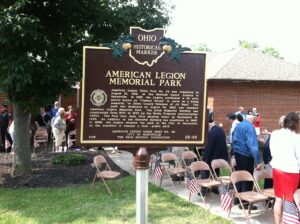
American Legion Union Post No. 79 was organized on August 21, 1919, at the National Guard Armory in Marysville. In 1927, the Legion purchased a 24 acre parcel known as “Clement Woods” to serve as a living memorial “to Union County Veterans of All Wars”. The park was dedicated on August 24, 1927, and renamed American Legion Memorial Park. The brick Memorial Building was constructed from 1937 to 1938 by the Works Progress Administration (WPA). The Post held their first meeting there on September 12, 1938. An addition to the Memorial Building was completed in 1960. In 1989, the Legion donated the park to the City of Marysville on the condition it remains a free, public park.
, OH
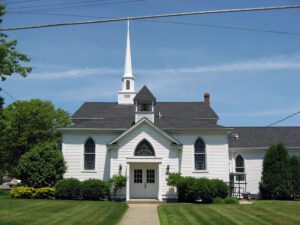
The Canfield Christian Church began as a Baptist congregation in 1822 and church met for worship in William Dean’s home. The Mahoning Baptist Association Meeting of 1826 was held in David Hayes barn. In 1827, Walter Scott was asked by the Association to be the first paid traveling evangelist in the Mahoning Valley area of Ohio. Scott accepted the offer and moved his family to a house next to the Canfield Church. By June of 1829, the Canfield Church voted to lay aside the Baptist name for the name Disciples of Christ. They believed all creeds were unnecessary and took the Bible alone as their sole rule of faith and practice. In 1847, a new church was built. Charter members of the church include James and Sarah Caldwell, Ann Winfield, Mr. and Mrs. Benjamin Caldwell and daughter, Mr. and Mrs. Andrew Flick, Mr. and Mrs. Walter Clark, Mr. and Mrs. John Flick, and Mr. and Mrs. Simmon Sackett and daughter. (Continued on other side)
, OH
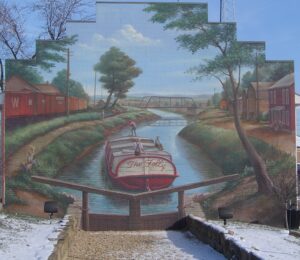
During the 1830s, the Ohio & Erie Canal was built through Newark. The Lockmaster’s House was home to the lockmaster of Lock #9. In 1852, the first railroad locomotive steamed into Newark, signaling the beginning of the end for the canal. By 1871, the Baltimore & Ohio Railroad took over the Lockmaster’s House and the encompassing land, and built the Little Red House on the corner for the stationmaster and telegraph operator. Passenger and freight stations, a freight yard, and roundhouse were constructed nearby and served as a B&O Division Point. In 1881, the Scheidler Machine Works built a factory to manufacture steam engines and sawmills. This building now houses The Works Museum. In 1890, an electric interurban railway line connected Newark’s B&O Station to the Toledo & Ohio Central station in Granville. By 1908, the old canal was filled-in. Interurban service ended in 1929 when the city purchased buses.
, OH
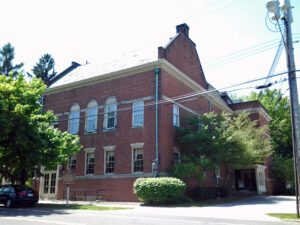
The Canfield WPA Memorial Building was constructed by the Works Progress Administration, a federal government program instituted by President Franklin D. Roosevelt as an effort to aid the United States in its recovery from the Great Depression of the late 1920s and 1930s. Local merchant Arron Weisner donated lands on the west side of Broad Street for the proposed project. A six member committee, comprised of two persons each representing the Argus Masonic Lodge, the American Legion, and the Village of Canfield, determined that the building be “a community building built around community projects.” Through local subscription and $60,000 in federal funds, the WPA project moved forward. The Youngstown architectural firm of W.H. Cook and W. Canfield designed the building in the Colonial Revival style. A ground breaking ceremony was held on December 20, 1935. During World War II, the United States government maintained offices in the building. (Continued on other side)
, OH
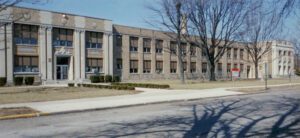
The North Baltimore Elementary and High School stood at 124 S. Second St. and was dedicated November 11, 1927. The tan and brown brick building replaced a school (built 1884) that a fire destroyed on January 26, 1926. The new school building, for children in grades 1-12, also included classrooms for home economics and business courses, as well as a 900-seat auditorium (including balcony), second floor cafeteria, gymnasium, administrative offices, and a public library. E.E. Leidy was the school’s superintendent and R. Vern Northup was the high school principal. The members of the board of education were Dr. E.A. Powell, President, D.B. Bushey, Vice President, C.G. Nigh, Clerk, and Nellie Roberts and R.E. Simon. Previously known as the “Independents,” the school’s sports teams became the “Tigers” in 1931. (Continued on other side)
, OH
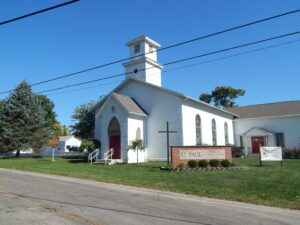
On July 30, 1816, the year before the establishment of Butler Township, a group of farmers of German background founded the Stillwater Church. The log structure with adjoining cemetery was located on three acres between Dog Leg Road and Frederick Pike. In 1842, the congregation replaced the log building with a brick one. In 1873, they moved the building to the northeast corner of Dog Leg and Little York Roads and renamed it St. Paul Lutheran Church. With a fruitful history of sharing God’s love, St. Paul celebrated it’s 200th anniversary on Sunday, July 31, 2016.