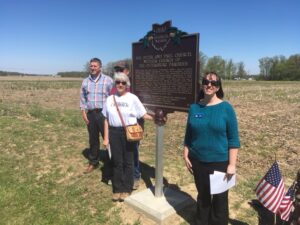
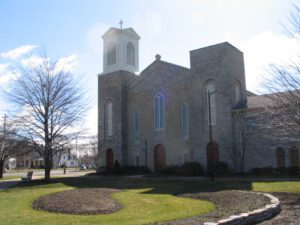
Saints Peter and Paul Church, Petersburg (1835), was the mother church for St. Joseph, Wapakoneta; St. John the Evangelist, Fryburg; St. Lawrence, Rhine; and Our Lady of the Immaculate Conception, Botkins. All were founded by German-Catholic immigrants to west-central Ohio. After the removal of the Wapakoneta Shawnee in 1832, the land became available for purchase. The 1830s and ’40s saw a wave of devout German settlers who wished to practice their faith in their new home, a desire served by missionary priests such as Father Wilhelm Horstman. Father Horstman first visited the settlement at Petersburg on May 8, 1835, presiding at Mass, baptizing, and blessing a marriage. In April 1836, immigrants John and Anna Mary Ruppert sold 40 acres of land in Pusheta Township to the trustees of the Catholic Church and a log church was built at the Petersburg site. (Continued on other side
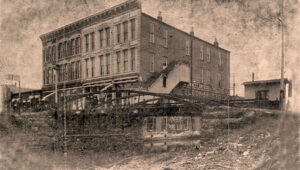
Emmitt-Greenbaum Building, 200 North Market Street, was built around 1878 by businessman and politician James Emmitt (1806-1893) to replace his 1837 wooden warehouse. The brick three-story Italianate building featured five vertical cast iron belts of simulated stone, a projecting cornice, reeded pilasters, and a “fortress-like fourteen bay front.” A covered wooden stairway on the building’s south side originally projected over the canal. Charles Louis Greenbaum (1871-1935) purchased the building in 1912 and opened his department store advertising it as “The Store with The Goods!” Over 140 years, the Emmitt-Greenbaum building was occupied by Jas. Emmitt Dry Goods, Hoffman’s, Greenbaum’s, Armbruster and Armbruster, Waverly Drugs, and the Bee Hive Tavern. A structural collapse after decades of deterioration condemned the building and the southwestern half was razed in 2021.
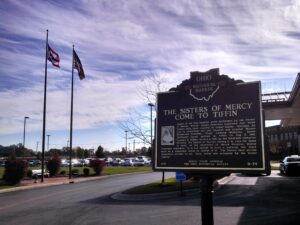
Pastor of St. Mary’s Church, Rev. Thomas F. Conlon met with the newly appointed bishop of the Toledo Diocese, Rt. Rev. Joseph Schrembs, to discuss building a charity hospital for the community. Community leaders and physicians promoted the necessity of a hospital that cared for all people regardless of race, creed, or color. Seven acres of land were purchased from Miss Emma J. Bowe on West Market Street for the construction of a four-story, fireproof brick building. Designed by local businessman George W. Netcher, the new hospital cost approximately $75,000. At the hospital’s dedication on October 26, 1913, Bishop Schrembs praised the people of Tiffin saying, “I appealed to the public-spirited citizens and my appeal did not fall upon deaf ears, as this building testifies.”
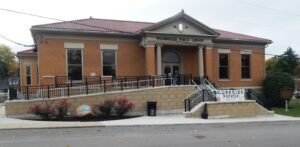
The Wilmington Public Library of Clinton County, one of 111 Carnegie libraries in Ohio, opened its doors to readers on June 30, 1904. A $12,500 gift from steel magnate and philanthropist Andrew Carnegie financed construction of the original 3,360-square-foot building. The community provided the building site, formerly known as Martin Field, and pledged tax funds for the library’s ongoing operation and maintenance. Expansions and modernizations have incorporated the original building and preserved its historic architectural style. “A Library outranks any other thing a community can do to benefit its people.” – Andrew Carnegie
This building was begun in 1835 and was completed in 1844. It is the oldest church building in continual use in Sandusky and incorporates a portion of the original structure. This marker commemorated the one hundred fiftieth anniversary of the laying of the cornerstone and the church’s sesquicentennial observance in 1985.
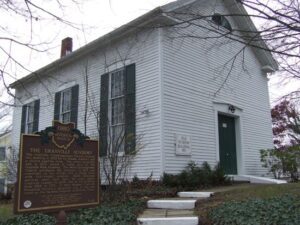
The Granville Congregational Church erected this building in 1833 for its Female Academy and a church meeting room. The school prospered and, in 1837, moved to make way for the Granville Male Academy. The Welsh Congregational Church purchased the structure in 1863 and converted its two stories into a single room with full-height windows. Welsh language services were held here for sixty years. Granville Grange #2230 met in the building from 1923 to 1973. It then became Granville Historical Society’s property and, in 1981, was listed on the National Register of Historic Places.
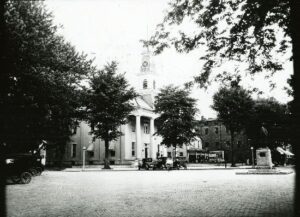
Morgan County was created in 1817 from parts of Washington, Muskingum, and Guernsey counties, with McConnelsville established as the seat of government. The first courthouse, a square brick structure, was built here in 1820. Its foundation stones form part of the wall surrounding the lawn. The present courthouse building was completed in 1858 at a cost of $10,000. This Greek Revival-style structure has had several major renovations since. The clock tower was added in 1886, and the building was enlarged and modernized in 1960.
SW Corner of Sunbury Square near S. Columbus St & E. Granville St.
Sunbury
, OH
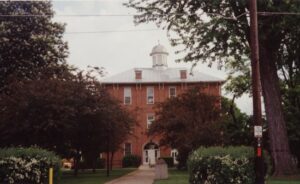
When Sunbury was platted in 1816, a town square was set aside for public use with the intention of constructing a town hall on the site. The first two stories of the Town Hall were built, as a school, in 1868 for $5,000. The Masons added the third story for $1,500 and occupied it for 91 years, until a lodge was constructed. Since 1868, the Town Hall has served Sunbury as a village office building, jail, fire station, and community library. Church services as well as Farmer’s Institutes were held in the building, and at one time it housed a bank. In 2002, the Town Hall was renovated for use as a community room and village offices.