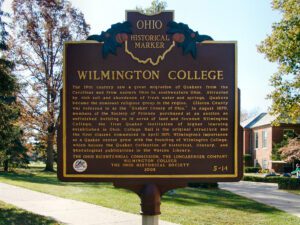
The 19th century saw a great migration of Quakers from the Carolinas and from eastern Ohio to southwestern Ohio. Attracted by rich soil and abundance of fresh water and springs, Quakers became the dominant religious group in the region. Clinton County was referred to as the “Quaker County of Ohio.” In August 1870, members of the Society of Friends purchased at an auction an unfinished building on 14 acres of land and founded Wilmington College, the first Quaker institution of higher learning established in Ohio. College Hall is the original structure and the first classes commenced in April 1871. Wilmington’s importance as a Quaker center grew with the founding of Wilmington College, which houses the Quaker Collection of historical, literary, and genealogical publications in the Watson Library.
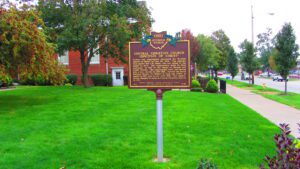
Harvey Howard, a local druggist, built the house at 407 North Market Street around 1860. After many owners, Captain James B. Taylor bought the home in 1893. Taylor commanded Company H of the 120th Ohio Volunteer Infantry during the Civil War. He studied law after the war and moved his practice to Wooster in 1882. Taylor’s wife Emelie died in 1905 and in 1906 Taylor sold the property to become Wooster’s first city hospital. Many of the town’s noted physicians practiced here and the facility was eventually enlarged to accommodate 30 beds. The house was a hospital until 1943, when Central Christian Church purchased it. The church used the building for education programs and restored much of its decor, including four fireplaces, inlaid floors, and bronze door hardware.
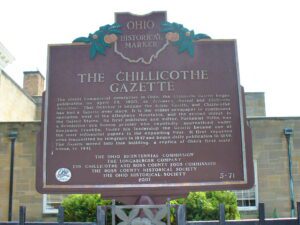
The oldest commercial enterprise in Ohio, the Chillicothe Gazette began publication on April 25, 1800, as Freeman’s Journal and Chillicothe Advertiser. That October it became the Scioto Gazette, and Chillicothe has had a Gazette ever since. It is the oldest newspaper in continuous operation west of the Allegheny Mountains, and the second oldest in the United States. Its first publisher and editor, Nathaniel Willis, was a Revolution-era Boston printer who reputedly apprenticed under Benjamin Franklin. Under his leadership the Gazette became one of the most influential papers in the expanding West. It first reported news transmitted by telegraph in 1847 and began daily publication in 1849. The Gazette moved into this building, a replica of Ohio’s first statehouse, in 1941.
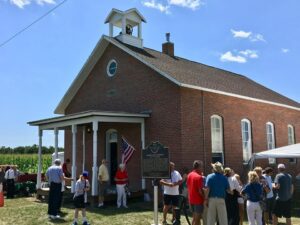
Bridenbaugh District No. 3 School. One-room schools were commonly named for people who furnished land for the building. Michael Bridenbaugh (1820-1895), who settled in Riley Township in 1835, and wife Jemima (1834-1903) sold a half-acre of land to the Riley Township school board in 1873. The first school on the site was a wooden structure, built in 1878. It was replaced by a brick building in 1889. The school operated until 1927, after which the district was consolidated. Students attended classes in nearby Pandora. (Continued on the other side)
Due to what is known as the Sharon Conglomerate or pebbly sandstone, these ledges have played an important role in the daily life of local residents and the economy. The porousness of this rock, which underlies much of Geauga County, supplies most of the county’s drinking water. Thompson Ledges also provided building stone with stone cutters working in quarries turning out doorsteps, watering troughs, gateposts, culverts, and bridges from mid-1800 to 1911 for use in Thompson, Geauga County and occasionally beyond. After 1900, cement became the preferred building material, but still used silica pebbles from the Ledges for gravel and cement. The Ledges have an unusual ecosystem containing several distinctive forests. A chestnut oak forest is pervasive on the top while a northern hemlock forest exists in the exposed creaks and crevices of the upper rim and ledges.
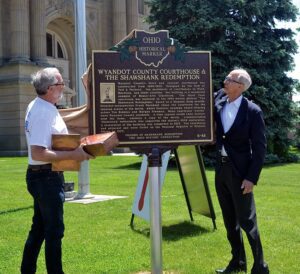
Wyandot County’s third and current courthouse was constructed from 1899-1900. Designed by the firm of Yost & Packard, the architects of courthouses in Wood, Harrison, and other counties, the building is a wonderful example of Beaux-Arts Classicism. The third floor courtroom was featured in the 1994 motion picture “The Shawshank Redemption,” based on a Stephen King novella. Director-screenwriter Frank Darabont chose the courtroom for the opening scenes of the movie, which features Academy Award-winning actors Tim Robbins and Morgan Freeman. Many courtroom “extras” were Wyandot County residents. A time capsule inside Lady Justice, atop the dome, contains a copy of the movie, commemorating ‘Shawshank’ enthusiasts who supported the statue’s 2009 restoration. A restoration of the building was completed in 2015. The courthouse and adjacent jail were listed on the National Register of Historic Places in 1973.
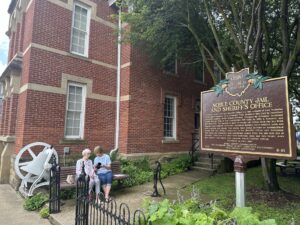
The Noble County Jail and Sheriff’s Office is a fine example of Late Victorian architecture designed by a prominent Ohio architect and built by important nineteenth century Noble County builders. Designed by Columbus architect Joseph Warren Yost, it was constructed 1881-1882 by Mills & Summers and cost $9,477.55. The building is made of orange-red bricks from the Ava Brick Company and features horizontal sandstone banding and a detailed gable end with brackets and finials. The Queen Anne design includes an asymmetrical façade with two distinct entrances to the Sheriff’s Office and Residence. The office and residence face courthouse square while the jail cells are at the rear. There are four first-floor individual cells and two larger men’s and women’s cells above with concrete barrel-vaulted ceilings. (Continued on other side)
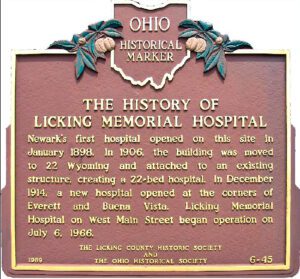
Newark’s first hospital opened on this site in January 1898. In 1906, the building was moved to 22 Wyoming and attached to an existing structure, creating a 22-bed hospital. In December 1914, a new hospital opened at the corners of Everett and Buena Vista. Licking Memorial Hospital on West Main Street began operation on July 6, 1966.