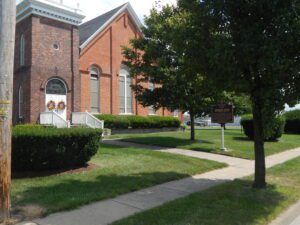
The Rev. Jacob Ward founded the Brunswick Methodist Episcopal Church in April 1817 with 13 members: Rhoda Stow, John and Lucy Stearns, John and Hannah Hulet, Samuel and Sarah Tillotson, Thomas and Phoebe Stearns, Solomon and Polly Harvey, Lydia Crittenden, and Olivia Ashley. In 1830, John and Lucy Stearns donated land for a cemetery, which included space for a church. A new church was completed in 1872. Bricks used for the building were fired locally and the first windows were glazed with clear glass and protected by shutters. In 1916, the church was extensively remodeled and redecorated. Stained glass replaced the clear glass, the church bell was relocated to the newly-added tower, and the main entrance was moved from the center of the building to the vestibule in the tower. (Continued on other side)
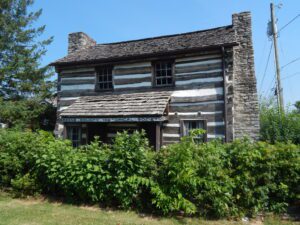
James Sr. and Rebecca (Junkin) Galloway moved with their family to Greene County from Kentucky in 1798, constructing their first home, a small log cabin. Galloway built the present structure around 1799 near the bend in the Little Miami River near what is now Goes Station on U.S. 68. In 1936, the Greene County Historical Society moved the home to the corner of Second and Monroe streets and then to the present site in 1965. The 1974 Xenia Tornado caused serious damage to the building, which has been restored and maintained by the historical society. James Sr. served as a hunter during the American Revolution, procuring game for the army, and while in Ohio, was the first treasurer of Greene County. His son James Jr. served as the first County Surveyor.
corner of South Michigan Avenue and East Indiana Street
Edgerton
, OH
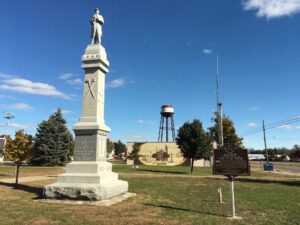
Edgerton was settled beside the St. Joseph River when the Lake Shore & Michigan Southern railroad was completed in 1854. The village was incorporated on December 4, 1865, and named for Alfred P. Edgerton, who donated the land for the park. He was an agent for Hicks & Company, a land speculation business. The firm of Von Behren & Shaffer built the town hall and opera house in 1884 for $7,998. The building and park became a hub of local activity. The park’s bandstand showcased the Edgerton Village Band and citizens gathered for picnics and festivities. (Continued on other side)
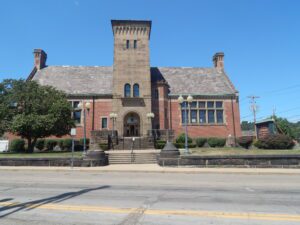
Andrew Carnegie was born in Dunfermline, Scotland. He immigrated to Allegheny City Pennsylvania with his family when he was 13. While operating the telegraphs for the Pennsylvania Railroad, Carnegie perceived the great need for steel in the railroad industry. With this insight, he founded the Carnegie Steel Corporation which operated for 35 years before he sold it to J.P. Morgan in 1901. Andrew Carnegie wrote the article, “Wealth” in 1889 in which he said that a responsible person of wealth should help his fellow man. Carnegie’s philanthropy provided 2,509 libraries throughout the world. Carnegie was already familiar with the city when he wrote a letter to offer funds to build the Steubenville library on June 30, 1899.(Continued on other side)
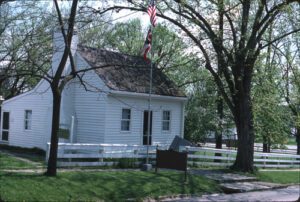
Hiram Ulysses Grant was born in this one-story, timber-frame home on April 27, 1822 to Jesse and Hannah Simpson Grant. The Grants settled in Point Pleasant the previous year, and Jesse took charge of the tannery located near the cottage. Now restored, the building remained in relatively good condition through the 1880s. In 1823, the family moved to Georgetown, Ohio, where Hiram lived until his appointment to West Point at age 17. Although reluctant to attend the Academy, Grant, now known as Ulysses Simpson Grant due to an error on the application, graduated in 1843 and was stationed at Jefferson Barracks near St. Louis, where he courted his future wife Julia Dent, with whom he had four children, Frederick, Ellen, Ulysses Jr., and Jesse. (continued on other side)
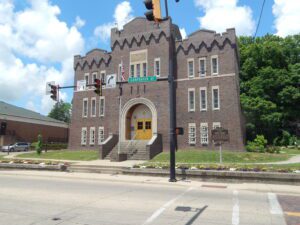
In the first years of the twentieth century, Athens’ citizens formed a new National Guard company. The guardsmen initially held drill at the Campbell Block on Court Street, but soon the Athens Commercial Club began advocating for an armory from the Ohio National Guard. In 1912, the Armory Board approved the request. Plans were drawn up for the armory and the Guard purchased land from the Athens Brick Company at the foot of Shale Hill. Construction began in the spring of 1915 and the Armory opened in December. In March of 1917, the city held a dedication ceremony and parade. Before World War I, the Athens Armory housed Company L and the Machine Gun Company, both part of the 7th Infantry Regiment, Ohio National Guard. (Continued on other side)
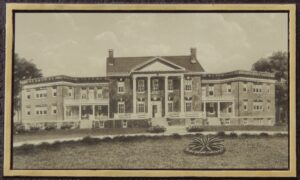
The Hillcrest Children’s Home stood near this site in Wheelersburg and opened in 1921 to the first 57 of many children who would come to live there. A 50-room building intended for 100 children, Hillcrest often housed double to triple that number. The extended community supported Hillcrest, providing entertainment, sponsoring activities, and donating presents for the children whose times there left indelible memories. The home closed in 1970 and was razed the following year.
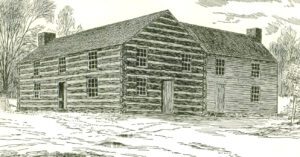
With the Division Act of 1800, the U.S. Congress divided the Northwest Territory at a line essentially the present boundary of Indiana and Ohio. The Indiana Territory stood west of the line. The name Northwest Territory was retained for the land east of the line and Chillicothe became its capital. The legislature for the territory convened in Chillicothe in November 1800. Since there were no public buildings in which the legislature could meet, its session was held in a two-story log house that stood on this site called “Abrams’ Big House.” It was so called for its owner, Basil Abrams. During the War of 1812, the building served as the barracks for the 19th U.S. Regiment of Infantry. Thereafter, it was known as the “old barracks” until it was razed circa 1840.