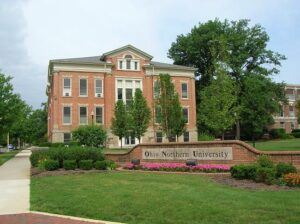
Henry Solomon Lehr founded Ohio Northern University in 1871 as the Northwestern Ohio Normal School. Its purpose was to train teachers and to provide higher education to the people in Northwest Ohio. In 1885, the school became Ohio Normal University. The new name recognized that the institution drew students from all over Ohio and the nation, and offered courses in many disciplines, including literature, music, business, telegraphy, and law, as well as teacher training. Beginning with 131 students, the institution’s enrollment grew rapidly during its first thirty years of existence. Buildings on the early campus included Dukes Memorial (left), built in 1905; the Normal School Building, built in 1871 and demolished in 1915 to make way for Lehr Memorial (center); and Hill building (right) finished in 1879. The Methodist Episcopal Church (predecessor to the United Methodist Church) assumed control in 1899. Ohio Normal University became Ohio Northern University in 1903. On June 3, 1910, President William Howard Taft delivered that year’s commencement address near this spot.
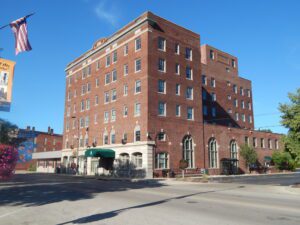
The Hotel Ashtabula was built in 1920 during an economic boom that lasted most of that decade. Architecturally, it represents a combination of Second Renaissance Revival and Georgian Revival styles. The H.L. Stevens and Company of Chicago and New York designed and built the hotel and others like it in Cleveland, Dayton, and Warren, Ohio and throughout the Midwest. The building included a ball room accommodating 300, a dining room that could seat 125, and club meeting and social rooms. A prominent structure of this downtown street, the Hotel Ashtabula was a hub for social activity. (Continued other side)
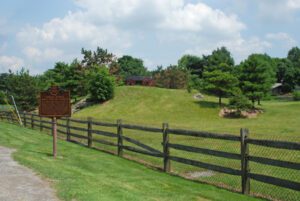
Adele Von Ohl Parker was a daredevil stunt rider once starring in Buffalo Bill’s shows. Stranded during the Depression, she started a riding school; her flamboyance captivated her young riders. The 34-building ranch was the scene of many rodeos and wild west shows. Visiting friends included Gene Autry and a circus owner whose elephants bathed in the Rocky River. This 37-year fantasy vanished forever upon her death in 1969.
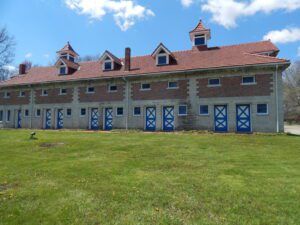
Ohio Columbus Barber, a wealthy Ohio businessman and founder of Barberton, retired in 1905 to develop his Anna Dean Farm. Built in 1910, the colt barn was a part of this 3000-acre estate. Although originally intended for bulls, the building was converted in 1912 to a stable for colts. Akron architects Harpster and Bliss designed the barn, and it was the smallest on the farm. Like many buildings erected by Barber, the colt barn features the patriotic red, white, and blue color scheme he favored. Between Barber’s death in 1920 and the founding of the Barberton Historical Society in 1974, all but nine of the estate’s thirty-five original buildings were razed. The historical society saved the colt barn in 1978, which led to the birth of the city’s historic preservation movement. The society completed restoration of the colt barn in 1998 with a grant from the Barberton Community Foundation.
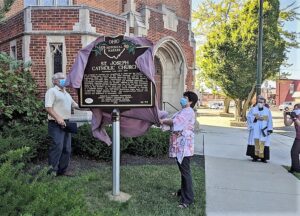
St. Joseph Catholic Church has been located here since the parish’s formation in 1845. Tiffin was established by Josiah Hedges in 1822, and shortly after, many German Catholic families began to settle in the area. They formed part of St. Mary’s parish until 1845, when they obtained permission from Bishop John Purcell of the Diocese of Cincinnati to organize as the separate congregation of St. Joseph. In May 1845, parishioners bought two acres of land at the conjunction of Melmore and South Washington Streets. Within the month, they laid the cornerstone for a 40-foot by 66-foot brick church that would be completed by August of that year. As the congregation grew, Rev. Joseph Bihn, pastor from 1856 to 1873, saw the need for a new church. (Continued on other side)
Marathon Center for the Performing Arts, 200 W. Main Cross Street
Findlay
, OH
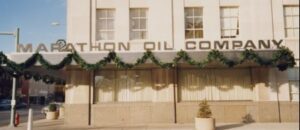
Site of the first Findlay Field Office for what was to become a world-wide oil company, formerly locally owned and operated. 1887: The Ohio Oil Company was incorporated by five independent oil producers in the Lima field. 1901: J.C. Donnell elected President of the Ohio Oil Company. Company’s ‘big well,’ the “Hugh McMurray,” comes in. 1929: Construction begins on new office building at South Main Street and Hardin Streets. 1962: Name changed to Marathon Oil Company to reflect international operations.
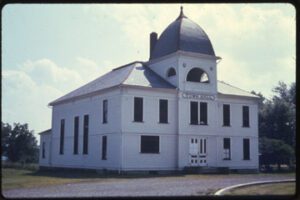
Major buildings dating from 1832 to 1898 surround the village green, the geographic center of Gustavus Township. Built in 1832 on the northwest quadrant, the George Hezlep House features Federal-Greek Revival architecture and has a closet reputedly used on the Underground Railroad. Built in 1840, the Farmers’ Exchange Store was originally a double entrance Greek Revival structure. The Storekeeper’s House, also a Greek Revival structure, was built next to the exchange store in 1840. South of this house is the Fraternal Hall, built in 1870. There were once four churches in Gustavus including the Methodist Church, built in 1856 with a temple front and a belfry, and the Congregational Church, built east of the center in 1854. The eclectic Town Hall was built in 1890 and fronts the southeast quadrant. The Gustavus Centralized School, reported as the first centralized school in the United States, was built in 1898 and was replaced by the current building in 1928.
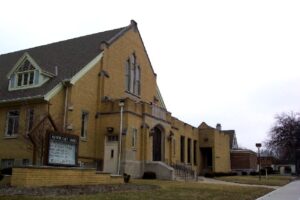
The first African American congregation and first African American Methodist Episcopal (AME) Church in Dayton trace their roots back to the early 1830s. They were organized by Father Thomas Willis and a small group of faithful men and women. After several moves, the congregation settled on Eaker Street and the church was dedicated in the early 1870s. The church was rededicated in 1882 and renamed Wayman Chapel AME Church. The eminent poet Paul Laurence Dunbar and his mother Matilda attended and worshiped at the Eaker Street church. His untimely death in 1906 brought family and friends to his funeral services held at the church. By 1923 church leadership felt the need for more secure space for the growing congregation and moved to a new building at Fifth and Banks streets. Three elegant chandeliers for the sanctuary were donated by the city’s newspaper, the Dayton Daily News. (Continued on other side)