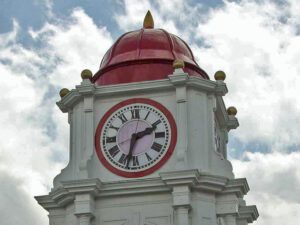
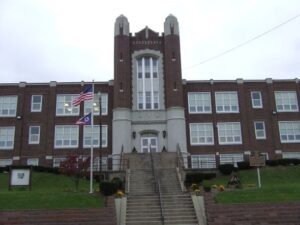
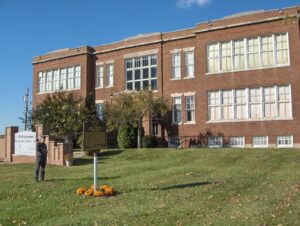
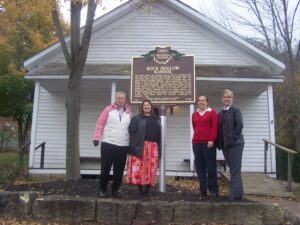
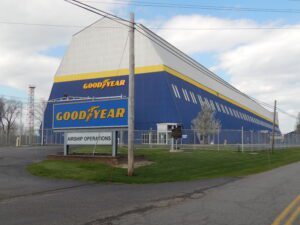
The Bellaire High School Clock Tower was erected in 1925 as the second town clock to be mounted on Bellaire’s public schools. C.W. Bates of Wheeling designed this tower, built by C.D. Keyser & Co. of Bellaire. The school building stretches 256 feet along 35th Street, and the tower rises 40 feet above the 3rd floor parapet of the roof. The clock faces are 6 feet, 7 inches in diameter. At the exterior corners of the bell room are 11 foot columns. The tower dome is painted red. E. Howard & Co. of Boston made the clock works and the McShane Bell Foundry of Baltimore cast the bell in August 1888. The BHS Alumni Association lighted the tower in 1998 to honor all “faithful and true-hearted” graduates of the school.
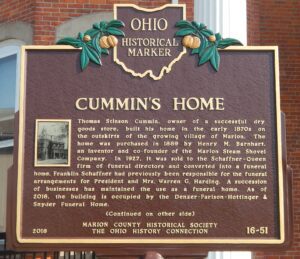
Thomas Stinson Cummin, owner of a successful dry goods store, built his home in the early 1870s on the outskirts of the growing village of Marion. The home was purchased in 1889 by Henry M. Barnhart, an inventor and co-founder of the Marion Steam Shovel Company. In 1927, it was sold to the Schaffner- Queen firm of funeral directors and converted into a funeral home. Franklin Schaffner had previously been responsible for the funeral arrangements for President and Mrs. Warren G. Harding. A succession of businesses has maintained the use as a funeral home. As of 2016, the building is occupied by the Denzer-Farison-Hottinger & Snyder Funeral Home. (Continued on other side)
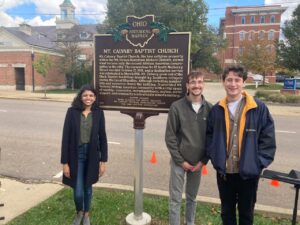
Mt. Calvary Baptist Church, the lone religious property within the Mt. Vernon Downtown Historic District, served what became only the second African American congregation in the city. The cornerstone for 13 South Mulberry Street was laid October 17, 1915, and a dedication service was celebrated in March 1916. Mt. Calvary grew out of the Black Baptist traditions brought by Southern refugees during the Great Migration. Although dwindling membership and resources closed the building, it provided Mt. Vernon’s African American community with a vital space of worship, communion, mutual assistance, asylum, social support, and community celebration for almost a century.
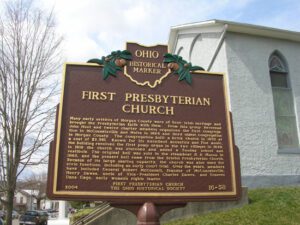
Many early settlers of Morgan County were of Scot-Irish heritage and brought the Presbyterian faith with them. From this group Reverend John Hunt and twelve charter members organized the first congregation in McConnelsville and Malta in 1824 and third oldest congregation in Morgan County. The congregation built a brick church in 1832 at a cost of $2,361. Known for its excellent acoustics and fine music, the building received the first pump organ in the two villages in 1849. In 1916 the church was stuccoed and added a Sunday school and vestibule. The original bell was sold to the steamboat H.D. Munson in 1865, and the present bell came from the Bristol Presbyterian Church. Because of its large seating capacity, the church was also used for civic functions, including an early court trial. Over the years, members have included General Robert McConnell, founder of McConnelsville, Henry Dawes, uncle of Vice-President Charles Dawes, and Frances Dana Gage, early women’s rights leader.
An October 23, 1927, ceremony was held for the laying of the cornerstone for the Dennison High School Building. It opened in the fall of 1928 and was called “Angel’s Castle” in honor of school superintendent William Hiram Angel. The building was designed by J.K. Griffin, an architect from Canton, Ohio, in a style that has the elements of Collegiate Gothic that was popular for school and college buildings during the early twentieth century. The distinguishing architectural features of the entrance towers enhance the school’s prominent location above the street level. Dennison High School is an important visual landmark in the community, as its towers are visible from the downtown area and surrounding neighborhoods. It has retained its integrity of location, materials, design, and association and conveys the early twentieth century ideals of education that the original design of the building was intended to inspire. (Continued on other side)
In 1832, Sylvanus Allen’s property became the site of Brown Township’s sixth and final school district. Following many building expansions, the current building, constructed in 1916, became the home of the Lena-Conover Consolidated School and became part of the Miami East Local School District in 1958. In 1991, the building’s educational legacy continued when it was returned to the trustees and became the home of the A.B. Graham Memorial Center Inc, named in honor of the Lena-Conover alumnus, educator and founder of the 4-H club movement.
Rock Hollow School was originally built in 1877 in a wooded ravine two miles south of Ringgold, Union Township, and housed classes for fifty-seven years. The first class was held in November 1877, with John D. Davis of Ringgold teaching. Grades one through eight were taught in this one-room building, with an enrollment average of twenty to twenty-five pupils. The school closed in 1934 and sold in 1937 to Hettie Woodward, a former student and teacher at Rock Hollow School. In 1980, the heirs of the late Hettie Woodward donated the school to the Morgan County Historical Society for preservation. Fearing vandalism due to its remote location, the historical society relocated the building to its present site in Malta in 1991. The building was disassembled and rebuilt in exact original condition. Rock Hollow School was officially rededicated on November 1, 1992.
In March 1917, a month before U.S. entry into World War I, The Goodyear Tire & Rubber Company began construction of the hangar on land the firm purchased here in 1916. During World Wars I and II, the hangar was used for building and testing lighter-than-air craft for military uses, including intelligence-gathering and antisubmarine warfare. The first class of Navy airship pilots also trained at Wingfoot Lake. (Continued on other side)