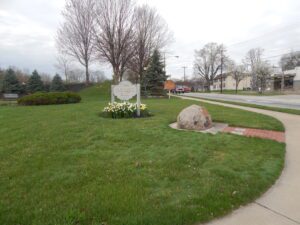
Trenton’s founder, Michael Pearce, came to the area in 1801. The original village of 33 lots was named Bloomfield. When the post office was established in 1820, it was named Trenton to honor the founder’s home state of New Jersey. Pearce’s son-in-law, Squier Littell, was the first resident doctor in Butler County. Originally settled by the English, Trenton saw a migration of Germans by 1840. By 1851, the farming community became a grain center with the introduction of the Cincinnati, Hamilton, and Dayton Railroad. Further development occurred when a franchise was granted to operate interurban electric traction cars through the village in 1896. Early commercial endeavors were Dietz, Good & Company grain elevator, Trenton Foundry, and Magnode Corporation. By 1991, the largest industries were Miller Brewing Company and Cinergy/Cincinnati Gas & Electric.
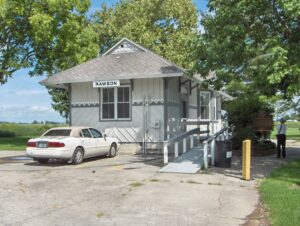
The original town plat of Rawson was filed on February 3, 1855, consisting of fifty-five lots in sections 13 and 14 of Union Township, Hancock County on the Frederick Keller and George J. Kelly farms. Several residential and business structures were built in anticipation of completion of a railroad rumored to pass from Fremont through the “Rawson” area on its way to the western boundary of Ohio. Farmers Keller and Kelly named their village Rawson after L.Q. Rawson, President of the railroad company, hoping that the name would encourage him to build through their area. Financial troubles delayed construction causing a standstill in Rawson. Seventeen years later the first locomotive arrived in Rawson, spurring new construction. At that time the railroad was called the Lake Erie and Louisville; in 1879 it was changed to the Lake Erie and Western and in 1922 became part of the Nickel Plate Railroad. (Continued on other side)
791 Farmview Rd (located on OH 588 just off US Route 35)
Bidwell
, OH
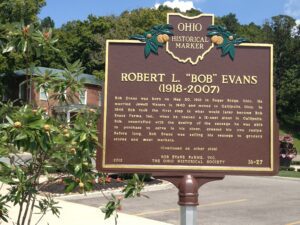
Bob Evans was born on May 30, 1918 in Sugar Ridge, Ohio. He married Jewell Waters in 1940 and moved to Gallipolis, Ohio. In 1946 Bob took the first step in what would later become Bob Evans Farms, Inc., when he opened a 12-seat diner in Gallipolis. Bob, unsatisfied with the quality of the sausage he was able to purchase to serve in his diner, created his own recipe. Before long, Bob Evans was selling his sausage to grocery stores and meat markets.
Cornelius D. Battelle was born July 13, 1807 in Washington County, Ohio. He entered the Methodist Episcopal Church on October 30, 1825 and the Pittsburgh Methodist Conference in 1833. He was assigned pastoral circuit duties in rural eastern Ohio and the small river settlement of “Belle Aire” where he delivered his first sermon in a warehouse during the winter of 1838. He established the first Methodist class of eleven members in 1839 and rallied subscriptions to build the first church in the community. He served the Ohio Conference for 64 years before his death on July 2, 1897.
The Randall Secondary rail line dates to the 1850s when the independent Cleveland & Mahoning Railroad (C&M) laid tracks through Aurora, Ohio. C&M, chartered in 1848, linked the Mahoning Valley coal and iron ore fields to the industries and lake port at Cleveland. For over a century, the Randall Secondary contributed to Aurora’s economic life ? fueling the region’s rapid growth during the late 19th and early 20th centuries. In its heyday, the line was an important route for commuter transport and freight service along the 67 miles between Cleveland and Youngstown. Although passenger service into Aurora Train Station stopped in the 1960s, freight service continued into the 1990s. The last remaining track of the Randall Secondary in Aurora stands near the station it served.
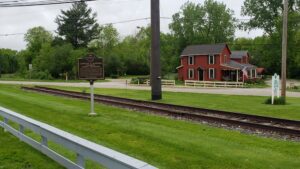
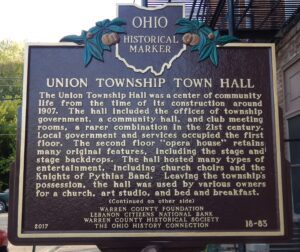
The Union Township Hall was a center of community life from the time of its construction around 1907. The hall included the offices of township government, a community hall, and club meeting rooms, a rarer combination in the 21st century. Local government and services occupied the first floor. The second floor “opera house” retains many original features, including the stage and stage backdrops. The hall hosted many types of entertainment, including church choirs and the Knights of Pythias Band. Leaving the township’s possession, the hall was used by various owners for a church, art studio, and bed and breakfast.(Continued on other side)
This site has long served the religious, education, and public interests of the residents of Mechanicsburg. A local Methodist congregation built its first church here in 1820, and the townspeople also used the structure as its village school. The Methodists replaced their original structure in 1837, using brick as the main building material. As the Methodist congregation grew, however, it was determined that a larger, more permanent structure was needed. As a result, the Mechanicsburg First Methodist Church was built here in 1858, and it served the congregation until 1894 when an African American based Second Baptist congregation purchased the building at a cost of $2,850. Besides religion and education, the site was also used as Mechanicsburg’s first cemetery. That cemetery lasted until the Maple Grove Cemetery was established and burials at this site were relocated there. [continued on other side]
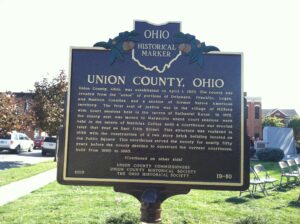
Union County, Ohio, was established on April 1, 1820. The county was created from the “union” of portions of Delaware, Franklin, Logan, and Madison Counties, and a section of former Native American territory. The first seat of justice was in the village of Milford with court sessions held in the tavern of Nathaniel Kazar. In 1822, the county seat was moved to Marysville where court sessions were held in the tavern of Matthias Collins until a courthouse was erected later that year on East Fifth Street. This structure was replaced in 1838 with the construction of a two story brick building located on the Public Square. This courthouse served the county for nearly fifty years before the county decided to construct the current courthouse, built from 1880 to 1883.