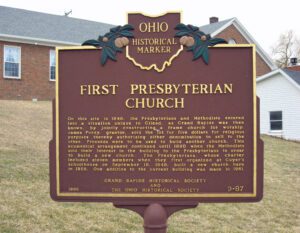
On this site in 1848, the Presbyterians and Methodists entered into a situation unique to Gilean, as Grand Rapids was then known, by jointly constructing a frame church for worship. James Purdy, grantor, sold the lot for five dollars for religious purposes thereby authorizing either denomination to sell to the other. Proceeds were to be used to build another church. This ecumenical arrangement continued until 1880 when the Methodists sold their interest in the building to the Presbyterians in order to build a new church. The Presbyterians, whose charter included eleven members when they first organized at Guyer’s schoolhouse on September 18, 1848, built a new church here in 1928. One addition to the current building was made in 1961.
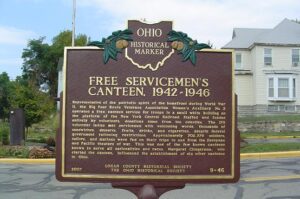
Representative of the patriotic spirit of the homefront during World War II, the Big Four Route Veterans Association Women’s Auxiliary No. 3 operated a free canteen service for troops in a small white building on the platform of the New York Central Railroad. Staffed and funded entirely by volunteers, donations came from ten counties. The 170 volunteer ladies met servicemen with welcoming words, thousands of sandwiches, desserts, fruits, drinks, and cigarettes, despite federal government rationing restrictions. Approximately 702,779 soldiers, sailors, and marines were fed on their trips to and from the European and Pacific theaters of war. This was one of the few known canteens known to serve all nationalities and races. Margaret Clingerman, who started the canteen, influenced the establishment of six other canteens in Ohio.
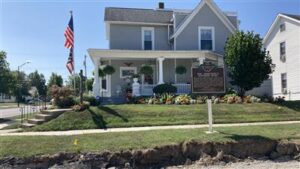
Stephen and Viola Armstrong moved their family, including 13-year-old Neil and his younger siblings, June and Dean, to the house at 601 West Benton Street in 1944. Here, Neil explored his fascination with flying by reading aviation magazines and building model airplanes. Neil completed flying lessons at nearby Port Koneta airport and earned his pilot’s license on his sixteenth birthday, even before receiving a driver’s license. Neil graduated from Blume High School in 1947 and studied aeronautical engineering at Purdue University on a Navy scholarship. The Korean conflict interrupted his studies, but he left the Navy as a decorated combat pilot, flying 78 missions. After graduating from Purdue in 1955, Neil worked at what would become the NASA Glenn Research Center in Cleveland. Soon after he became a test pilot at Edwards Air Force Base in California. (Continued on other side)
Founded November 8, 1815 by General Joseph Darlington and named for his Virginia birthplace, Winchester was incorporated in 1864 and later became the eastern terminus of the Cincinnati and Eastern Railway (1877-1880). The first locomotive to enter Winchester, the “Dick Thomson,” was named after a local businessman who was largely responsible for building the railroad. Winchester was also the birthplace of Evelyn (Longman) Batchelder, first woman sculptor to become a full academician at the National Academy of Design in 1919.
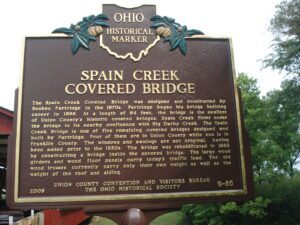
The Spain Creek Covered Bridge was designed and constructed by Reuben Partridge in the 1870s. Partridge began his bridge building career in 1866. At a length of 64 feet, the bridge is the smallest of Union County’s historic covered bridges. Spain Creek flows under the bridge to its nearby confluence with Big Darby Creek. The Spain Creek Bridge is one of five remaining covered bridges designed and built by Partridge. Four of them are in Union County while one is in Franklin County. The windows and awnings are not original, having been added prior to the 1930s. The bridge was rehabilitated in 1988 by constructing a bridge inside the covered bridge. The large wood girders and wood floor panels carry today’s traffic load. The old wood trusses currently carry only their own weight as well as the weight of the roof and siding.
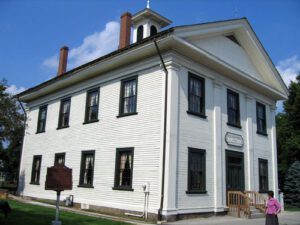
The Village of Tallmadge was founded in 1807. The first Academy building was erected in 1815. The first home of the Academy was located on the second floor of this Town Hall, which was erected in 1859. The Academy served students from northeast Ohio, who desired advanced courses not offered by local school systems, until 1876.
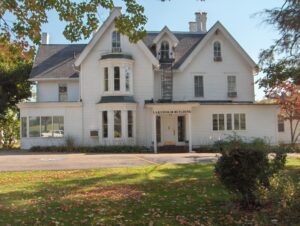
Lakeholm was built as the home of Columbus Delano while serving as Secretary of the Interior under President Ulysses S. Grant from 1870 to 1875. Delano (1809-1896) came to Mount Vernon in 1817, attended public schools, studied law, and was admitted to the bar in 1831. In addition to practicing law in Mount Vernon and serving as the Prosecuting Attorney of Knox County, Delano was a farmer, mill owner, and politician. Lakeholm, originally part of a 300-acre farm, contains many of its original rooms and Italianate features. In 1966, 209 acres of the farm were acquired for the establishment of the Mount Vernon Nazarene College. The house served as offices, meeting rooms, and classrooms. In 2002, the college became a university and continues to use Lakeholm for administrative offices. Historic Lakeholm is a focal point on the Mount Vernon Nazarene University campus and a symbol of the institution’s ties with the Mount Vernon community.
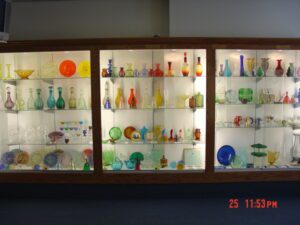
With ready access to raw materials, fuel, skilled labor, and transportation, the Ohio Valley became the center of the American glass industry during the late 1800s. Among dozens of local manufacturers, the Imperial Glass Company, founded in 1901 by river man and financier Edward Muhleman, first made glass in 1904 and distinguished itself for mass production of attractive and affordable pressed glass tableware using continuous-feed melting tanks. One of the largest American handmade glass manufacturers during the 20th century, Imperial also produced blown glass, several lines of art glass, and its trademark “Candlewick” pattern. Bellaire’s glassmaking era ended when the “Big I” closed its doors in 1984, and the building was razed in 1995. Its diverse products remain highly prized by glass collectors.