The Independent Order of Odd Fellows (IOOF) traces its origins to mid-18th-century England, where it served as a mutual benefit society for traveling workmen. Odd Fellowship moved to the United States in 1819; the first Ohio lodge was established in 1830, and the Canfield Lodge was instituted in 1850. The charter members of this lodge were E.J. Estep, John G. Kyle, James Powers, W. M. Prentice, and William W. Whittlesey. Many of the early members of this lodge were businessmen, lawyers, physicians, and tradesmen. Lodge 155 remains one of the oldest active lodges in northeastern Ohio. (continued on other side)
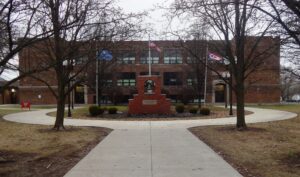
In 1893, Ohio and Indiana constructed the first Union School on the state line separating Ohio and Indiana. For 111 years, students from both states have been educated in what is the only schoolhouse located in Ohio and Indiana. In 1925, a new Union School was designed to replace the old schoolhouse. The dedication of this new school building took place on December 21, 1926. A new addition was added in 2004. The Union School Building has special architectural features such as a center stone placed on the Ohio and Indiana state line and Ohio and Indiana arched doorways. The bell from the 1893 Union School is displayed to the south side of the current school.
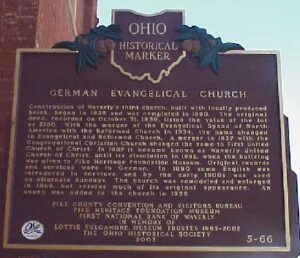
Construction of Waverly’s third church, built with locally produced brick, began in 1859 and was completed in 1860. The original deed, recorded on October 31, 1859, listed the value of the lot as $180. With the merger of the Evangelical Synod of North America with the Reformed Church in 1934, the name changed to Evangelical and Reformed Church. A merger in 1957 with the Congregational Christian Church changed the name to First United Church of Christ. In 1987 it became known as Waverly United Church of Christ, until its dissolution in 1992, when the building was given to Pike Heritage Foundation Museum. Original records and services were in German. In 1890 some English was introduced in services, and by the early 1900s was used on alternate Sundays. The church was remodeled and enlarged in 1869, but retains much of its original appearance. An annex was added to the church in 1959.
A founder of the Standard Oil Company, Henry Morrison Flagler spent his formative years in Bellevue and began his business career here in 1844, building his home near this site in 1858. He first became associated with John D. Rockefeller as a fellow grain merchant. The two later formed the Standard Oil Company in 1870 with capital partially furnished by members of the local Harkness family. Standard Oil became America’s largest and most powerful corporation in the late 1800s, and Flagler used his wealth to develop the state of Florida. His Florida East Coast Railroad, known as “the railroad over the sea,” extended from Jacksonville to Key West, Florida. The cities of Miami, Palm Beach, Fort Lauderdale, and St. Augustine grew with Flagler’s intensive development efforts.
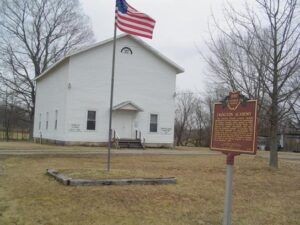
The Ewington Citizens’ Literary Institute purchased this site and sponsored the construction of Ewington Academy which opened in 1859. The building, designed by George Ewing, was financed by popular subscription with much labor and materials donated. It provided high school level education to approximately 60 students each year. It ceased operation as an academy in 1901 and then served as an elementary school until about 1947. Ewington Academy was listed on the National Register of Historic Places September, 1982.
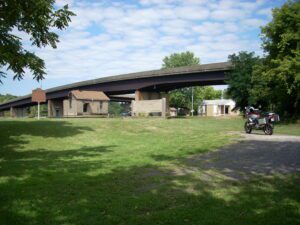
Lowell was the site of one of ten wooden covered bridges, built from 1820 to 1887, that crossed the Muskingum River from Marietta to Coshocton. The Lowell bridge was built in 1881. Bridges were built out of wood because there was plenty of lumber available, and building with wood was easier and cheaper than using stone. Covers protected the timbers from rain. The bridge connected Lowell, on the north side of the river, with the railroad that ran on the south side. This bridge suffered from many mishaps typical of wooden bridges. In 1882 a severe storm blew off the roof. In 1884 a flood washed the bridge off its stone piers. The bridge was restored, only to be destroyed by the 1913 flood, a disaster that removed many bridges on the river. An iron bridge was built on the site. The last covered bridge on the river was at Conesville seven miles south of Coshocton. Built in 1876, the bridge was condemned in 1958 and destroyed by a controlled fire.
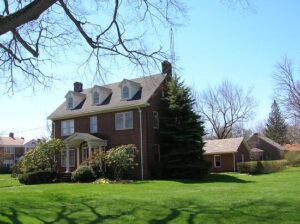
Administration Building built in 1931. Chapter House built in 1962. Commemorating American Red Cross Centennial, 1881-1981.
Early Western Reserve burial grounds, 1804-1848. Grave sites of 12 Revolutionary War veterans and Mary Chesney, member of pioneer Warren family and for whom local D.A.R. chapter was named.
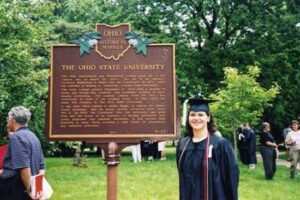
The Ohio Agricultural and Mechanical College grew out of the Cannon Act of March 22, 1870. “But let it be started,” Governor Rutherford B. Hayes told the Legislature in 1873, “with the intention of making it a great State University.” The little college opened September 17, 1873 with a faculty of seven and twenty-four students. One academic building at first housed everything. The campus, remote from the city, was surrounded by some of the original forest. In May, 1878 the name was changed to The Ohio State University. It was after 1900 before it really began to realize its educational potential, and its major growth occurred after World War II. By 1970, the Centennial Year, the university had more then met the hopes of its founders. A leading university with great manpower and physical resources, it had earned high standing in many fields covering a wide range of educational and research activities.