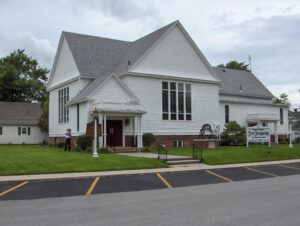
Organization of the congregation began in 1848 under the Rev. George Van Eman, and a charter was granted in 1854. The oldest Presbyterian church building in continuous use in Hancock County, the sanctuary was constructed in 1855-56. Members of the congregation included first Congressional Medal of Honor recipients John R. Porter and William Bennsinger, honored for their exploits as members of Andrews Raiders during the Civil War.
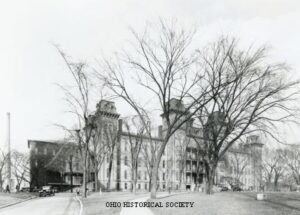
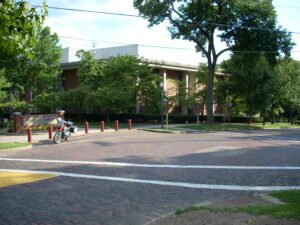
This ten acre site was purchased in 1829 for the Ohio School for the Education of the Deaf. The first school building opened here in 1834; the school was enlarged in 1845. In 1868 the original school was replaced. Another school building was added in 1899 and a hospital in 1908. The Deaf School was relocated on Morse Road in 1953.
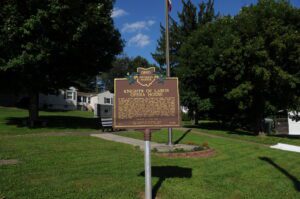
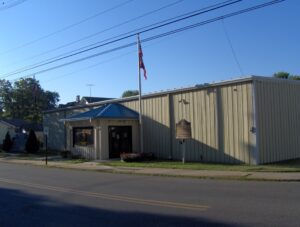
In 1869 a secret organization, The Knights of Labor, was founded in Philadelphia. The K.O.L. promoted an ideal society based on bettering life for others with the slogans, “labor was the first capital” and “an injury to one is the concern of all.” Shawnee’s Local Assembly #169 Knights of Labor was organized in 1876, and quickly became a powerful voice for labor in Ohio. National labor leader, William T. Lewis, later Labor Commissioner of Ohio, taught free grammer classes at night for the miners. Lewis initiated “The Ohio Plan,” the first free empployment bureaus in the United States. William H. Bailey, later head of National District Assembly #135 of Miners and T.L. Lewis, President of the United Mine Workers in 1910, also started their careers here. Meetings involving these leaders led to the formation of the United Mine Workers in 1890. (Continued on other side)
General James V. Hartinger, 1925-2000, was born in Middleport, Ohio, and graduated from Middleport High School in 1943. He graduated from the United States Military Academy at West Point in 1949 and was a career-long fighter pilot with the United States Air Force, flying every type of fighter craft the Air Force procured during his 35 years of active duty. He saw military action during World War II, the Korean War, and the Vietnam War. Named commander-in-chief of the North American Aerospace Defense Command (NORAD) in Colorado Springs in 1979, he was promoted to four stars and became the “founding father” of Air Force Space Command. The headquarters building of Air Force Space Command is named the James V. Hartinger Building in his honor and the Hartinger Medal is awarded annually for extraordinary achievement in space.
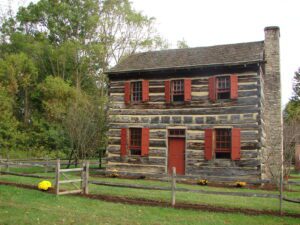
Zachariah Price DeWitt was born of a Dutch family in New Jersey in 1768. With brothers Jacob and Peter, he migrated to Kentucky where, in 1790, he married Elizabeth Teets, who was born in Pennsylvania in 1774. By 1805 all three brothers had settled in Ohio near Four Mile (Talawanda) Creek. Here Zachariah and Elizabeth raised corn, hogs, and eventually, nine children. Zachariah became a prominent community leader, operating a sawmill, building houses in Oxford, serving as Masonic Lodge secretary, and commanding a rifle company during the War of 1812. Tradition has it that Elizabeth wore a black sunbonnet to cover a scar from having been scalped as a child in Kentucky. Elizabeth died in 1843, followed by Zachariah in 1851. Both are buried in Darrtown Cemetery.
In April 1797, a committee of Marietta citizens, led by General Rufus Putnam, met to establish an academy suitable for preparatory instruction for their youth. Muskingum Academy, completed late that year, became the first institution of its kind in the Northwest Territory, providing “classical instruction… in the higher branches of an English education.” Its first instructor was David Putnam, a 1793 Yale graduate. The building also served as the home of the Congregationalist Church until 1808. Growing and expanding with Ohio’s first city, the academy served Marietta’s educational needs for more than thirty years as the forerunner of Marietta College.
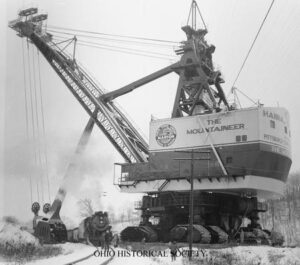
The Marion Steam Shovel Company built the primary tools for America’s civil engineering for more than 100 years. Founded in 1884 by Henry M. Barnhart, George W. King, and Edward Huber, the company’s patent steam shovels helped revolutionize railway and road construction, and were used in the building of the Panama Canal, Hoover Dam, and the Holland Tunnel. “The Shovel” also built ditchers, log loaders, dredges, and draglines, including some of the largest land vehicles ever built. The first electric machine was built in 1915, but it was not until 1946 that the name was changed to Marion Power Shovel. In the mid-twentieth century, “The Shovel” employed 2,500 workers. In the 1960s, the National Aeronautics and Space Administration selected Marion to build the crawlers that transport spacecraft to their launch pads. Hundred-year rival Bucyrus International acquired and closed the company in 1997.
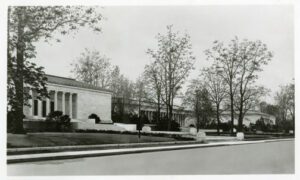
Founded in 1901 under the leadership of Edward Drummond Libbey, who established the glass industry in Toledo, the Museum building was designed by the architect Edward Green. It was completed in three stages in 1912, 1926, and 1933. From the outset the Museum has aimed to be a community and educational resource in the visual and performing arts.