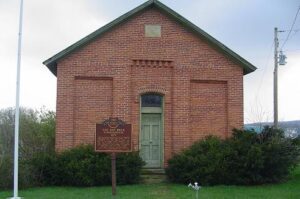
Typical of many schoolhouses in the Frankfort area during the 1800s, this school, with its pot-bellied stove and flip-top desks, was part of the public school system of that era. The building and its contents have been restored by the citizens of Frankfort in conjunction with the Budd Company.
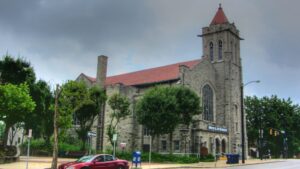
Oldest Religious Congregation in north-central Ohio. First Methodist Sermon preached at the “spring” in 1809 by Rev. James Copus. Services then conducted in blockhouse, 1811; in first court house, 1813; at church home of Dr. William B. James, 1814; first church building located N.W. corner Park Avenue East and Adams, 1820; present site in 1870. All land donated by General James Hedges, a distinguished member.
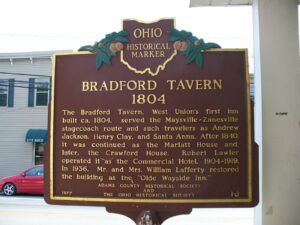
The Bradford Tavern, West Union’s first inn built ca. 1804, served the Maysville-Zanesville stagecoach route and such travelers as Andrew Jackson, Henry Clay, and Santa Anna. After 1840, it was continued as the Marlatt House and, later, the Crawford House. Robert Lawler operated it as the Commercial Hotel, 1904-1919. In 1936, Mr. and Mrs. William Lafferty restored the building as the “Olde Wayside Inn.”
Named for John Paulding, a Revolutionary War soldier whose capture of a British spy implicated Benedict Arnold in treason, Paulding County was formed in 1820 from the last remaining unorganized area of Ohio. Sparsely settled, it remained under the jurisdiction of Wood County until 1824 and then Williams County until 1839. Paulding’s first county seat was established at New Rochester in 1839, then moved to Charloe in 1841. Neither village exists today. Centrally-located Paulding Center became the county seat in 1851, and a courthouse was built the following year. The present courthouse, built during the region’s timber boom of the late 19th century, was designed by architect Edward Oscar Fallis and patterned after his Lenawee County courthouse in Adrian, Michigan. The four-faced Romanesque style building was completed in 1888 at a cost of $40,000. It was listed on the National Register of Historic Places in 1974.
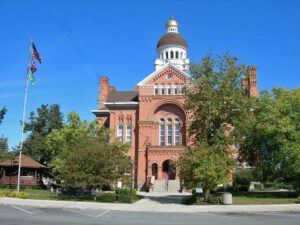
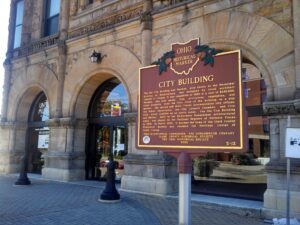
The Old City Building and Market, also known as the Municipal Building or Marketplace, was designed by local architect Charles A. Cregar. It was completed in 1890 at a cost of $250,000. Vendors, who sold meats, fish, provisions, vegetables, and other products, used the first floor of the building as a city market. The second and third floors accommodated city offices, the police department, the City Council Chamber, and City Hall, which doubled as an opera house. The Old City Building and Market, built in the Richardson Romanesque architectural style, was placed on the National Register of Historic Places in 1973. In March 2001, it became the home of the Clark County Historical Society and renamed the Heritage Center of Clark County.
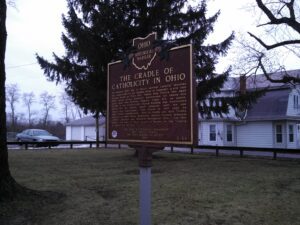
In April 1830 four Dominican sisters from St. Catherine’s, Kentucky, founded St. Mary’s Academy, the first Catholic school in Perry County. Bishop Edward Fenwick, first Bishop of Ohio, donated a small brick house and attached building situated on an acre of land for the school’s use. Classes began with forty students. The following year the sisters built a three-story structure with a dormitory for boarders; by the end of the Civil War, enrollment had increased to 134 students, and St. Mary’s gained recognition as one of the finest schools in Ohio. An 1866 fire destroyed the academy, and in 1885 the Dominican sisters reestablished the academy as a parish school. The present Holy Trinity School building dates to 1968.
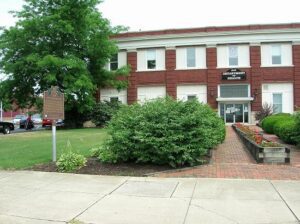
In 1910, the Ohio Electric Railway Company opened this terminal, formerly the Interurban Building, which served interurban passengers until 1937. Along with offices, it contained space for express and baggage handling, ticket windows, a newsstand, a lunch counter, and waiting rooms. Three tracks were laid at the rear of the building. At its peak, Ohio Electric radiated from Lima to Springfield, Toledo (via Ottawa), Defiance, and Fort Wayne. Its competitor, The Western Ohio Railway (“Lima Route”) connected Dayton and Toledo (via Findlay). The interurban network in and around Lima led to the creation of suburbs, linked industrial and residential areas, and promoted the creation of amusement parks and small lake resorts. With decreased passenger traffic due in part to personal automobiles and the Great Depression, the interurban and street railway era in Lima ended in 1939, 52 years after it had begun as Ohio’s first successful electric streetcar system.
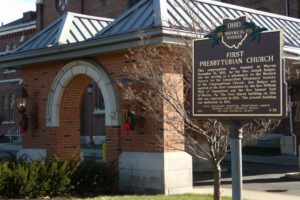
This congregation was founded in Warren November 19, 1803, by the Rev. Joseph Badger, who was serving as a missionary in the Western Reserve for the Connecticut Missionary Society of the Congregational Church. Rev. Badger was assisted at the first communion by the Rev. William Wick of Youngstown and the Rev. Samuel Tait of Mercer, Pa. The first church building on this site was constructed in 1832. The present building was dedicated in 1878.