

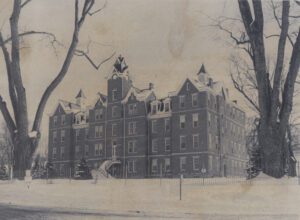
, OH
The surrounding 132 acres of land served as the Knox County Poor Farm (aka Knox County Infirmary and County Home) from 1842 to 1955. The farm was nearly self-sustaining. Able residents grew their own food, raised livestock, and did various chores as partial compensation for their care. In 1874, a fire in the original wood farmhouse resulted in one death. Public outrage and concerns for residents’ safety compelled the county commissioners to build a new “fireproof” poorhouse. The four-story brick building was constructed from 1875-1877. It is believed to be the last building designed by architect William Tinsley, utilizing a version of the Kirkbride Plan. This plan, conceived by Dr. Thomas Story Kirkbride, improved the layout of institutions and infirmaries for the well-being of their charges. (Continued on other side)
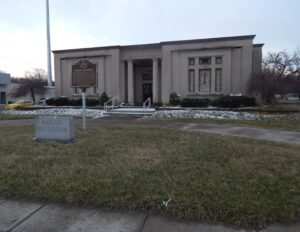
, OH
The Marion Mausoleum represents a time in early 20th-century America in which burial practices changed because of advances in engineering and construction materials, concerns about hygiene, and a new rise in wealth among the middle class. Exhibiting elements of the Neo-Classical Revival and Prairie architectural styles, construction of the sandstone building began in 1906. The mausoleum opened to the public in 1916. The interior is comprised of marble and concrete. Furnishings include chandeliers, wool carpeting, and wrought iron furniture. Stained-glass windows admit natural light. Two windows feature an upside-down torch with a still-burning flame, which symbolizes a belief in eternal spiritual life after death and burial. The mausoleum has space for 383 internments. As of 2016, it is supported and maintained by a perpetual care fund.
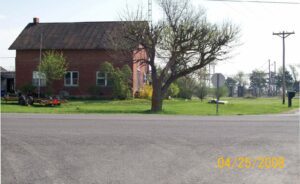
, OH
Built in 1886 by direct descendants of slaves, the Black and White schoolhouse provided education for local youth until 1928. Denied admission to white schools in the area, local African-American families first built a log schoolhouse across the road in 1883 in which to educated their children. Three years later, this brick building was constructed. The black families allowed white children to attend and, as a result, the school became known as the Black and White school. It is an early integrated school in Ohio.
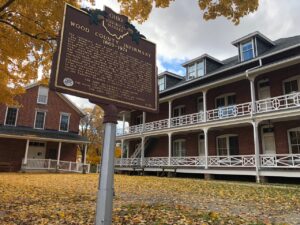
, OH
The Infirmary, also known as the poorhouse or simply “The Home,” is one of the last county poorhouse sites in Ohio where nearly all of the original structures still stand. The main building, constructed in 1868 with outbuildings added over the years, served as home for the county’s poor, sick, orphaned, elderly, and mentally ill. The Lunatic House was added in 1885 as a facility for the violently insane. The Infirmary operated as a self-sufficient farm where residents contributed according to their ability. Throughout its 102 years of service, the Infirmary had an average population of eighty residents, swelling to over 140 during the Great Depression of the 1930s. The site closed as a poorhouse in 1971 but reopened in 1975 as the Wood County Historical Center and Museum. The Wood County Infirmary was added to the National Register of Historic Places in 1979.
, OH
St. Mary of the Assumption parish — Ohio’s second and Fairfield County’s first — was founded circa 1817-1820 by Father Edward Dominic Fenwick. Dominican priests from Somerset began ministering regularly to Lancaster faithful and a small church was dedicated during Easter 1819. Construction on the parish’s third church building, The Basilica of St. Mary of the Assumption, began in February 1854 under the pastorate of Rev. Henry Lange. On August 15, 1859, the Very Rev. John Purcell, Bishop of Cincinnati, laid the cornerstone and it was blessed by former pastor Rev. Josue M. Young, Bishop of Erie, Pennsylvania. Construction proved slow as the Civil War depleted both parish funds and available workers. Father Lange rallied his parishioners, enlisted local contracters Guy and George Blair, and continued the work until his death in February 1864. (Continued on other side)
, OH
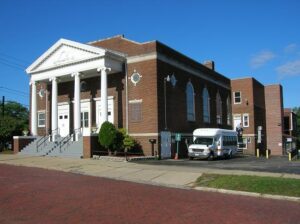
This church, founded in 1866, is the oldest Black congregation in Akron. After worshiping in several locations, the congregation held a fund-raiser to help finance the construction of a permanent home. The person collecting the most money had the privilege of renaming the church. That honor went to Mrs. Belle (Smith) Wesley. Completed in 1928, the current structure is a Neo-Classical Revival style building, featuring a classical pedimented portico, or porch, and four distinctive ionic columns. An education wing was added in 1963 by the late Rev. Dr. E. E. Morgan, Jr. Akron Black architects Herbert L. Wardner and John O. Somerville designed the church, and then a Black contractor, Samuel Plato, completed the structure. The church has long been a vital religious and social focal point for Akron’s Black community. The local chapter of the National Association for the Advancement of Colored People (NAACP) was organized at Wesley Temple. Placed on the National Register of Historic Places 3/19/94.
, OH
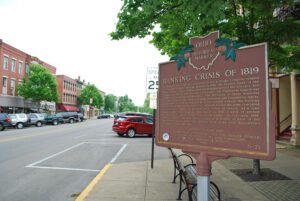
To provide direction and stability to the economy, Congress created the nation’s largest lending agency in 1816, the Second Bank of the United States. Branch banks were established around the country, two of them in Ohio-Chillicothe and Cincinnati. The Chillicothe branch was located in a building on this site. The presence of these branches adversely affected the ability of state chartered and independent banks, which had long printed and lent their own money without the backing of species. When the Secretary of Treasury forced the state chartered and independent banks to redeem their notes in specie, at a time when a sharp recession hit the nation in 1819, a wave of protest arose from those connected with those banks. In February 1819, Ohio’s General Assembly levied a tax of $50,000 on each of the two branch banks, and bank officers were given until September 1 to comply with the law. (continued on other side)
, OH
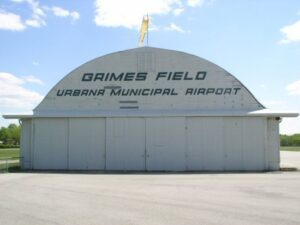
Raised in an Ohio orphanage, Warren G. Grimes (1898-1975) ran away after finishing the ninth grade and at age 16 went to work for the Ford Motor Company in Detroit. He later became a partner in an electrical business where he was instrumental in designing and developing the first lights for the Ford Tri-Motor airplane. In 1930 Grimes moved to Urbana and founded a small lighting fixture plant, Grimes Manufacturing. The inventor of the familiar red, green, and white navigation lights found on the wing tips and tails of aircraft, Grimes, known as the “Father of the Aircraft Lighting Industry,” also developed other aircraft fixtures, including landing, instrumental, and interior lights. Every American-made airplane flown during World War II was equipped with Grimes lights. Grimes served as mayor of Urbana and chairman of the State of Ohio Aviation Board.