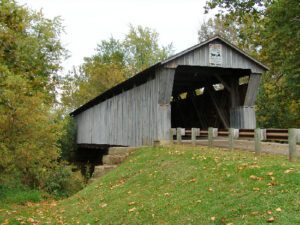
In March, 1887, the Franklin County Commissioners announced the building of a bridge in Madison Township over Little Walnut Creek at Kramer’s Ford. Area citizens had petitioned for a bridge to transport agricultural products to the canal and railroad. Michael Corbett of Groveport contracted to construct the abutments and the Columbus Bridge Company built the covered bridge for $2,690.00. Reuban L. Partridge, company vice president, supervised the building, using his patented truss system consisting of double and triple truss members constructed of pine and oak.
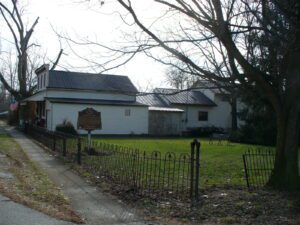
Dunham Tavern is the oldest building still standing on its original site in the City of Cleveland. Once a stagecoach stop on the old Buffalo-Cleveland-Detroit road (modern Euclid Avenue), the tavern dates from 1824. The structure was built by Rufus and Jane Pratt Dunham, who journeyed to the Western Reserve from Mansfield, Massachusetts. The Dunhams sold the tavern in 1853. However, it continued to serve the public until 1857, when it was converted to a private residence. It remained a home until the nineteen thirties, when commercial development threatened the former tavern’s existence. The historic structure was dedicated in 1936 as a museum depicting the life of an early Cleveland pioneer family. Dunham Tavern is listed in the National Register of Historic Places and is a designated Cleveland Landmark building.
The foundation for the first Welsh settlement in Ohio was laid on June 29, 1801, when William and Morgan Gwilym purchased land in what is now Morgan Township at the Cincinnati Land Office. The Welsh, who settled in Pennsylvania beginning in the late eighteenth century, moved westward and settled here in 1802. This area was also the major terminus for the 1818 migration from Montgomeryshire and Cardiganshire in Wales. In 1803 a Congregational Church was organized and services were held in members’ homes or outdoors. A brick Meetinghouse, complete with a Welsh death door leading to the cemetery, was constructed in 1824. The building now serves as the Community House. The present brick church was built in 1854. For many years, the library, formed in 1852, was housed in the New London Special School District building that stood on this site. (Continued on other side)
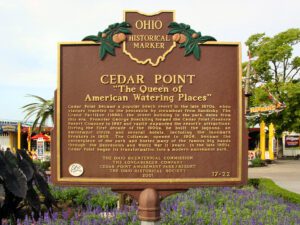
Cedar Point became a popular beach resort in the late 1870s, when visitors traveled to the peninsula by steamboat from Sandusky. The Grand Pavilion (1888), the oldest building in the park, dates from this era. Promoter George Boeckling formed the Cedar Point Pleasure Resort Company in 1897 and vastly expanded the resort’s attractions. During the first decade of the 1900s, he built the lagoons, an amusement circle, and several hotels, including the landmark Breakers in 1905. The Coliseum, opened in 1906, became the centerpiece of the park and hosted many of the famous big bands through the Depression and World War II years. In the late 1950s, Cedar Point began its transformation into a modern amusement park.
Parking area along the river E of intersection of Main Street and Lynn Street
Pomeroy
, OH
Since it was formed in 1819, Meigs County was fostered by its location on 57 miles of the Ohio River, named by the Indians”Oyo,” meaning beautiful river. Pomeroy, the county seat, was named for Samuel Wyllys Pomeroy, an early landholder. His company, Pomeroy, Sons & Company, and his son-in-law, Valentine B. Horton (1802-1888), were influential in developing the coal, salt, and iron industries of the region. Horton pioneered the transportation of coal by river, building the world’s first coal barges and, in 1835, the first coal-fueled towboat, the Condor. Coal, salt, and iron, in addition to other local products, were shipped from Pomeroy’s 125′ x 40′ wharf to ports from Pittsburgh to Cincinnati. Excursion, passenger, shanty and showboats also visited Pomeroy’s port. Today, the Ohio River continues to be a busy waterway carrying commodities such as coal, petroleum, chemicals, steel, sand, and gravel. It is also a busy haven for recreational crafts as well as stern wheel boats.
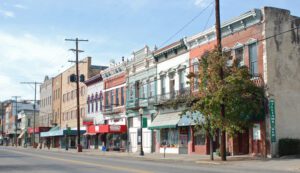
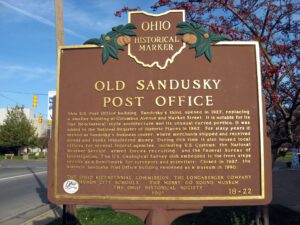
This U.S. Post Office building, Sandusky’s third, opened in 1927, replacing a smaller building at Columbus Avenue and Market Street. It is notable for its fine Neoclassical-style architecture and its unusual curved portico. It was added to the National Register of Historic Places in 1982. For sixty years it served as Sandusky’s business center, where merchants shipped and received goods and banks transferred money. During this time it also housed local offices for several federal agencies, including U.S. Customs, the National Weather Service, armed forces recruiting, and the Federal Bureau of Investigation. The U.S. Geological Survey disk embedded in the front steps serves as a benchmark for surveyors and scientists. Closed in 1987, the historic Sandusky Post Office building reopened as a museum in 1990.
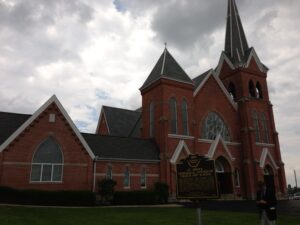
St. John’s Evangelical Lutheran Church was organized in 1838 by German Lutheran immigrants, primarily from Bavaria and Hesse-Darmstadt, who located in this vicinity in the 1830s. The congregation, called Neudettelsau, erected a second log church in 1843 centrally located in the “German Settlement”. A congregational split in 1846 resulted in the conservative members building a separate brick church a half mile away. This church in 1847 became one of the 12 charter members of the Lutheran Church-Missouri Synod. Growing membership required a larger brick church built on this site in 1860. In 1878 the two St. John’s congregations in the settlement reunited.
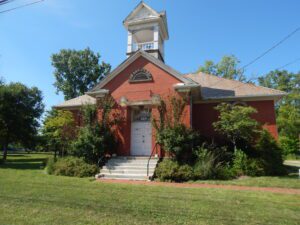
A fine example of the district school building common to Ohio in the early years of the twentieth century, this two-room, red-brick schoolhouse was completed in 1913. Accommodating elementary school children in east Berea and adjacent areas of Middleburg Township, the Berea “Little Red Schoolhouse” replaced an original wood-frame, one-room school built in the late nineteenth century on the same site. No longer active as a school, the building was used by the Berea Fine Arts Club from 1935 to 1980, and subsequently by the Berea Jaycees for meetings and community projects. This historic structure has been carefully restored and opened to public gatherings by the Berea Little Red Schoolhouse Foundation, Inc. It was placed on the National Register of Historic Places in 1975.