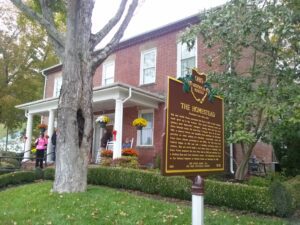
The Homestead was built in 1820 by Nehemiah Wood with an addition completed in 1822 by his son, Harrison. The Wood family, a pioneer family of Gallia County, arrived in 1805. The Homestead remained in the Wood family for over 100 years. The two-story Federal style building is constructed of bricks made on site by freed slaves who accompanied Nehemiah Wood from Virginia. The lane just below the house was a stagecoach route that ran between Chillicothe and Gallipolis. In the mid-1800s the Homestead served as an inn and stagecoach stop. The Wood family sold the farm to Rio Grande College in 1938 which used the land for college gardening and farming programs. (Continued on other side)
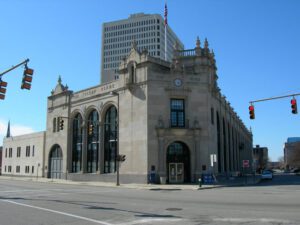
The Toledo Blade is the city’s oldest continuing business. The newspaper was first published on December 19, 1835, during the Ohio-Michigan boundary dispute known as the “Toledo War.” The name is derived from that conflict and the famous swords of Toledo, Spain. A copy of the first edition and two gift swords from that Spanish city are displayed inside the Blade Building.
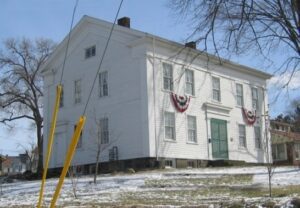
Built circa 1840 by Henry Barnhisel Jr. in the Greek Revival architectural style, the Barnhisel home is one of the oldest remaining structures in Girard. Henry and Eve Anna Barnhisel purchased the land where the house stands in 1813 when they acquired 318 acres in the Connecticut Western Reserve. The couple moved onto the land with their eleven children, and the family lived among a large group of Pennsylvania Germans who settled in Liberty Township. Their son, Henry Jr., took over the farm after his father’s death in 1824. In 1833 he married Susan Townsend. Henry contributed to his community by playing a key role in the building of both the Methodist Church and the first brick school in Girard and Liberty Township. He fathered five daughters, some of whom married into other leading families of the Mahoning Valley, including William Tod, son of the governor. Two granddaughters married into the Wicks and Stambaughs.
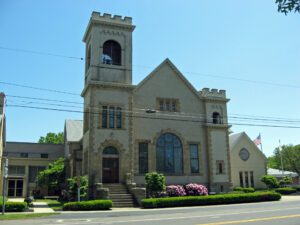
On this site, the Canfield Congregational Church, the first church in Canfield village, was built in 1822. The congregation was organized in 1804 by Joseph Badger and Thomas Robbins, both missionaries from the Connecticut Missionary Society. This was the fifth Congregational Church organized west of the Allegheny Mountains and the fourth organized on the Western Reserve. In 1853, there was a division in the church and a faction split off to form the Canfield Presbyterian Society. In 1837, an antislavery speech was given by Reverend Miller from the Poland Methodist Church. A rowdy group of outsiders protested his words and threw eggs onto the pulpit. They waited for him outside with tar and feathers, but the ladies of the church hastily escorted him out the back door to his horse and buggy, and he made a hasty and safe departure. The Bible with egg on it is displayed in the church.
The Canfield War Vet Museum was chartered in 1988 by American Legion Post 177 and Ladies Auxiliary to collect and preserve items and history from American wars. The building that houses the museum was built in 1809 by Comfort S. Mygatt, a Revolutionary War veteran, and later, passed through several generations of the Church family. Colonel James Madison Nash, a Civil War officer, lived here for a time, giving the house its nickname, “The Colonel’s House.” The structure stands as the oldest building in Canfield on its original site. The carding barn on the rear of the property was built in 1810 to process sheep wool. The Wall of Honor at this site honors war veterans, in particular, the Revolutionary War veterans interred in Canfield cemeteries and the 18 Canfield men who lost their lives in World War II.
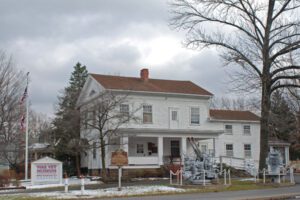
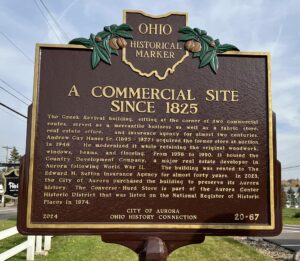
James Willard Converse (1806-1892) opened his store in 1825 at 10 South Chillicothe Road. Serving residents, merchants, and travelers, the store proved central to Aurora’s early commercial development. Converse’s Daybook survives as a glimpse into the habits of early citizens, who, along with household items, regularly purchased whiskey. Surprisingly, such sales surged on George Washington’s February 22 birthday. Converse deeded the business to employee Seth A. Gillett in 1834. Hopson Hurd Sr. (1793-1869) purchased it from Gillett in 1845. Hurd’s store was popular with local farmers who used their home made cheese as legal tender and enjoyed the barrel of whiskey kept in Hurd’s basement for customers who paid their bills. Hurd added a cheese warehouse to his store and, as a major exporter of cheese to Cleveland, Warren, and Pittsburgh, amassed a sizeable fortune.
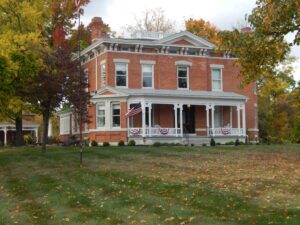
Built of bricks of clay from the Little Miami River, the King Mansion has stood majestically overlooking the town of Kings Mills since 1885. The home of industrialist Ahimaaz King and the first house in Kings Mills, this 12-room, three-story Italianate-style house is crowned with a widow’s walk and features stained-glass windows, distinctive fireplaces, and a tack room. The carriage house included a milking operation for cows on the lower level, stables on the main level, and carriage storage on the upper level. A cast iron fountain in the yard gave the name “Fountain Square” to the area. Occupied by three generations of Kings until 1988, the mansion was added to the National Register of Historic Places in 2008 and is a reminder of Ahimaaz King’s importance to the history of Kings Mills.
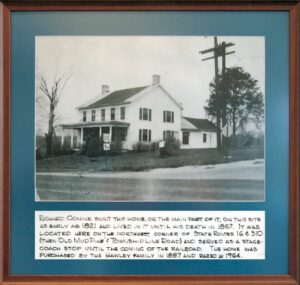
Born in New Jersey, Richard and Sarah Conine, the founders of the village of Pataskala, moved to Lima Township and lived on this site as early as 1821 when Richard established a grist mill nearby. Their homestead also served as a stagecoach stop on the mud pike between Columbus and Newark prior to the coming of the railroad. Richard platted “Conine Town” south and west of here in 1851, and the town was renamed Pataskala soon after. The public-spirited Conines contributed to the building of several area schools and churches and donated land for the Pataskala Cemetery. After their deaths, Sarah’s nephew Jacob Van Dorn inherited the property. John Hawley purchased the home in 1887 and for many years it was known as “The Hawley House.” It was demolished in 1964 to make way for commercial development.