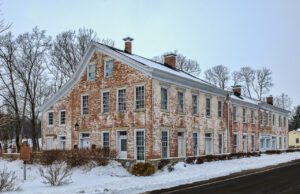
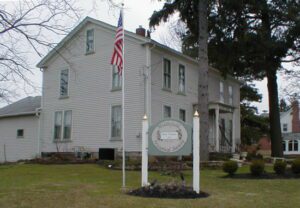
The Bunker Hill House, previously the Bunker Hill Tavern, was built in stages between 1834 and 1862. The building is one of Ohio’s best representations of Federal-Greek Revival style “pike town” architecture. This architectural style is closely associated with pre-Civil War horse-powered turnpike transportation and lodging. The building was a way station for pioneers heading west and for drovers driving their animals to Cincinnati stockyards. It was also a stagecoach stop on Eastern Stage Coach Company’s Cincinnati Omnibus Line that operated daily between Cincinnati and Richmond, Indiana. Tavern operations ceased in 1858 due to decreased turnpike travel resulting from the newly completed railroad through nearby Camden. In 1862, a general store was established to supply the growing population in the area. The store closed in the early 1900s with the advent of the automobile, which made travel to larger, more distant stores viable. The Bunker Hill House was listed on the National Register of Historic Places in 2001. (continued on other side)
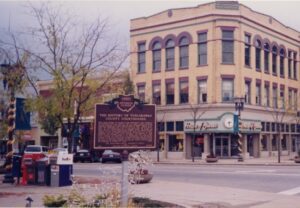
When David Knisely, the founder of New Philadelphia, first arrived in the Tuscarawas Valley on August 27, 1803, he found a sparsely populated, pristine wilderness. Five years later the state legislature approved a bill organizing Tuscarawas County effective March 15, 1808. Shortly thereafter, New Philadelphia was chosen as the county seat, and on April 16, 1808, the first commissioners met at Leininger’s tavern. By August, the tavern proved to be an inappropriate location for the county’s official business, and the commissioners approved the construction of a two-story, combination jail and county office building on land donated by John Knisely on the northeast corner of the square. By 1818 a new, larger brick courthouse was authorized by the commissioners. This building was occupied in 1825 and served as the courthouse until 1882 when the present structure was approved. Occupied in 1888, the building continues to be the center of the county’s business. The beautiful, state-of-the-art annex was dedicated on October 27, 1990.
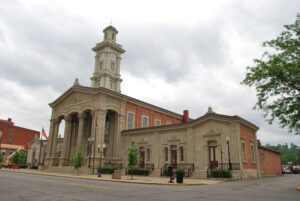
Ross County’s first courthouse was Ohio’s first statehouse. The courthouse was erected on the Public Square in 1801. Thomas Worthington, one of the building’s superintendents, laid out the foundation. Chillicothe was the last capital of the Northwest Territory, and the final session of the territorial legislature met in the courthouse in 1801. Ohio’s first constitution was written here in 1802. On March 1, 1803, Ohio’s first General Assembly convened in the building, making it the statehouse. During a time of strained relations between Native Americans and settlers in Ohio, the great Shawnee leader Tecumseh delivered a speech here in 1807 to reassure citizens that the Indians would remain peaceful. The courthouse served as the statehouse from 1803 to 1810 and from 1812 to 1816. The building was razed in 1852 to make way for the present courthouse.
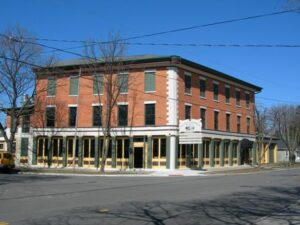
Levi Beebe built in 1836 this structure then known as the Commercial Building housing stores, bank, and post office. During the canal era, the building was a stagecoach stop and social center for Maumee, the Lucas County seat until 1853. Later the inn was called the Neely House, Schiely House, the Bismark, Seurin Hotel Langley Inn, and, after 1940, The Old Plantation.
Originally called the James Thompson Inn, named for its builder, the son of Middlefield’s first settler, Isaac Thompson, the Batavia House is Middlefield’s oldest remaining structure. Built in 1818, the two-story wood frame structure was operated continually as an inn by Thompson until his death in 1877. It became the private residence of his daughter, Caroline, until 1907 when again it became an inn, functioning as the Century Inn until 1951. The one-story cement block portion was added circa 1950 to accommodate the weight of the heavy printing presses of the Shetler Printing Company, which occupied the building until 1983.
The West Liberty area, in the Mad River Valley, was the location of at least seven Shawnee Indian villages. This elevated site was the location of one of those villages. Several septs or divisions of the Shawnee nation lived in this area after being forced from their homes in southern Ohio. In 1786, together with Simon Kenton, Colonel Benjamin Logan’s army destroyed all the Shawnee villages in retaliation for the Indian raids in southern Ohio and Kentucky. Consequently, the remaining Shawnees moved to northwest Ohio near the present-day site of Maumee.
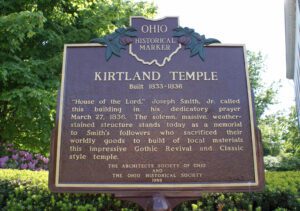
House of the Lord, Joseph Smith Jr. called this building in his dedicatory prayer March 27, 1836. The solemn, massive weather stained structure stands today as a memorial to Smith’s followers who sacrificed their worldly goods to build of local materials this impressive Gothic Revival and Classic style temple.
Conceived by leaders of the automobile industry to encourage the building of “good roads,” the Lincoln Highway was established in 1913 as the first transcontinental automobile route in the United States. It traversed twelve states and 3,389 miles from New York to San Francisco. The first route across Ohio connected Van Wert, Delphos, Lima, Ada, Upper Sandusky, Bucyrus, Galion, Mansfield, Ashland, Wooster, Massillon, Canton, Minerva, Lisbon, and East Liverpool. By the 1930s much of the original route had become part of the Federal Highway System and U.S. Route 30–many miles of which have, in turn, been bypassed by modern four-lane highways.