

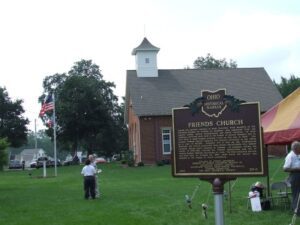
, OH
Among the earliest settlers to Rush Township were members of the Religious Society of Friends or Quakers, who emigrated from the eastern states, mostly Pennsylvania and North Carolina. At first religious services were held in the homes of devout Quakers who in turn built a small-framed meeting house on this site in 1842. The present Friends Church replaced the original structure in the 1870s at a cost of $4,245. Although not a stop on the Underground Railroad, the church supported local ardent Abolitionists who helped runaway slaves reach freedom in Canada. An epidemic during the winter of 1850-1851 reduced the Friends’ membership and led to several Quaker families relocating to Iowa. The final religious service was held here on October 26, 1997, after which the church was donated to the village of North Lewisburg.
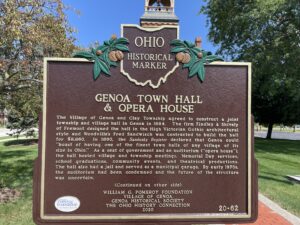
, OH
The Village of Genoa and Clay Township agreed to construct a joint township and village hall in Genoa in 1884. The firm Findley & Shively of Fremont designed the hall in the High Victorian Gothic architectural style and Woodville’s Fred Sandwisch was contracted to build the hall for $8,860. In 1890, the Sandusky Register declared that Genoa could “boast of having one of the finest town halls of any village of its size in Ohio.” As a seat of government and an auditorium (“opera house”), the hall hosted village and township meetings, Memorial Day services, school graduations, community events, and theatrical productions. The hall also had a jail and served as a municipal garage. By early 1970s, the auditorium had been condemned and the future of the structure was uncertain. (Continued on other side)
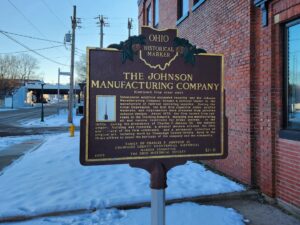
, OH
The Johnson Manufacturing Company was incorporated in 1902 by brothers James B., J. Will, Isaac T., and Charles F. Johnson, all of Quaker heritage. The company manufactured tin and galvanized iron ware for railroad lines across the United States. The initial product was the No. 1 long-spouted locomotive oiler with the patented dripless spout. That was quickly followed by other types of oil cans, signaling equipment, engine buckets, tallow pots, torches, track inspection devices, tin cups, and caboose and cabin car lamps, all carrying the Diamond J trademark. The makers created the patterns and everything was cut, riveted, and soldered by hand. As production expanded, the original frame building at 605 Miami Street was replaced by a brick structure in 1910, the southernmost part of the present building. (continued on other side)
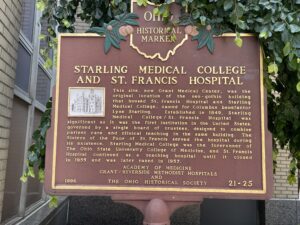
, OH
This site, now Grant Medical Center, was the original location of the neo-gothic building that housed St. Francis Hospital and Starling Medical College, named for Columbus benefactor Lyne Starling. Established in 1849, Starling Medical College/St. Francis Hospital was significant as it was the first institution in the United States, governed by a single board of trustees, designed to combine patient care and clinical teaching in the same building. The Sisters of the Poor of St. Francis served the hospital during its existence. Starling Medical College was the forerunner of The Ohio State University College of Medicine, and St. Francis Hospital continued as a teaching hospital until it closed in 1955 and was later razed in 1957.
, OH
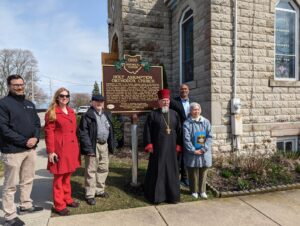
Established in 1898 as the Russian Orthodox Church of the Dormition, Holy Assumption was founded by Carpatho-Russian immigrants from the Austro-Hungarian Empire. Constructed in 1905-1906, it is considered to be the oldest Orthodox church building in Ohio. Archbishop Tikhon, head of the Russian Orthodox Church in North America, consecrated the church and celebrated the first Liturgy. Tsar Nicholas II of Russian personally donated the four icons on the iconostas, or icon screen, as well as liturgical items. Both the Tsar and, by then Patriarch, Tikhon were murdered by the Bolsheviks during the 1917 Russian Revolution and were glorified as Saints of the Orthodox Church. Holy Assumption Orthodox Church continues to be a beacon of the Orthodox Faith on the Marblehead peninsula.
, OH
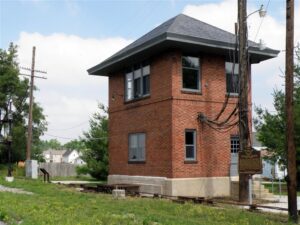
The Bradford or “BF” Tower was built by the Pennsylvania Railroad circa 1929, at the important site of Bradford Junction. It replaced an earlier wooden tower that stood to its west. From this building, operators controlled the movement of every train, aligned track switches, set the track side signals, and relayed messages to the crews in the locomotive and caboose of passing trains. The tower originally housed a desk, telegraph equipment, and the all-important railroad clock. Its core housed many steel throw-arms, known as Armstrong levers. These were hand thrown, connecting track switches and signals via pipes throughout the junction area. The operator telegraphed other outlying towers and dispatching centers in Columbus, Ohio and Indianapolis and Logansport, Indiana. Railroad telephones appeared during the late 1920s and radios just after World War II. The tower was closed January 3, 1984. This is an example of the once common railroad interlocking tower that dotted railroads throughout Ohio and the United States.
, OH
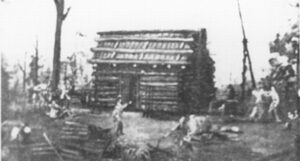
In the late 1790s General Benjamin Whiteman built near this site one of the first log cabins in Alpha, the first settlement in what would become Beavercreek Township of Greene County. The cabin, later owned by Whiteman’s father-in-law, Owen Davis, and leased for use as a tavern to Peter Borders, became the first courthouse of Greene County. Twenty-five feet square, it had one room below and a chamber above, serving as the family sleeping quarters. A small ladder through a hole in the ceiling reached the upper level. The building was constructed of burr oak logs with a roof made of clapboards held in place by long poles laid across them. Considered to be one of the finest houses in that part of the county, the cabin had one door, one window, and a huge fireplace with an outside chimney built of sticks, stones, and clay. (Continued on other side)
, OH
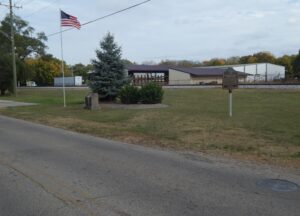
Carlisle Station Depot. The Carlisle depot for the Cincinnati, Hamilton & Dayton (CH&D) railroad was located nearby. The CH&D started operations in 1851 and was the second railroad through Warren County. Carlisle Station was a passenger and freight-shipping depot and was joined in 1872 by another, when Cincinnati & Springfield Railroad (later part of the Big Four and the New York Central Railroads) erected a depot in nearby Franklin. Carlisle was originally known as the “Jersey Settlement,” because many settlers in the early 1800s were from New Jersey. George Carlisle, vice-president of the CH&D, purchased a large tract of land here. After Carlisle and his wife Sarah donated a lot to the community in 1856, residents renamed the place “Carlisle Station.” The Carlisle Literary Association built a hall on the lot c. 1856, which, as of 2019, remains as the older section of Carlisle’s municipal building. Side B: Schenck-Stanton Rally, October 3, 1868.