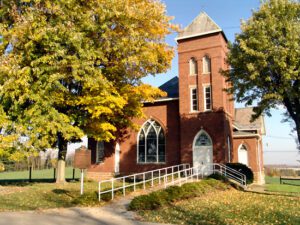
Zion (Ribel’s) Church was built on this site in 1808. The log structure was located in the Zion Ridge Cemetery, adjacent to the first school in Thorn Township. The congregation of Zion Reformed Church is the oldest in Perry County still in existence. The church was officially organized in 1806 when the German Reformed and Lutheran congregations joined together in building the first church in Perry County. They purchased this land on June 30, 1806, and shared the building, alternating Sundays, until 1911. In 1803, Reverend Johannes Christian Koenig (John King) became the first minister to settle in Perry County and became the founding minister for the German Reformed congregation. In 1805, Reverend Wilhelm Georg Forster (William Foster) was the first Lutheran minister to settle in Perry County and was the founding minister for the Lutherans. The present Zion Reformed Church was built across the street from the original church in 1910.
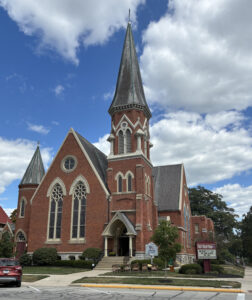
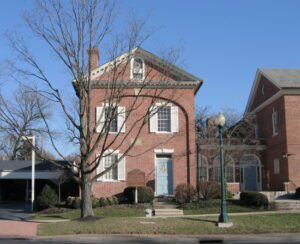
Sidney’s First Presbyterian Church formally organized on September 4, 1825, under the guidance of Reverend Joseph Stevenson, who traveled from Bellefontaine for that purpose. The original eight-member congregation worshipped outdoors or in the Shelby County Courthouse until able to finance their own building in 1834. First Presbyterian’s small frame chapel was constructed on the half-acre parcel that became their permanent home. Two centuries later, the congregation continues to worship at the corner of Miami Avenue and North Street on Lot 109, set aside for religious use in Charles Starrett’s 1819-1820 agreements platting Sidney’s original 70-acre tract. (Continued on other side)
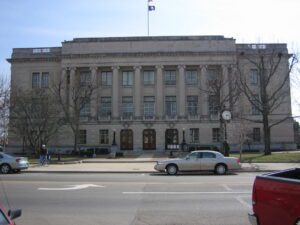
The current Preble County Courthouse, the third courthouse erected on this site, was designed by noted architect and Preble County native Harvey Heistand. Its cornerstone was laid on March 17, 1917, with a copper box containing a bible, historic papers, and other memorabilia placed under the stone. Upon completion, the building was dedicated on September 10, 1918, with three thousand people attending the ceremony. Designed in the Neo-Classical style, the exterior was constructed of Indiana Bedford limestone with ten immense columns that extend upward from the second floor. Above the colonnade, a dentiled entablature is inscribed, Salus Populi Suprema Lex, meaning “The health of the people is the supreme law.” The façade is enhanced with a bricked courtyard flanked by balustraded terraces. [continued on other side]
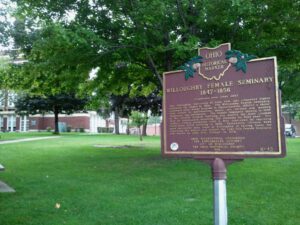
The village of Chagrin, founded in 1798, changed its name in 1834 to honor Dr. Westel Willoughby, a pioneer medical educator. That same year, the Willoughby University of Lake Erie was chartered, and the Willoughby Medical College opened its doors, signaling the beginning of medical education in northern Ohio. The Medical College trained 160 doctors, educated in contemporary methods of medicine, anatomy, chemistry, and surgery. Financial struggles and public outcry against grave-robbing — which supplied cadavers for anatomy classes — hampered the college’s development. The movement of faculty to Cleveland and the transfer of the state charter to Columbus hastened the demise of the Medical College in 1847, and laid the foundation for the establishment of the medical schools of Case Western and Ohio State universities. (Continued on side two)
Worthington was the center of Masonry for the central Ohio area in the early years of the nineteenth century. New England Lodge, with its original charter from the Grand Lodge of Connecticut dated 1803, is the oldest lodge in continuous existence in Ohio. This building, erected in 1820, is the oldest Masonic Temple west of the Allegheny Mountains. [Masonic Emblem]
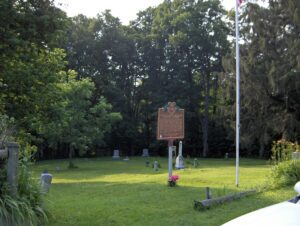
This cemetery stands as evidence of a once thriving African American farming community established in the 1820s. With the aid of community leader, Alexander “Sandy” Harper (c.1804-1889), Captina, originally called Guinea, became a stop on the Underground Railroad, a national network, shrouded in secrecy, of volunteers who directed slaves northward. Harper is buried in this cemetery, along with Benjamin Oliver McMichael (1865-1941), an educator who taught for twelve years in Captina/ Flatrock at a segregated schoolhouse. There are 113 known burials in the cemetery, including nine Civil War veterans. At this site in 1825, an African Methodist Episcopal Church was established to serve the community. Many of its members left Captina to work in cities, but the church continued services until 1962. The building then fell into disrepair and collapsed during a windstorm in 1978.
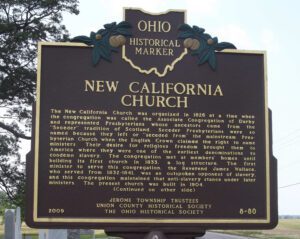
The New California Church was organized in 1826 at a time when the congregation was called the Associate Congregation of Darby and represented Presbyterians whose ancestors came from the “Seceder” tradition of Scotland. Seceder Presbyterians were so named because they left or “seceded from” the mainstream Presbyterian Church when the English Crown claimed the right to name ministers. Their desire for religious freedom brought them to America where they were one of the earliest denominations to condemn slavery. The congregation met at members’ homes until building its first church in 1833, a log structure. The first minister to serve this congregation, the Reverend James Wallace, who served from 1832-1841, was an outspoken opponent of slavery, and this congregation maintained that anti-slavery stance under later ministers. The present church was built in 1904. (continued on other side)
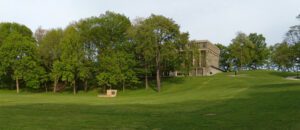
In 1968, Richard Nixon won the presidency partly based on a campaign promise to end the Vietnam War. Though the war seemed to be winding down, on April 30, 1970, Nixon announced the invasion of Cambodia, triggering protests across college campuses. On Friday, May 1, an anti-war rally was held on the Commons at Kent State University. Protestors called for another rally to be held on Monday, May 4. Disturbances in downtown Kent that night caused city officials to ask Governor James Rhodes to send the Ohio National Guard to maintain order. Troops put on alert Saturday afternoon were called to campus Saturday evening after an ROTC building was set on fire. Sunday morning in a press conference that was also broadcast to the troops on campus, Rhodes vowed to “eradicate the problem” of protests at Kent State. (Continued on other side)