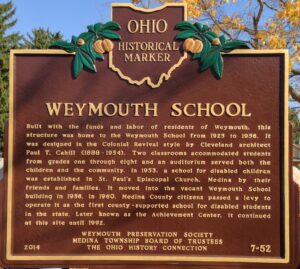
Built with the funds and labor of residents of Weymouth, this structure was home to the Weymouth School from 1925 to 1956. It was designed in the Colonial Revival style by Cleveland architect Paul T. Cahill (1888-1954). Two classrooms accommodated students from grades one through eight and an auditorium served both the children and the community. In 1953, a school for disabled children was established in St. Paul’s Episcopal Church, Medina by their friends and families. It moved into the vacant Weymouth School building in 1956. In 1960, Medina County citizens passed a levy to operate it as the first county-supported school for disabled students in the state. Later known as the Achievement Center, it continued at this site until 1992.
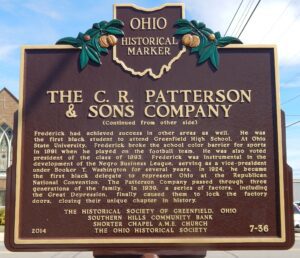
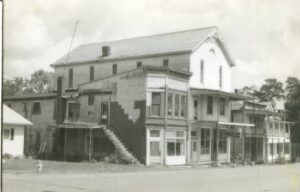
The factory of the C. R. Patterson & Sons Company once stood near here at 138 N. Washington Street. Established in the mid-nineteenth century by the black businessman Charles Richard (C. R.) Patterson and his white partner, J. P. Lowe, the business, originally known as J. P. Lowe & Company, became a successful carriage firm. Patterson became the sole owner in 1893 and changed the name to C. R. Patterson & Sons. After succeeding his father as owner, C. R.’s son, Frederick, became the first known African-American automobile manufacturer. Under his leadership, the company transitioned from building carriages to automobiles, then to trucks and buses to keep up with the changing demands of the transportation industry. (Continued on other side)
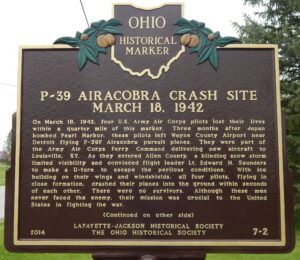
On March 18, 1942, four U.S. Army Air Corps pilots lost their lives within a quarter mile of this marker. Three months after Japan bombed Pearl Harbor, these pilots left Wayne County Airport near Detroit flying P-39F Airacobra pursuit planes. They were part of the Army Air Corps Ferry Command delivering new aircraft to Louisville, KY. As they entered Allen County, a blinding snow storm limited visibility and convinced flight leader Lt. Edward H. Saunders to make a U-turn to escape the perilous conditions. With ice building on their wings and windshields, all four pilots, flying in close formation, crashed their planes into the ground within seconds of each other. There were no survivors. Although these men never faced the enemy, their mission was crucial to the United States in fighting the war.
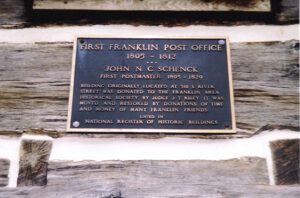
The oldest known structure standing in Franklin, the Old Log Post Office is a reminder of the links the community’s earliest members maintained to the rest of the young state of Ohio and to the United States during the early nineteenth century. John Noble Cumming Schenck, older brother of one of the founders of Franklin, William C. Schenck, established a store here in 1802. In 1805 President Thomas Jefferson appointed John Schenck postmaster of Franklin, a position he held until 1829. Schenck’s store is considered Franklin’s first post office and was one of the first four in Warren County. This building first stood at 310 South River Street and over the years was completely covered by additions and clapboards. They were removed in October 1974 and the house was moved to this location on December 6 of that year. In 1976 the structure was listed on the National Register of Historic Places.
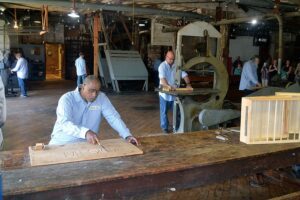
In 1888, John Shealy bought a lumber yard from the Stoll Brothers. Ten year later, his son, Charles F. Shealy and partner Edwin F. Stephan formed the Shealy Lumber Company. The business had a “well equipped sash and door factory and an extensive lumber yard” and many area homes contained components made by company craftsmen. The Shealy Lumber Company became the Stephan Lumber Company when Shealy sold his share of the partnership to Stephan in 1911.
The commercial building that stood at 305 Main Street for over a century was built by Justus S. Law in 1897. On April 1, 1897, Law leased the Odd Fellows and Knights of Pythias joint-use of the third floor, rent-free, for 99 years after they completed its construction and added a slate roof to the building. Although the Pythians purchased the remainder of the building in 1921, they continued to share their “Castle Hall” with the Odd Fellows until 1965. In July 1974, the Pythians assigned their Pleasant City property to the Ohio Knights of Pythias Home in Springfield. From 1974 to 2012 the property exchanged private ownership multiple times until forfeited to the state in 2020. After the dilapidated Victorian building was demolished in 2021 the land was donated to the Village of Pleasant City.
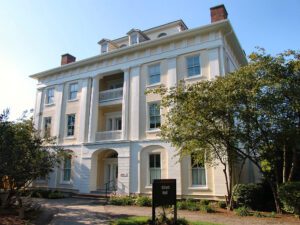
Built in 1833 as a health resort named the Mansion House Hotel, Elliott Hall is noted as Ohio’s oldest collegiate Greek Revival building. The closure of the Bank of the United States and an economic panic in 1837 created nation-wide financial difficulties, which led to the decline of the luxury resort. Under the leadership of Reverend Adam Poe, minister of William Street Methodist Church, the citizens of Delaware purchased the building for the establishment of a Methodist college for men. Ohio Wesleyan University was chartered on March 7, 1842, and the founding building was named for Dr. Charles Elliott, Ohio Conference leader who helped examine the site and establish the university. In 1877, Ohio Wesleyan University and the Ohio Wesleyan Female College merged into a co-educational institution. Elliott Hall was moved to its present location in 1892 when University Hall was built.
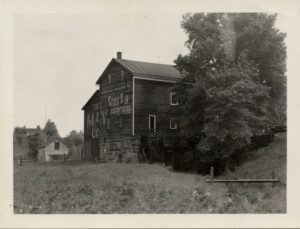
Fowlers Mill (originally Fowler’s Mills) developed around a group of mills built in the 1830s on the Chagrin River. Opportunities from these mills led to Fowlers Mill becoming the commercial center of Munson Township. From the 1830s into the twentieth century, the community expanded with construction of churches, a post office, township hall, stores, hotel, blacksmith shop, schools, and houses built in such styles as Federal, Greek Revival, Italianate, and Queen Anne. This type of community center was common in rural, nineteenth century America, but rarely survives with so much original fabric intact. On Mayfield Road, the Disciple Church was built in 1842. East of the church, the brick central school built in 1913 replaced earlier one-room schoolhouses. The gristmill is the only mill standing in Geauga County. The cemetery contains burials dating from the 1830s. The Fowler’s Mills Historic District was placed on the National Register of Historic Places in 2002.