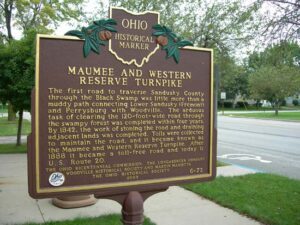
The first road to traverse Sandusky County through the Black Swamp was little more than a muddy path connecting Lower Sandusky (Fremont( and Perrysburg with Woodville. The arduous task of clearing the 120-foot-wide road through the swampy forest was completed within four years. By 1842, the work of stoning the road and draining adjacent lands was completed. Tolls were collected to maintain the road, and it became known as the Maumee and Western Reserve Turnpike. After 1888 it became a toll-free road and today is State Route 20.
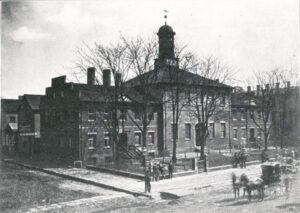
In 1809 the citizens of Zanesville erected a building on this site which served as the capitol of Ohio from October 1, 1810, until May 1, 1812. The 9th and 10th sessions of the Ohio General Assembly met here before returning to Chillicothe in May 1812. The building was then used as the Muskingum County Courthouse until the present courthouse was built in 1874. The 1809 date stone from the old building was incorporated into the new building and may be seen over the front steps.
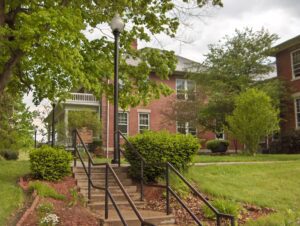
In the first quarter of the nineteenth century, when the general public believed that the insane and paupers could be rehabilitated into productive citizens, the Ohio Legislature gave authorization to county commissioners to establish county “poor houses.” The Athens County Home, formerly known as the Athens County Infirmary, opened on this site in 1857 to provide care for indigent citizens of Athens County. When fire destroyed the original building in 1903, a new building was constructed from 1904-1905, designed with the capacity to house up to one hundred people. When it was built, it was considered to be one of the finest and most modern charitable institutions of its time. The facility continued to provide housing for indigent and elderly residents until 1997 when the County Commissioners closed the home and it became a primary location for the delivery of social services in Athens County. (continued on the other side)
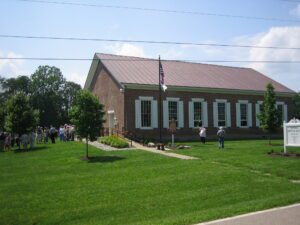
The Hopewell Associate Reformed Church and Cemetery, now known as Historic Hopewell, was founded in 1808 in a log building that was replaced in 1826 with the present building. It was built by the area’s first settlers, mainly Scotch-Irish who left Kentucky and South Carolina because of their opposition to slavery. The church encouraged worship by African Americans and played an important role in the Underground Railroad. It became the parent church for four “Daughter” Presbyterian congregations: Fairhaven in 1835, Oxford in 1837, College Corner in 1849, and Morning Sun in 1876. Reverend Alexander Porter, the first pastor, was committed to education and constructed a school near the Hopewell Spring that still produces clear water. “Old Hopewell” was completely refurbished in 1880, but by 1915 the membership declined and regular services discontinued. Today Hopewell holds Sunday services in the summer and is maintained by a generous and devoted group of volunteers.
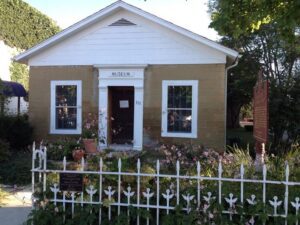
Built by William Stedman in 1816 of local stone, this building served as the Bank of the Alexandrian Society, which printed its own currency. The bank failed in 1817 and 1837. This building has also been used as a store, post office, and interurban railway depot. It was enlarged and opened as a museum during Granville’s Sesquicentennial Celebration in 1955, and was listed on the National Register of Historic Places as part of the Granville Historic District in 1980.
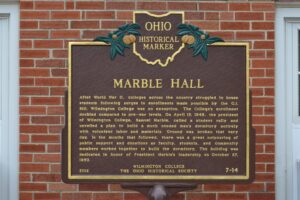
After World War II, colleges across the country struggled to house students following surges in enrollments made possible by the G.I. Bill. Wilmington College was no exception. The College’s enrollment doubled compared to pre-war levels. On April 13, 1948, the president of Wilmington College, Samuel Marble, called a student rally and unveiled a plan to build a much needed men’s dormitory entirely with volunteer labor and materials. Ground was broken that very day. In the months that followed, there was a great outpouring of public support and donations as faculty, students, and community members worked together to build the dormitory. The building was dedicated in honor of President Marble’s leadership on October 27, 1950.
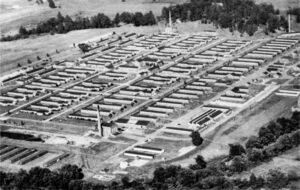
During the Second World War, the U.S. Army constructed a 131-building hospital on level farmland a quarter mile northwest of this marker. The army built the facility as a 1,520-bed hospital in the winter and spring of 1942-’43. It was later expanded to 168 buildings with a 2,000-bed capacity, including a German POW camp for 234 prisoners engaged in hospital work. Between June 1943 and March 1946, when the facility closed, 17,608 veterans were treated here, most having returned with injuries received in the European or Pacific theaters of war. Convalescence and rehabilitation were the hospital’s primary missions. Most patients returned to active duty when they recovered. After the war, the facility became the Cambridge State Hospital, which treated mentally ill and developmentally disabled Ohioans until 2008. Thereafter, the facility became the privately-operated Cambridge Behavioral Hospital and the state-operated Cambridge Developmental Center.
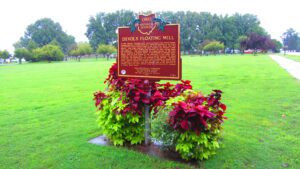
In 1791, Captain Jonathan Devol, upon a proposal from Griffin Greene, designed and built a floating grain mill, which was erected on two boats and anchored within several yards of the Ohio River shore near this marker. Oak planks fastened the boats together and formed a deck, upon which sat a frame building that enclosed the mill’s running gears and millstones. The mill’s position in a rapid portion of the river and its proximity to Farmer’s Castle, a fortification of thirteen blockhouses, built by local farmers at the beginning of the Indian Wars, shielded it from Indian raids. The river’s current revolved the wheel of the mill, and depending on the strength of the current, between twenty-five and fifty bushels of grain were processed in twenty-four hours. Devol’s floating mill replaced the hand mill, which had become too laborious to operate. The mill supplied meal to the garrison at Farmer’s Castle and other settlers along the Ohio River for a distance of nearly thirty miles.