

, OH
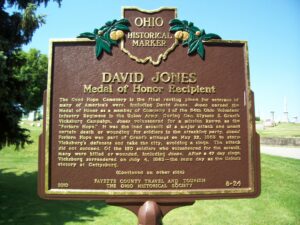
The Good Hope Cemetery is the final resting place for veterans of many of America’s wars, including David Jones. Jones earned the Medal of Honor as a member of Company I of the 54th Ohio Volunteer Infantry Regiment in the Union Army. During Gen. Ulysses S. Grant’s Vicksburg Campaign, Jones volunteered for a mission known as the “Forlorn Hope.” It was the lead assault of a major attack and meant certain death or wounding for soldiers in the attacking party. Jones’ Forlorn Hope was part of Grant’s attempt on May 22, 1863 to storm Vicksburg’s defenses and take the city, avoiding a siege. The attack did not succeed. Of the 150 soldiers who volunteered for the assault, many were killed or wounded, including Jones. After a 47 day siege, Vicksburg surrendered on July 4, 1863—the same day as the Union’s victory at Gettysburg.
, OH
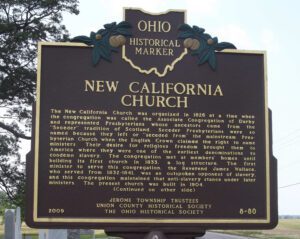
The New California Church was organized in 1826 at a time when the congregation was called the Associate Congregation of Darby and represented Presbyterians whose ancestors came from the “Seceder” tradition of Scotland. Seceder Presbyterians were so named because they left or “seceded from” the mainstream Presbyterian Church when the English Crown claimed the right to name ministers. Their desire for religious freedom brought them to America where they were one of the earliest denominations to condemn slavery. The congregation met at members’ homes until building its first church in 1833, a log structure. The first minister to serve this congregation, the Reverend James Wallace, who served from 1832-1841, was an outspoken opponent of slavery, and this congregation maintained that anti-slavery stance under later ministers. The present church was built in 1904. (continued on other side)
, OH
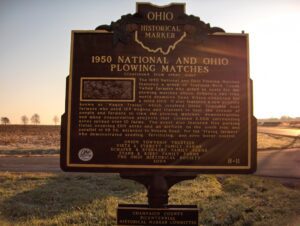
Benson Road and the North Urbana Lisbon Road (SR 54) in Champaign County was the site of the 1950 National and Ohio Plowing Matches and the National Association of Soil Conservation Districts Field Days. The three-day event drew a crowd of nearly 75,000 and was headquartered in the woods of the Edwin (Ned) Kirby farm located a quarter mile north on Benson Road. The National Association of Soil Conservation Districts sponsored the National and Ohio Plowing Matches. The first national matches were held in Mitchellville, Iowa in 1939 and continued until halted by the start of World War II. They resumed in 1945. Ohio’s 1950 Champaign County-Union Township National Plowing Matches was the first “National” to be held outside Iowa. (continued on other side)
, OH
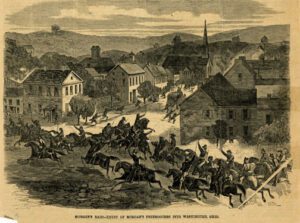
General John Hunt Morgan led a force of 2,000 Confederate calvalrymen into Meigs County during a raid north of the Ohio River. More than 50,000 Union troops and militia pursued Morgan across Ohio. Colonel Basil Duke wrote that while passing near Pomeroy on July 18, 1863, there was a continual fight for nearly five miles through a ravine. Led by Colonel J.W. Grisby and the 6th Kentucky, with Major T.C. Webber and the 2nd Kentucky in the rear, the Confederate calvarymen fought local militia who felled trees and fired upon the calvarymen from the hills and roads. After suffering losses at Buffington Island, Morgan surrendered eight days later near West Point in Columbiana County. The surrender field was the northernmost point ever reached by Confederate forces during the Civil War.
, OH
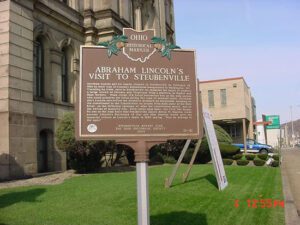
Abraham Lincoln and his family stopped in Steubenville on February 14, 1861 on their way to Lincoln’s presidential inauguration in Washington, D.C. Traveling by train, once in Steubenville he departed the depot to address a large crowd of Ohioans and Virginians from a platform at Market and High Streets. When Judge W.R. Lloyd introduced him as the only person who could preserve the Union during this time of national crisis, President elect Lincoln electrified the attentive audience by eloquently speaking on the commitment to the Constitution by people from both sides of the Ohio River, on the differing opinions of what the Constitution means, and on the virtues of majority rule. Fifty-seven days later, the Civil War began. No one at the time knew that Steubenville native Edwin M. Stanton would become Lincoln’s Secretary of War and that Stanton would give the immortal tribute at Lincoln’s death in 1865 saying, “Now he belongs to the ages!”
, OH
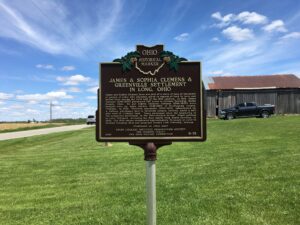
James and Sophia Clemens’ lives are part of a story of tens of thousands of people of color who migrated north in search of land to farm and better lives during the first half of the 19th century. In 1818, James Clemens (1781-1870) purchased 387 acres in German Township, Darke County, Ohio. He and Sophia (Sellers) Clemens (1786-1875) were brought here by Adam Sellers (1742-1821) of Rockingham County, Virginia. In 1822, Thornton Alexander (1783-1851), emancipated by A. Sellers, purchased land in Randolph County, Indiana, about a half mile west of Clemens’ land. These purchases were the beginning of the Greenville Settlement on the Ohio-Indiana border. Other settlers of color followed, including the Bass family from North Carolina, in 1828. The 1830 census enumerated approximately 78 people of color in German Township Ohio and adjacent Green’s Fork Township, Indiana. (Continued on other side)
, OH
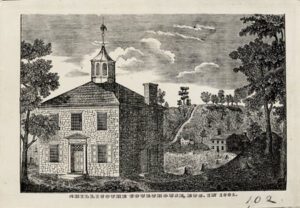
The first Northwest Territory assembly formally met in Cincinnati in September 1799 to initiate self-government. The legislators were deeply divided politically. The Republicans (antifederalists or “Jeffersonians”), led by Thomas Worthington and Edward Tiffin of Chillicothe, opposed the appointed government headed by the Federalist governor, Arthur St. Clair. They saw it as arbitrary and autocratic and recognized that change could occur only with statehood. To deter the movement, the St. Clair faction in 1801 divided the territory and removed the capital from Chillicothe to Cincinnati. Their actions triggered a violent confrontation led by the antifederalist Michael Baldwin who incited the local rabble-rousers, known as “the Bloodhounds,” to riot in the streets of Chillicothe. Both political unrest and advancing settlement accelerated the Chillicothe faction’s campaign for Ohio statehood.
, OH
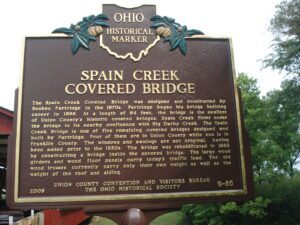
The Spain Creek Covered Bridge was designed and constructed by Reuben Partridge in the 1870s. Partridge began his bridge building career in 1866. At a length of 64 feet, the bridge is the smallest of Union County’s historic covered bridges. Spain Creek flows under the bridge to its nearby confluence with Big Darby Creek. The Spain Creek Bridge is one of five remaining covered bridges designed and built by Partridge. Four of them are in Union County while one is in Franklin County. The windows and awnings are not original, having been added prior to the 1930s. The bridge was rehabilitated in 1988 by constructing a bridge inside the covered bridge. The large wood girders and wood floor panels carry today’s traffic load. The old wood trusses currently carry only their own weight as well as the weight of the roof and siding.