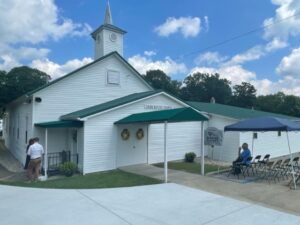
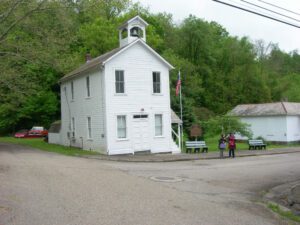
Union Baptist Church, established in 1819, is one of Ohio’s early Black churches. Its pastor and members were active on the Underground Railroad from that early date. Between the 1840s-1860s Black churches along the route to and from nearby Poke Patch assisted over 200 escaped slaves. Members met in their homes until able to obtain a log cabin (circa 1879) on a Blackfork farm. In 1919, a larger church was built on land given by The Cambria Clay Products Company. The adjacent cemetery has over fifty veterans from the Civil, Spanish American, both World, Korean, and Vietnam wars. Donald Russell Long, laid to rest in 1966, received a posthumous Congressional Medal of Honor. Union Baptist Church, the historic foundation of the Poke Patch-Blackfork community, celebrates an annual Church Anniversary to honor its legacy.
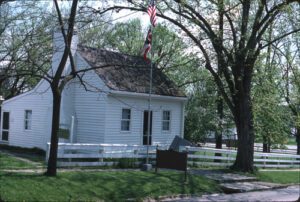
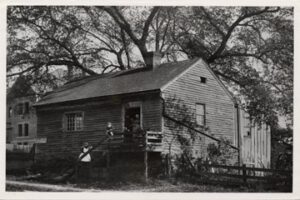
Hiram Ulysses Grant was born in this one-story, timber-frame home on April 27, 1822 to Jesse and Hannah Simpson Grant. The Grants settled in Point Pleasant the previous year, and Jesse took charge of the tannery located near the cottage. Now restored, the building remained in relatively good condition through the 1880s. In 1823, the family moved to Georgetown, Ohio, where Hiram lived until his appointment to West Point at age 17. Although reluctant to attend the Academy, Grant, now known as Ulysses Simpson Grant due to an error on the application, graduated in 1843 and was stationed at Jefferson Barracks near St. Louis, where he courted his future wife Julia Dent, with whom he had four children, Frederick, Ellen, Ulysses Jr., and Jesse. (continued on other side)
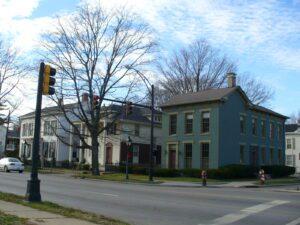
Rossville was settled in April 1801 shortly after the U.S. Government initiated land sales west of the Great Miami River. Its original proprietors–John Sutherland, Henry Brown, Jacob Burnet, James Smith and William Ruffin–named the town in honor of Pennsylvania Senator James Ross (1762-1847), who favored Ohio statehood and advocated free navigation of inland rivers. These founders envisioned Rossville as a shipping port for the rapidly growing population of farmers settling west of the Great Miami. The most practical outlet for their products was by flatboat down the Great Miami, Ohio, and Mississippi rivers to New Orleans. The town of Rossville was founded in 1804, the year after the Louisiana Purchase, which made the Mississippi River a United States possession. (Continued on other side)
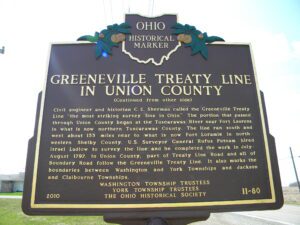
The Treaty of Greeneville created the Greeneville Treaty Line. It was the boundary between lands in the original possession of the Indians and those they ceded to the United States, which were south and east of the boundary. Major General “Mad” Anthony Wayne negotiated the treaty with the tribes his army defeated at the Battle of Fallen Timbers on August 20, 1794. Leaders of 12 tribes, including Wyandots, Delawares, Shawnees, Ottawas, and Miamis, signed the Treaty of Greeneville on August 3, 1795 with General Wayne, William Henry Harrison, and other representatives of the United States. Treaties that followed Greeneville up to the Treaty with the Miamis in 1818 extinguished the various tribes’ original claims and created Indian reservations on the lands northwest of the Greeneville Treaty Line, making it obsolete. (Continued on other side)
SE corner of Racine-Bashan Road/County Road 28 and Eagle Ridge Road
Racine
, OH
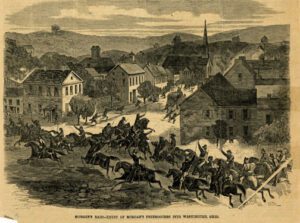
General John Hunt Morgan led 2,000 Confederate cavalrymen into Meigs County on July 18, 1863, during a 45-day raid north of the Ohio River. In pursuit, Union forces under Gen. James M. Shackelford and Col. Frank L. Wolford deployed near Bashan Church on the morning of July 19. Near this point five regiments of Kentucky cavalry and the 45th Ohio Mounted Infantry met Confederates retreating from the battle at Buffington Island, three miles east. During this skirmish, Confederate Colonels Richard C. Morgan, William W. Ward, and D. Howard Smith surrendered their commands, numbering about 400 men and officers.
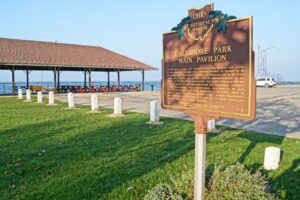
At 440 feet in length, the Lakeshore Park Main Pavilion, now known as the Ashtabula Township Park Lakefront Pavilion, is thought to be the longest and oldest lakefront pavilion in continuous use on the Great Lakes. Built in 1919, the pavilion, with its bandstand/gazebo in the middle, is of steel frame construction, and stood unchanged for the most part except for the swept wing design roof replacement. Extensive Civilian Conservation Corps improvements were made in the park near the pavilion during the Great Depression of the 1930s. Since its founding, people from all over northeast Ohio, western Pennsylvania, and northern West Virginia have chosen this site for family outings and company, union, and political gatherings.
Following the establishment of the public land system in 1785, the Continental Congress appointed a committee, chaired by James Monroe, to establish government in the new territory north and west of the Ohio River. Drafted prior to the Constitution of the United States, the Ordinance of 1787 provided the mechanism by which prospective states would enter the Union on an equal basis with existing states. It also prohibited slavery in the new territory and pledged good faith in dealing with Native American tribes. According to this plan, the Northwest Territory became the states of Ohio, Indiana, Illinois, Michigan, Wisconsin, and part of Minnesota in due course.
Established in 1879 by Chicago industrialist William P. Rend as a coal mining town, Rendville became a place where African Americans broke the color barrier. In 1888, Dr. Isaiah Tuppins, the first African American to receive a medical degree in Ohio, was elected Rendville’s mayor, also making him the first African American to be elected a mayor in Ohio. Richard L. Davis arrived in Rendville in 1882 and became active in the Knights of Labor. He was one of the labor organizers from the Little Cities of Black Diamonds region who helped found the United Mine Workers of America in 1890. An outstanding writer and orator, Davis was elected to UMWA’s national executive board and organized thousands of African Americans and immigrants to join the union. (continued on other side)