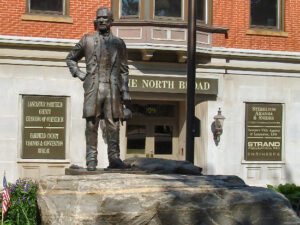
Lancaster’s native son, Civil War General William Tecumseh Sherman, was a four-star military genius. He played a major role in the Union victory during the Civil War as a brilliant commander and grand strategist who revolutionized war by incorporating psychological and economic warfare into his military tactics, culminating with the famous “March to the Sea” through Georgia. In retrospect, he declared “War is Hell.” Honoring an allegiance to the United States Constitution, he fought to preserve the Union. His self-written epitaph was “Faithful and Honorable.”
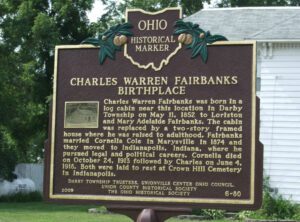
Charles Warren Fairbanks was born in a log cabin near this location in Darby Township on May 11, 1852 to Loriston and Mary Adelaide Fairbanks. The cabin was replaced by a two-story framed house where he was raised to adulthood. Fairbanks married Cornelia Cole in Marysville in 1874 and they moved to Indianapolis, Indiana, where he pursued legal and political careers. Cornelia died on October 24, 1913 followed by Charles on June 4, 1918. Both were laid to rest at Crown Hill Cemetery in Indianapolis.
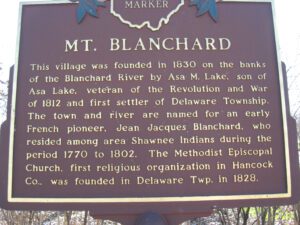
This village was founded in 1830 on the banks of the Blanchard River by Asa M. Lake, son of Asa Lake, veteran of the Revolution and War of 1812 and first settler of Delaware Township. The town and river are named for an early French pioneer, Jean Jacques Blanchard, who resided among area Shawnee Indians during the period 1770 to 1802. The Methodist Episcopal Church, first religious organization in Hancock Co., was founded in Delaware Twp. in 1828.
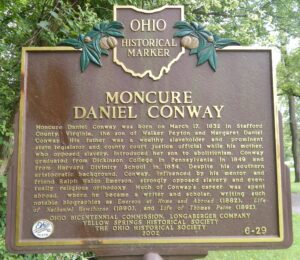
Moncure Daniel Conway was born on March 17, 1832 in Stafford County, Virginia, the son of Walker Peyton and Margaret Daniel Conway. His father was a wealthy slaveholder and prominent state legislator and county court justice official while his mother, who opposed slavery, introduced her son to abolitionism. Conway graduated from Dickinson College in Pennsylvania in 1849 and from Harvard Divinity School in 1854. Despite his southern aristocratic background, Conway, influenced by his mentor and friend Ralph Waldo Emerson, strongly opposed slavery and eventually religious orthodoxy. Much of Conway’s career was spent abroad, where he became a writer and scholar, writing such notable biographies as Emerson at Home and Abroad (1882), Life of Nathaniel Hawthorne (1890), and Life of Thomas Paine (1892).
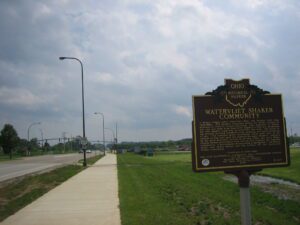
A Shaker village called Watervliet, Ohio, was located here from 1806-1900. The Shakers, originally called the United Society of Believers in Christ’s Second Appearing, were followers of Mother Ann Lee who came from Manchester, England in 1774 and established the first Shaker community in Watervliet, New York. The tenets of the religion included communal living, celibacy, and public confession of sins. The frenzied dance movements, which were part of the worship of their sect, gave the members the name “Shakers.” Attracted by the great Kentucky revivals in the late 1700s and early 1800s, Eastern Shaker missionaries came west to find converts and establish communities. A discontented Presbyterian congregation in the Beaver Creek area called Beulah was the nucleus for the Watervliet Shaker community. (continued on other side)
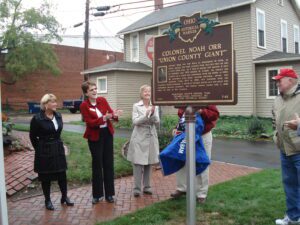
Cyprian Lee (1792-1854) settled in the Union County wilderness in 1820 and purchased the 118 West Sixth Street lot in 1828 for $6. County treasurer, coroner, shoemaker, and anti-slavery activist, Lee lived here in a log cabin until 1832 when this Greek Revival two-story brick house was completed. Other notable citizens to have resided in this oldest brick house in Marysville were showman Noah Orr (1836-1882), also known as the “Union County Giant,” and Josiah Jacob Morelock (1833-1899), a member of the Marysville City Council and the first Fire Department in Marysville. The Morelock family tannery business and stables were located behind this house.
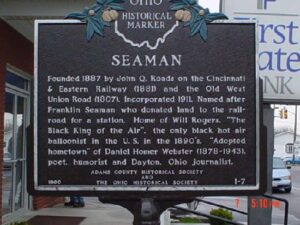
Founded 1887 by John Q. Roads on the Cincinnati & Eastern Railway (1881) and the Old West Union Road (1807). Incorporated 1911. Named after Franklin Seaman who donated land to the railroad for a station. Home of Will Rogers, “The Black King of the Air,” the only black hot air balloonist in the U.S. in the 1890’s. “Adopted hometown” of Daniel Homer Webster (1878-1943), poet, humorist and Dayton, Ohio, journalist.
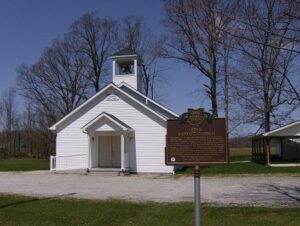
Thirteen African American families migrated to Pebble Township in Pike County in the early 1820s from Virginia. Some of the families were former slaves while others were freeborn people of color. Their farm knowledge and skill helped to make them prosperous, angering some of their white neighbors who began a campaign of harassment. Ten of the original African American settlers eventually moved away, but despite the difficulties with the white population, other African Americans continued to arrive to the settlement. They founded a church, later known as the Eden Baptist Church, built a meeting hall, and organized a school. Several of the families were also involved in the activity of the Underground Railroad. The PP Settlement thrived until the 1950s when, for economic reasons, residents moved to other communities.