

, OH
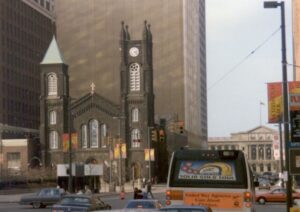
Religious worship began on this site in 1820 as a Plan of the Union Sunday School with ministers recruited by the Connecticut Home Missionary Society. Its first stone church, officially known as the First Presbyterian Church of Cleveland, was built and dedicated on February 26, 1834, but as the congregation grew, a second stone church was constructed and finished on August 12, 1855. Built of Berea Sandstone, it stands now as the oldest building on Public Square. Ravaged by fires in 1857 and 1884, the church was rebuilt according to the original plans, and the 1884 interior restored by East Coast architect, Charles W. Schweinfurth. From 1965 to 1983, the chapel served as the worship center for the Cleveland Chinese Christian Church.
, OH
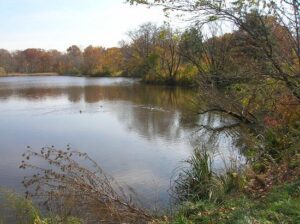
In 1822, Ralph Russell, a Connecticut pioneer who had settled in Warrensville Township ten years earlier, founded the North Union Shaker Community. The Shakers created Horseshoe Lake in 1852 when they built a dam across Doan Brook and harnessed its waterpower to operate a woolen mill near Lee Road and South Park Boulevard. The community disbanded in 1889; its 1,366 acres were eventually sold to a real estate syndicate from Buffalo, New York, the Shaker Heights Land Company. In 1896, this group deeded the Shaker Lakes Parklands to the City of Cleveland to preserve the green space in perpetuity. Ten years later, the Van Sweringen Company began to develop Shaker Heights Village as a Garden City suburb where William J. Van Aken served as mayor from 1915 until 1950. In the 1960s local residents successfully fought the proposed Clark Freeway, saving Horseshoe Lake and the Parklands from destruction.
, OH
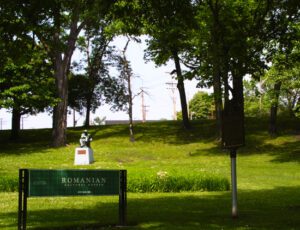
The Union and League of Romanian Societies, Incorporated was formed in 1928 from a unification of two separate fraternal organizations, the Union and the League. The Union, founded on July 4, 1906, was originally organized for the purpose of promoting the general welfare of its members through life insurance policies obtained through individual societies located in the United States and Canada. The societies of the Union and League offer social interaction within their local lodges and through the strength of the larger parent organization. The purpose of the current Union and League is to maintain and encourage Romanian cultural heritage by promoting interest in Romanian ethnic values through cultural activities and to sustain loyalty to the United States and Canada among its respective members.
, OH
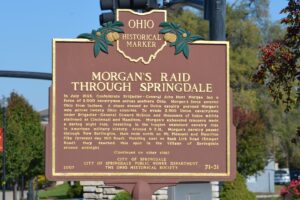
In July 1863, Confederate Brigadier-General John Hunt Morgan led a force of 2,000 cavalrymen across southern Ohio. Morgan’s force entered Ohio from Indiana. A chase ensued as Union cavalry pursued Morgan’s men across twenty Ohio counties. To evade 2,500 Union cavalrymen under Brigadier-General Edward Hobson and thousands of Union militia stationed at Cincinnati and Hamilton, Morgan’s exhausted troopers made a daring night ride, resulting in the longest sustained cavalry ride in American military history. Around 9 P.M., Morgan’s cavalry passed through New Burlington, then rode north on Mt. Pleasant and Hamilton Pike (present day Mill Road). Heading east on Bank Lick Road (Kemper Road), they reached this spot in the Village of Springdale around midnight. (Continued on other side)
, OH
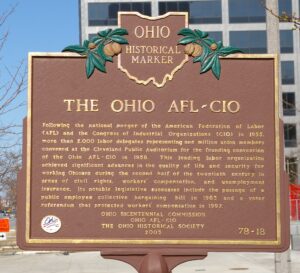
Following the national merger of the American Federation of Labor (AFL) and the Congress of Industrial Organizations (CIO) in 1955, more than 2,000 labor delegates representing one million union members convened at the Cleveland Public Auditorium for the founding convention of the Ohio AFL-CIO in 1958. This leading labor organization achieved significant advances in the quality of life and security for working Ohioans during the second half of the twentieth century in areas of civil rights, workers’ compensation, and unemployment insurance. Its notable legislative successes include the passage of a public employee collective bargaining bill in 1983 and a voter referendum that protected worker’s compensation in 1997.
, OH
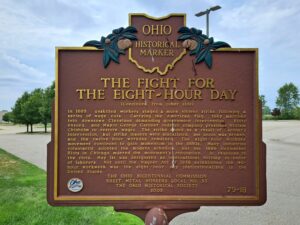
Organized efforts to establish an eight-hour workday existed as early as 1866 in the United States. The Cleveland Rolling Mills Strikes of 1882 and 1885, as part of this almost-70-year struggle, contributed to the establishment of the eight-hour workday. Both strikes challenged the two-shift, twelve-hour workday in addition to seeking recognition of the Amalgamated Association of Iron, Steel, and Tin Workers. The first strike – by English, Welsh, and Irish skilled workers – was at the Newburgh Rolling Mills, a major producer of steel rails for the rapidly expanding railroad industry that once stood near this site. It was quickly broken when unskilled Polish and Czech immigrants, unaware of the ongoing labor dispute, were hired. The strike ended when these new workers did not support the union. (continued on other side)
, OH
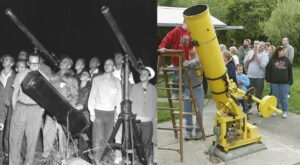
On October 4, 1957 the Soviet Union surprised the world with the launching of Sputnik 1, the world’s first artificial satellite. The Cincinnati Astronomical Society’s Moonwatch Team, organized in 1956 as part of its participation in the International Geophysical Year, was immediately activated by the Smithsonian Astrophysical Observatory (S.A.O.). First observations of satellites were made December 15, 1957. On these grounds, from 1957 to 1964, the Cincinnati Moonwatch Team, principally under the leadership of Tom Van Flandern (1940-2009), spent thousands of man-hours optically observing and recording data to verify the positions of satellites in space. Many times the team compiled the best satellite tracking records in the world. Because of this work The Moonwatch Team and the Cincinnati Astronomical Society were recognized by the S.A.O. as one of its leading teams worldwide.
, OH
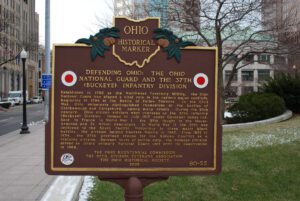
With five army camps in Columbus, Capitol Square was a military crossroads from 1861 to 1865. Ohio troops were mustered, paid, and on some occasions garrisoned at the Statehouse. Three of every five male Ohioans between the ages of 18 and 45 served in the Civil War. Ohio’s contribution to the war effort was enormous, supplying almost 320,000 soldiers to the Union Army, representing 230 regiments and 26 independent artillery batteries. More than 35,000 soldiers died during the war, and 30,000 more were disabled. One hundred forty-eight Ohio soldiers received the Congressional Medal of Honor for valor. Perhaps Ohio’s greatest contribution to the war was to the Union leadership that won it: Generals Ulysses S. Grant, William Tecumseh Sherman, Philip H. Sheridan, and James B. McPherson, as well as Secretary of War Edwin Stanton and Secretary of the Treasury Salmon Chase, were all Ohioans.