Near Warren G. Harding High School, 860 Elm Road NE
Warren
, OH
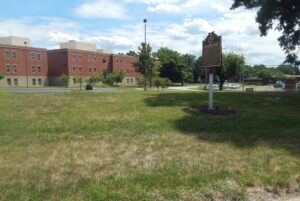
After the outbreak of the Civil War in the spring of 1861, the U.S. War Department commissioned Ohio Senator B.F. Wade of Jefferson and local Congressman John Hutchins of Warren to supervise the Union Army’s recruiting service in Northeastern Ohio. Recruitment rolls were to be filled in summer so training could be conducted during the fall. The Oak Grove Fairgrounds in Warren, home of the Trumbull County Agricultural Society, was one of the sites selected for the training. This camp was named Camp Hutchins in Congressman Hutchins’ honor. John Hutchins, an attorney by profession, had served as Trumbull County Clerk of Courts and had been assocaited with future Ohio governors David Tod (1862-1864) and Jacob Cox (1866-1868), in their law firms. An ardent anti-slavery man and Underground Railroad agent, Hutchins served in the U.S. Congress from 1859 to 1863.
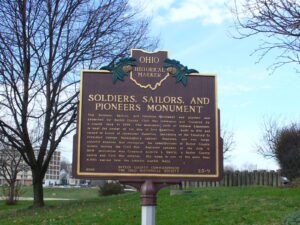
The Soldiers, Sailors, and Pioneers Monument was planned and promoted by Butler County Civil War veterans and financed by a county levy in 1899. The monument, built of Indiana Limestone, is near the center of the site of Fort Hamilton, built in 1791 and named in honor of Alexander Hamilton, Secretary of the Treasury in President George Washington’s cabinet. Featured, are two large, colorful windows that recognize the contributions of Butler County women during the Civil War. Featured speaker at the July 4, 1906, dedication was Governor Andrew L. Harris, a Butler County native and Civil War veteran. His name is one of the more than 4,300 carved into the interior marble walls.
Cincinnati Museum Center at Union Terminal, 1301 Western Avenue
Cincinnati
, OH
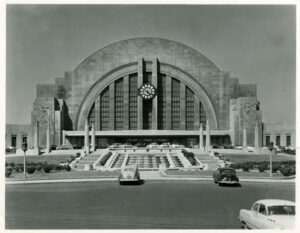
The Cincinnati Union Terminal opened in March 1933 and integrated rail travel in the city, which previously operated from five separate passenger terminals. Built when rail travel was already in decline, Union Terminal stopped operating as a passenger railroad station in 1972. Only during WWII was the terminal used to capacity with as many as 34,000 people travelling through the building daily in 1944. As part of preservation efforts, 14 mosaics depicting Cincinnati industry of the 1930s by Winold Reiss were saved from the concourse and moved to the Greater Cincinnati Airport. The restored Union Terminal became a Museum Center in November 1990 with the opening of the renovated Cincinnati Museum of Natural History and new Cincinnati History Museum. Cincinnati Union Terminal has been described as one of the most outstanding examples of Art Deco train stations in the nation and was listed on National Register of Historic Places in 1972.
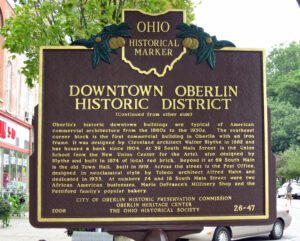
The intersection of Main and College streets has been the center of Oberlin since the town and college were founded in 1833. The first downtown buildings were made of wood and were destroyed by a series of spectacular fires. The first college building, Oberlin Hall, stood on the southwest corner of College and Main and included recitation rooms, a dining hall, chapel, offices, and lodging. In 1887, Akron architect Frank Weary designed the large brick building at numbers 5 to 13 West College. Number 23 West College (Gibson Block) once housed a silent movie theater on the second floor. East College Street’s historic buildings include the Apollo Theater, which showed Oberlin’s first talking movie on May 11, 1928. From 1897 to 1929, an interurban streetcar line connected Oberlin’s downtown to Cleveland. Oberlin’s downtown historic district was placed on the National Register of Historic Places in 2003.
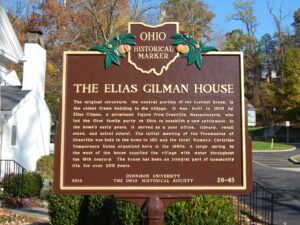
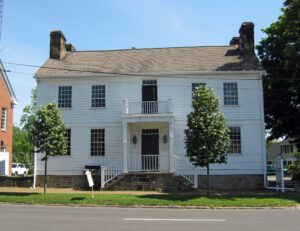
The original structure, the central portion of the current house, is the oldest frame building in the village. It was built in 1808 by Elias Gilman, a prominent figure from Granville Massachusetts, who led the first family party to Ohio to establish a new settlement . In the home’s early years, it served as a post office, library, retail store, and select school. The initial meeting of the Freemasons of Granville was held in the home in 1811 and the local Women’s Christian Temperance Union organized here in the 1880s . A large spring to the west of the house supplied the village with water throughout the 19th century . The house has been an integral part of community life for over 200 years.
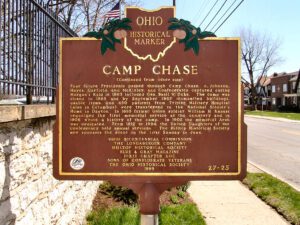
Camp Chase was a Civil War camp established in May 1861, on land leased by the U.S. Government. Four miles west of Columbus, the main entrance was on the National Road. Boundaries of the camp were present-day Broad Street (north), Hague Avenue (east), Sullivant Avenue (south), and near Westgate Avenue (west). Named for former Ohio Governor and Lincoln’s Secretary of the Treasury Salmon P. Chase, it was a training camp for Ohio soldiers, a parole camp, a muster-out post, and a prisoner-of-war camp. As many as 150,000 Union soldiers and 25,000 Confederate prisoners passed through its gates from 1861-1865. By February 1865, over 9,400 men were held at the prison. More than 2,000 Confederates are buried in the Camp Chase Cemetery.
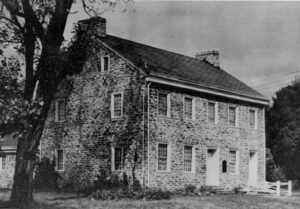
Built in 1804 by Jonathan Fowler, one of the founders of Poland Village, this structure served as his family home, general store, tavern and a hotel all at the same time. It became an important stagecoach stop on the main highway between Pittsburgh and Cleveland. In 1861, the future President of the United States, William McKinley was sworn into the Union Army from the tavern’s front porch.
Waldschmidt Cemetery is located on land purchased from former New Jersey judge and Congressman John Cleves Symmes in 1795 by Christian Waldschmidt, one of the first settlers in the Little Miami River Valley. Waldschmidt, from Lancaster, Pennsylvania, was a veteran of the American Revolution, and he and his family are buried here. During the Civil War this area, named for Governor William Dennison, served as a training site and hospital for the Union effort. A portion of the cemetery was the temporary interment site for 349 Union soldiers and 31 Confederate prisoners of war, most of whom died at the camp hospital. On July 4, 1869, the Union soldiers were moved to Spring Grove Cemetery in Cincinnati. About the same time, the Confederate soldiers were reinterred in Chase Cemetery in Columbus, Ohio.