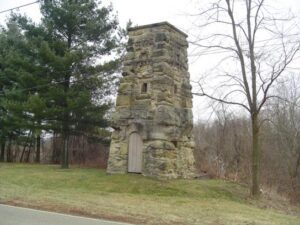
These three stone water towers were erected by local craftsmen in 1892 and serviced the Ohio Hospital for Epileptics until 1950. The sandstone of the uncoursed masonry walls was quarried from the surrounding hills. The hospital facility, a former Union Hospital site during the Civil War, was the first of its kind in the United States. The towers were restored in 1981-1982.
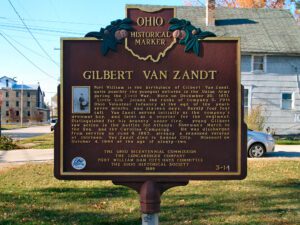
Port William is the birthplace of Gilbert Van Zandt, quite possibly the youngest enlistee in the Union Army during the Civil War. Born on December 20, 1851, “Little Gib” joined the ranks of Company D, 79th Ohio Volunteer Infantry at the age of ten years, seven months, and sixteen days. Barely four feet tall, Van Zandt served initially as the company’s drummer boy, and later as a courier for the regiment. Distinguished for his bravery under fire, young Gilbert saw action in the battles for Atlanta, Sherman’s March to the Sea, and the Carolina Campaign. He was discharged from service on June 9, 1865, already a seasoned veteran at thirteen. Van Zandt died in Kansas City, Missouri on October 4, 1944 at the age of ninety-two.
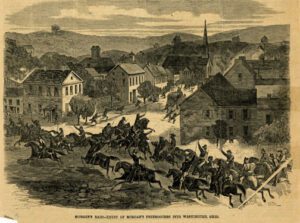
During the summer of 1863, General John Hunt Morgan, a Confederate cavalry leader from Kentucky, invaded southern Ohio with 2,460 mounted men. Throughout the campaign Morgan’s men plundered and looted before being captured by Union forces. On July 17, Morgan led his troops into Wilkesville stealing horses, sacking stores, and robbing private citizens. That night Morgan and some of his troops took lodging and meals with his first cousin Ruth Virginia Althar Cline and her husband Dr. William Cline. Morgan’s troops camped near the house of John and Elzia Levis where Elzia cooked for the men for fear they would harm her family. Additional soldiers of the raiding party stayed on the village square. Legend has it that while Morgan slept at the Cline Mansion, his black servant stole his looted money, and abolitionists Dr. Cline and Abraham Morris, helped him escape to freedom on the Underground Railroad.
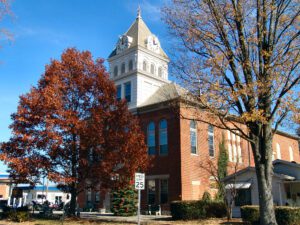
The Richwood Opera House and Town Hall was erected in 1890 as a community center designed to house the town council chambers, fire department, jail and opera house. The Richardsonian Romanesque styled building served Richwood in all these capacities for nearly 75 years. The Opera House was the site of minstrel shows, concerts, movies, lecture courses, revivals, farmers’ institutes, commencements, and community meetings. The second floor gymnasium was used for a men’s independent basketball league, dance classes, and as a teen center after World War II. Construction of an interurban railway running between Richwood and the resort town of Magnetic Springs in 1906 provided an expanded audience for the Opera House. (continued on other side)
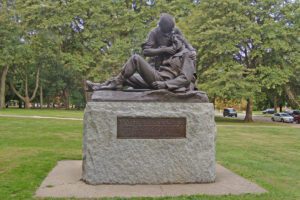
Mary Ann Ball was born in this vicinity in 1817 and began her nursing career at age 20. When the Civil War broke out in 1861, Mary at the age of 45 went to the soldiers’ aid. Ignoring rank, protocol, and allegiance, she pursued fearlessly and with inexhaustible energy her mission to care for the sick and wounded. Rebel, Union, and Negro soldiers all received the same attention. She risked enemy fire, especially through Grant’s Western Campaign and Sherman’s Georgia Campaign, to rescue suffering men, often going out at night to hunt for the fallen. When the victorious armies of the North were reviewed in Washington at the war’s end, “Mother Bickerdyke” road her faithful white horse beside the generals and colonels. Veterans along the line of march gave her the loudest cheers.
Camp Latty was located at the corner of Riverview and Glenwood Avenues in Napoleon, Ohio and included Glenwood Cemetery in its grounds. This camp was named for Judge Alexander S. Latty, a staunch supporter of the Union. From October to December 1861 the 68th Regiment was organized. The 68th Regiment then took part in the Battles of Fort Donelson, Shiloh, the Siege of Corinth, the Battles of Hatchies’s Bridge, Port Gibson, Raymond, Champion Hill, the Siege of Vicksburg, the Meridian Campaign, the Atlanta Campaign, the Battle of Kennesaw Mountain, the Battle of Atlanta, the Siege of Atlanta, the Battle of Jonesboro, Sherman’s March to the Sea, the Carolinas Campaign, the Battle of Bentonville, the Surrender of Johnston’s Army, and the Grand Review in Washington, D.C. The 68th Regiment served in every Confederate State except Florida and Texas. (Continued on other side)
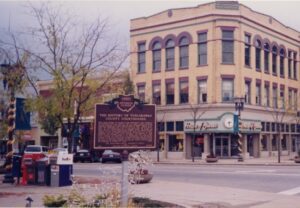
When David Knisely, the founder of New Philadelphia, first arrived in the Tuscarawas Valley on August 27, 1803, he found a sparsely populated, pristine wilderness. Five years later the state legislature approved a bill organizing Tuscarawas County effective March 15, 1808. Shortly thereafter, New Philadelphia was chosen as the county seat, and on April 16, 1808, the first commissioners met at Leininger’s tavern. By August, the tavern proved to be an inappropriate location for the county’s official business, and the commissioners approved the construction of a two-story, combination jail and county office building on land donated by John Knisely on the northeast corner of the square. By 1818 a new, larger brick courthouse was authorized by the commissioners. This building was occupied in 1825 and served as the courthouse until 1882 when the present structure was approved. Occupied in 1888, the building continues to be the center of the county’s business. The beautiful, state-of-the-art annex was dedicated on October 27, 1990.
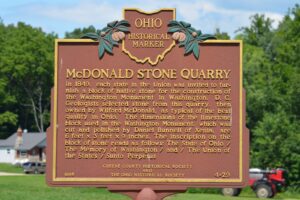
In 1849, each state in the Union was invited to furnish a block of native stone for the construction of the Washington Monument in Washington, D.C. Geologists selected stone from this quarry, then owned by Wilford McDonald, as typical of the best quality in Ohio. The dimensions of the limestone block used in the Washington Monument, which was cut and polished by Daniel Bunnell of Xenia, are 6 feet x 3 feet x 9 inches. The inscription on the block of stone reads as follows: The State of Ohio/ The Memory of Washington / and / The Union of the States / Sunto Perpetus