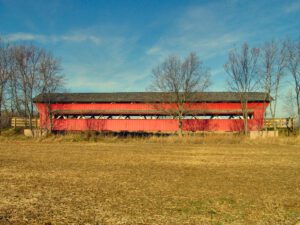
The Pottersburg Bridge, sometimes called the Upper Darby Bridge, was designed and constructed by Reuben Partridge in 1868. Originally located on North Lewisburg Road spanning the Big Darby Creek, the bridge was moved to this North Lewisburg Trail location in 2006 and renovated by Union County Engineer Steve A. Stolte to preserve its 1930s appearance. Its windows with awnings are not original, having been added prior to the 1930s. The steel rods were likely added in 1949. Partridge was a prolific bridge builder, having built more than 100 bridges in Union and surrounding counties. Most of his bridges were built with wood and covered, but a few were constructed with iron.
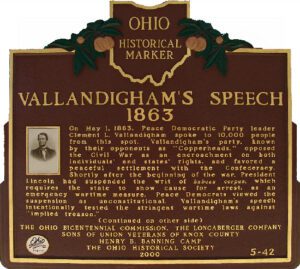
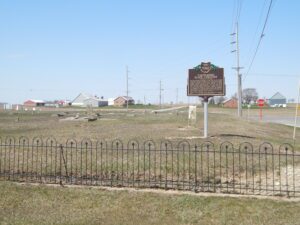
On May 1, 1863, Peace Democratic Party leader Clement L. Vallandigham spoke to 10,000 people from this spot. Vallandigham’s party, known by their opponents as “Copperheads,” opposed the Civil War as an encroachment on both individuals’ and states’ rights, and favored a peaceful settlement with the Confederacy. Shortly after the beginning of the war, President Lincoln had suspended the writ of habeas corpus, which requires the state to show cause for arrest, as an emergency wartime measure. Peace Democrats viewed the suspension as unconstitutional. Vallandigham’s speech intentionally tested the stringent wartime laws against “implied treason.” (continued on other side)
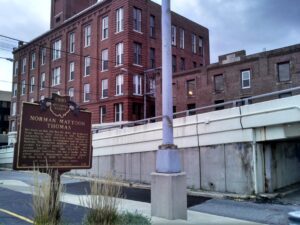
Was born on this site Nov. 20, 1884. He graduated from Marion High School in 1901, Princeton University in 1905, and from Union Theological Seminary. Thomas, a clergyman, and the son of Marion’s Presbyterian minister, was a tireless worker for social security, civil rights, and human justice. Six time Socialist Party presidential candidate, he was a leader in the effort toward disarmament and world peace. He died Dec. 19, 1968, in Huntington, N.Y.
After witnessing the slave trade in Wheeling, Virginia, Quaker abolitionist Benjamin Lundy (1789-1839) resolved to battle the institution, first organizing the Union Humane Society in St. Clairsville in 1815. In 1821, Lundy moved to Mount Pleasant and began publishing the Genius of Universal Emancipation, a newspaper devoted wholly to anti-slavery issues. The newspaper would later be published in Tennessee, Baltimore, Washington D.C., and Philadelphia. Lundy traveled widely to promote circulation, lecturing on the moral evils of slavery and its associated negative economic and social effects. The Lundy home served as an Underground Railroad stop.
The Carthagena Black Cemetery (Union Cemetery) is a remnant of approximately 70 documented rural black and mulatto settlements established in Ohio before the Civil War. In the charged atmosphere following race riots in Cincinnati in 1829, Quaker abolitionist Augustus Wattles led 15 black families north in 1835. In 1837 Wattles purchased 189 acres where the cemetery is located. Headstones date from 1840, the year mulatto Charles Moore, platted the Village of Carthagena. Wattles and mulatto clergymen Sam Jones and Harrison Lee were Underground Railroad conductors. Wattles moved to Kansas in 1855. By 1860, more than 100 black and mulatto families, totaling 600 people, owned over 10,000 acres. (Continued on other side)
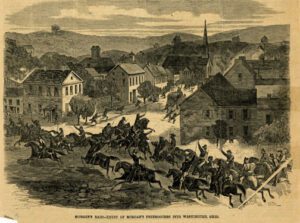
General John Hunt Morgan of Kentucky led a force of Confederate calvarymen into Meigs County during a forty-six day raid north of the Ohio River. The advance forces burned Benjamin Knight’s carding mill and sawmill, the Shade River Bridge, and pillaged local businesses in Chester on July 18, 1863, while waiting for the rest of the column to catch up. This two-hour halt delayed General Morgan’s arrival at the ford at Buffington Island until after dark, allowing Union troops to arrive before he could make his escape. General Morgan surrendered eight days later near West Point in Columbiana County, the northernmost point ever reached by Confederate forces during the Civil War.
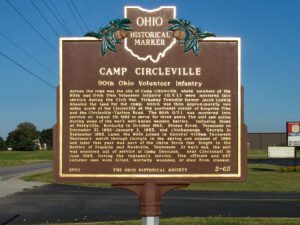
Across the road was the site of Camp Circleville, where members of the 90th and 114th Ohio Volunteer Infantry (O.V.I.) were mustered into service during the Civil War. Pickaway Township farmer Jacob Ludwig donated the land for the camp, which was then approximately two miles south of the Circleville at the southwest corner of Kingston Pike and the Circleville-Tarlton Road. The 90th O.V.I was mustered into service on August 29, 1862 to serve for three years. The unit saw action during some of the war’s well-known western battles, including those at Perryville, Kentucky in October 1862; Stones River, Tennesee on December 31, 1862-January 2, 1863, and Chickamauga, Georgia in September 1863. Later, the 90th joined in General William Tecumseh Sherman’s march through Georgia in the spring and summer of 1864 and later that year was part of the Union force that fought in the Battles of Franklin and Nashville, Tennesee. At war’s end, the unit was mustered out of service at Camp Dennison, near Cincinnati in June 1865. During the regiment’s service, five officers and 247 enlisted men were killed, mortally wounded, or died from disease.
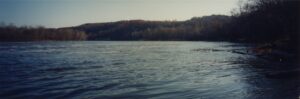
In the heyday of steamboating on the Muskingum, many people made their livelihood on the river. Jane McMillan, known as Old Jane, was one of the few women reported to have piloted boats on the river. In the 1840s she was co-owner of the “Zanesville Packet.” McMillan worked a variety of jobs, from cook to pilot. She was reported to know the twists and turns of the river so well that she could navigate safely at night, something many pilots refused to do. Isaac Newton Hook, a descendant of the earliest settlers in Zanesville, used skills he learned on the Muskingum River as a pilot on the Mississippi during the Civil War. He shipped supplies needed by the Union army. His tomb is in the Brick Church cemetery between Hooksburg and Stockport. He had the grave built out of concrete and above the level of the 1898 flood. The 1913 flood submerged the tomb, but it survived and can be viewed to this day.