On Allen Street between Lower and Upper Market Streets
Lebanon
, OH
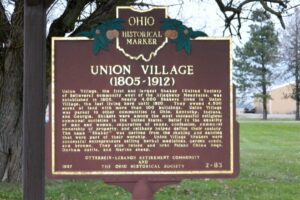
Union Village, the first and largest Shaker (United Society of Believers) community west of the Allegheny Mountains, was established in 1805. Nearly 4,000 Shakers lived in Union Village, the last living here until 1920. They owned 4,500 acres of land with more than 100 buildings. Union Village was parent to other communities in Ohio, Kentucky, Indiana, and Georgia. Shakers were among the most successful religious communal societies in the United States. Believe in equality of men and women, separation of sexes, confession, communal ownership of property, and celibacy helped define their society. The name “Shaker” was derived from the shaking and dancing that were part of their worship. Union Village Shakers were successful entrepreneurs selling herbal medicines, garden seeds, and brooms. They also raised and bred Poland China hogs, Durham cattle, and Merino sheep.
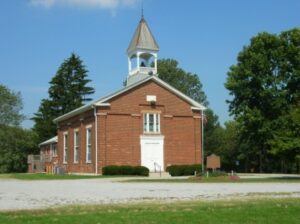
On this site in 1809, pious Christians from Virginia and North Carolina erected a Methodist Church, the first in Greene County. The church was officially organized on May 23, 1807 as the Bonner Society. Frederick Bonner, Sr. and the illustrious Rev. John Sale were the principal organizers. This Methodist Church, one of the oldest in Ohio, has been serving the area known as the Union Neighborhood uninterrupted from this site since 1809. Rev. Bennett Maxey was the first pastor. (Continued on other side)
Intersection of S. Sandusky Street & Olentangy Avenue
Delaware
, OH
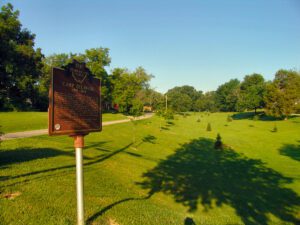
Near this site, the Union army established two camps on either side of the Olentangy River during the Civil War. Both were known as Camp Delaware. The first camp, situated on the west side of the river in the summer of 1862, was where the white recruits of the 96th and 121st regiments of Ohio Volunteer Infantry were mustered into service. A second camp, on the east side of the Olentangy, was established in the summer of 1863 and became the rendezvous point for most African-American Ohioans joining the army. The 127th Regiment of Ohio Volunteer Infantry-later renamed the 5th Regiment United States Colored Troops, the 27th U.S. Colored Troops, and members of other African-American units were mustered into service at Camp Delaware.
Brown County Fairgrounds off W. State Street/OH 125
Georgetown
, OH
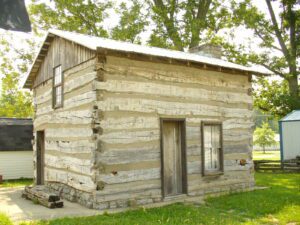
This house originally stood at Logan’s Gap, Union Township. By tradition, it was constructed in 1793 by Indian scouts William Dixon and Cornelius Washburn who became residents of Brown County. Dixon lived in this house until 1800.
Described as a Columbus “institution” when he died in 1969, Emerson C. Burkhart was born on a farm in Union Township, Putnam County in 1905. The son of Albert and Nora Burkhart, Emerson graduated from Kalida High School in 1924 and from Ohio Wesleyan University in 1927. After studying art in Provincetown, Massachusetts and in New York City, he settled in Columbus and, in 1937, married Mary Ann Martin, an artists’ model who devoted herself to his career. Burkhart was a prolific painter and completed an estimated 3,000 pictures during his 40-year career, including street scenes, rural landscapes, and more than 250 self-portraits, once noting his face was “cheaper than a model’s and always there.”
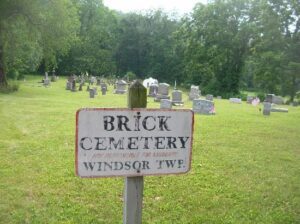
The Windsor Township Baptist Association was organized January 11, 1818 by Elder William Davis with 35 members who met in homes, barns and schoolhouses. At the death of the six-year-old granddaughter of Samuel and Tabitha Davis Henery, this plot by the river was laid out of a church yard and deeded by John Henery in 1837. In 1838 a brick church was built at the cost of $1,000. It served this community until the road and church were destroyed by the flood of 1913. More than 50 men from this area served in the Civil War. Twenty-six War of 1812 veterans are buried here as well as William Davis, veteran of the American Revolution; Obadiah Brokaw, founder of Big Bottom State Memorial; and Captain Isaac Newton Hook, river pilot at the age of ten and U.S. master of inland navigation, 1860-1873, who ran supplies on the Tennessee and Cumberland rivers for the Union Army. At Captain Hook’s death in 1906, the steamers Valley Gem, Zanesville, and Sonoma from Marietta in his honor landed passengers at the church here for his funeral, “largest ever held in the Muskingum Valley.” “The Lord and the River giveth and then taketh away.”
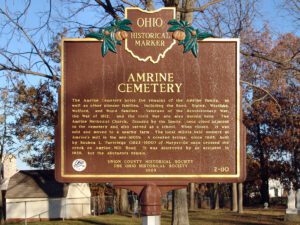
The first permanent settlement in the Marysville area, was founded in 1817 by Revolutionary War veteran Abraham Amrine (1761-1849) and his sons. The Amrines emigrated from Switzerland to Pennsylvania in the early 1700s and, after living in Belmont County, Ohio for 16 years, Abraham purchased 1000 acres here along Mill Creek circa 1817, paying $2 an acre. When Paris Township was organized in 1821, the township officers were elected in Amrine’s home on Newton Pike (now Raymond Road). All seven of his sons, John, Andrew, Moses, Frederick, Jeremiah, Abraham, Jr., and Henry, settled here. Andrew was a Justice of the Peace and leader in the church. Near this site, Henry built a sawmill in 1822 and a gristmill in 1825, which were operated by the family for more than 50 years.
On French Ridge in Richland Township, on June 5, 1863, local citizens in defiance of conscription attacked Elias Robinson, an enrolling officer of the Union Army. When Captain James Drake, the provost marshal, imprisoned the ringleaders, armed locals released them. Colonel William Wallace of the 15th Ohio Volunteer Infantry was sent to the scene with a force of 420 soldiers from Camp Chase in Columbus. On June 17, the soldiers approached the fortified camp of nearly one thousand malcontents. After firing upon the soldiers, the “rebels” scattered with only a few captured or wounded. The next morning, local Peace Democrats, led by politician Daniel P. Leadbetter, negotiated a surrender of the ringleaders. More than forty people were indicted for involvement in the rebellion, but only Lorenzo Blanchard, owner of the farm where the camp was located, was found guilty. Once this riot at “Fort Fizzle” ended, resistance to the draft in Holmes County subsided.