

, OH
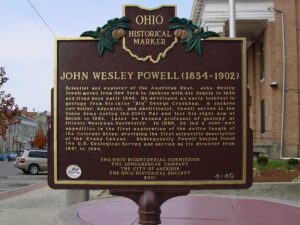
Scientist and explorer of the American West, John Wesley Powell moved from New York to Jackson with his family in 1838 and lived here until 1846. He developed an early interest in geology from his tutor “Big” George Crookham, a Jackson salt boiler, educator, and abolitionist. Powell served in the Union Army during the Civil War and lost his right arm at Shiloh in 1862. Later he became professor of geology at Illinois Wesleyan University. In 1869, he led a nine-man expedition in the first exploration of the entire length of the Colorado River, providing the first scientific description of the Grand Canyon. Subsequently Powell helped found the U.S. Geological Survey and served as its director from 1881 to 1894.
, OH
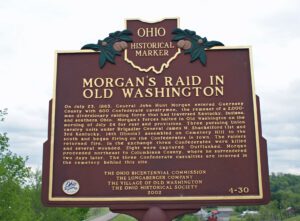
On July 23, 1863, General John Hunt Morgan entered Guernsey County with 600 Confederate cavalrymen, the remnant of a 2,000-man diversionary raiding force that had traversed Kentucky, Indiana, and southern Ohio. Morgan’s forces halted in Old Washington on the morning of July 24 for rest and provisions. Three pursuing Union cavalry units under Brigadier General James M. Shackelford (1st and 3rd Kentucky, 14th Illinois) assembled on Cemetery Hill to the south and began firing on the Confederates in town. The raiders returned fire. In the exchange three Confederates were killed and several wounded. Eight were captured. Outflanked, Morgan proceeded northeast to Columbiana County, where he surrendered two days later. The three Confederate casualties are interred in the cemetery behind this site.
, OH
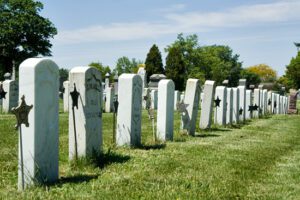
In 1884 the Ohio General Assembly authorized “the burial of the body of any honorably discharged union soldier, sailor or marine of this state who shall hereafter die without leaving means sufficient to defray funeral expenses.” Permanent government-issued headstones have been provided to veterans since the late 19th century. Between 1884 and the 1930s, Washington Cemetery buried 47 white soldiers (including 15 unknown) and 35 African-American soldiers. These veterans served in the Civil War, the Spanish-American War, and WWI. They are remembered for the sacrifices they made. In the fall of 2001, the cemetery underwent significant renovations, in which students of the Washington Senior High School Research History program aided in identifying the buried soldiers and restoring and replacing the gravestones. Here in Soldiers’ Row, the words of local United States Colored Troops veteran, Albert Bird, echo centuries later: “We have suffered to save the country; we ought to be remembered.”
, OH
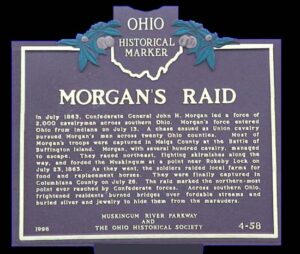
In July 1863, Confederate General John H. Morgan led a force of 2,000 cavalrymen across southern Ohio. Morgan’s force entered Ohio from Indiana on July 13. A chase ensued as Union cavalry pursued Morgan’s men across twenty Ohio counties. Most of Morgan’s troops were captured in Meigs County at the Battle of Buffington Island. Morgan, with several hundred cavalry, managed to escape. They raced northeast, fighting skirmishes along the way, and forded the Muskingum at a point near Rokeby Lock on July 23, 1863. As they went, the soldiers raided local farms for food and replacement horses. They were finally captured in Columbiana County on July 26. The raid marked the northern-most point ever reached by Confederate forces. Across southern Ohio, frightened residents burned bridges over fordable streams and buried silver and jewelry to hide them from the marauders.
, OH
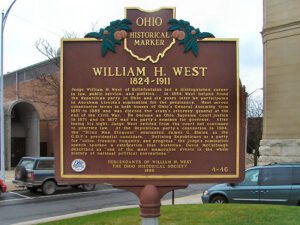
Judge William H. West of Bellefontaine led a distinguished career in law, public service, and politics. In 1854 West helped found the Republican party in Ohio and six years later he participated in Abraham Lincoln’s nomination for the presidency. West served consecutive terms in both houses of Ohio’s General Assembly from 1857 to 1865 and was elected the state’s attorney general at the end of the Civil War. He became an Ohio Supreme Court justice in 1871 and in 1877 was his party’s nominee for governor. After losing his sight, Judge West retired from the court but continued to practice law. At the Republican party’s convention in 1884, the “Blind Man Eloquent” nominated James G. Blaine as the G.O.P.’s presidential candidate. Defining Republicans as a party for “union, freedom, humanity, and progress,” the judge’s nomination speech sparked a celebration that historian David McCullough described as “one of the most memorable events in the whole history of national political conventions.”
, OH
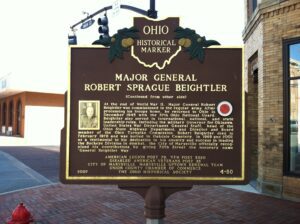
Robert Sprague Beightler was born in 1892 in Marysville. A graduate of Marysville High School, he began his career as a soldier in 1911, when he enlisted as a private in Marysville’s guard unit, Company E, Fourth Ohio Infantry Regiment. He served in Mexico from 1916-1917, World War I from 1917-1919, and World War II from 1940-1945. From his stint with the Ohio Infantry, he rose in rank to command the famous 37th Ohio National Guard Buckeye Division as Major General during WWII. Beightler was one of the most successful National Guard Generals and the only National Guard General to lead his troops through both training and combat in WWII. He was with his troops through 700 days of fighting in the South Pacific Theater. Fighting occurred on Bougainville Island and in the islands of New Georgia and the Philippines. (Continued on other side)
, OH
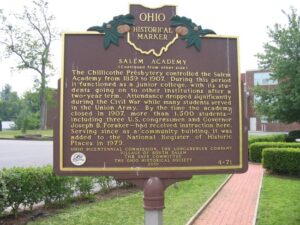
Presbyterian minister Hugh Stewart Fullerton asked his congregation in 1841: “Shall we endeavor to form an academy to provide better educational advantages to the young citizens of this remote community?” Predating the founding of the town of South Salem, the Salem Academy was built and opened in 1842, its stone coming from a quarry south of Greenfield. Its primary purpose was to prepare ministers and teachers for the West. Professor J.A. Lowes served as principal during the “golden age” of the academy from 1848 to 1858. (continued on other side)
, OH
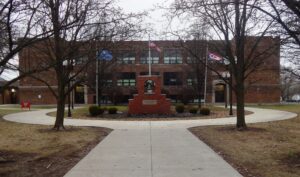
In 1893, Ohio and Indiana constructed the first Union School on the state line separating Ohio and Indiana. For 111 years, students from both states have been educated in what is the only schoolhouse located in Ohio and Indiana. In 1925, a new Union School was designed to replace the old schoolhouse. The dedication of this new school building took place on December 21, 1926. A new addition was added in 2004. The Union School Building has special architectural features such as a center stone placed on the Ohio and Indiana state line and Ohio and Indiana arched doorways. The bell from the 1893 Union School is displayed to the south side of the current school.