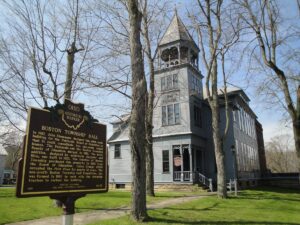
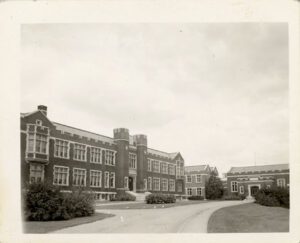
In 1887, John Eisenmann designed this stick-style building for the Peninsula Board of Education so that it could consolidate two one-room school houses. The Peninsula and the Boston Township Boards of Education merged in 1919. The brick addition, designed by architects Harpster and Bliss, was built in 1920. The trustees of Boston Township purchased this property in 1939 from the Board of Education. Union Grange #2380 occupied the first floor for nearly 50 years. The non-profit Boston Township Hall Committee, Inc. was formed in 1990 to work with the township trustees to restore the building.
Hebrew Union College (HUC), founded in Cincinnati in 1875, is the oldest institution of higher Jewish learning in the United States. Its founder, Rabbi Isaac Mayer Wise (1819-1900), was a leading proponent of Reform Judaism in America. In 1950, the college merged with the Jewish Institute of Religion (JIR), a liberal Jewish seminary in New York founded by Rabbi Stephen S. Wise (1874-1949) in 1922. A third center opened in Los Angeles in 1954 to serve Jewry on the West Coast and, in 1963, a fourth campus opened in Jerusalem. As of 2003, HUC-JIR educates rabbis, cantors, communal, and educational professionals. It also offers advanced academic training for scholars of all faiths. The holdings of the school’s Klau Library constitute one of the most extensive Jewish libraries in the world.
Moses Fleetwood Walker was born on October 7, 1856 in Ohio to Moses M. Walker, a physician, and Caroline, a midwife. He attended and played baseball at Oberlin College and the University of Michigan. In 1883, Walker joined the newly formed Toledo Blue Stockings and became the first African American major league ballplayer when Toledo joined the Major League-sanctioned American Association the following year. As a barehanded catcher, his biggest assets were his catching ability, powerful throwing arm, and aggressive base running. He endured racial prejudice from teammates, opponents, and baseball fans, and eventually left to become a writer, inventor, civil rights advocate, and entrepreneur. Walker was elected to the Ohio Baseball Hall of Fame in 1991. He died in 1924 and is buried in Stuebenville, Ohio in the family plot at Union Cemetery.
Born in Richmond, Virginia, Powhatan Beaty moved to Cincinnati in 1849, where he spent the majority of his life. Beaty enlisted as a private in the Union Army in June 1863, and two days later was promoted to first sergeant, Company G, 5th United States Colored Troops (USCT). All the officers of Company G were killed or wounded during an attack on Confederate forces at New Market Heights, Virginia, in September 1864. Beaty took command of his company, and for his valor received the Congressional Medal of Honor. Beaty was one of two African-Americans buried in Ohio to receive the Medal of Honor for service in the Civil War. He died on December 6, 1916, leaving two sons, attorney and state representative A. Lee Beaty and John W. Beaty. He is buried in Union Baptist Cemetery along with nearly 150 USCT veterans.
On January 9, 1919, a group of eight men and three women, being led by the Holy Spirit, met at a house on Wallace Street to form a new black Missionary Baptist Church in Hamilton, Ohio. The group quickly raised $150 to make the down payment on a two-story brick building at 333 Chestnut Street being sold for $1,850. The building was occupied on March 25, 1919, and the name Pilgrim Baptist Church was suggested and accepted. On May 11, 1919, a special council requested admittance into the Western Union Baptist Association, a district association now affiliated with the Ohio Baptist General Convention. Requirements for admission were met and Pilgrim Baptist Church was recognized as a Missionary Baptist Church. In 2019, Pilgrim Baptist Church celebrated a centennial of faithfulness in Hamilton.
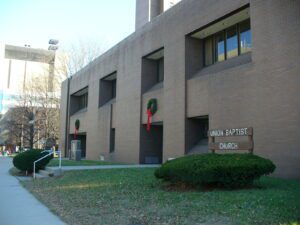
George Washington Williams was born in 1849 in Bedford, Pennsylvania. At age 14, he enlisted in the Union Army to fight in the Civil War and received a medical discharge in 1868. In 1874, he became the first African American to graduate from the Newton Theological Institution in Cambridge, Massachusetts, and shortly after married Sarah. A. Sterrett. He became pastor of the Twelfth Baptist Church in Boston before moving to Washington, D.C. to serve as editor of a newspaper called The Commoner. He then moved to Cincinnati to become pastor of the Union Baptist Church and while there served as the first black member of the Ohio Legislature from 1879-1881. Williams went to the Belgian Congo in 1890 where he criticized King Leopold II in an Open Letter for his inhumane policies in the Congo. He died in 1891 in England.
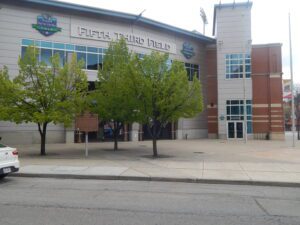
801 E. Pete Rose Way, Bicentennial Commons at Sawyer Point
Cincinnati
, OH
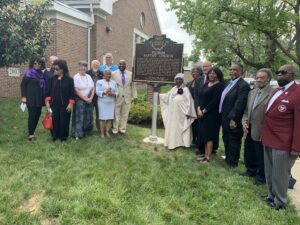
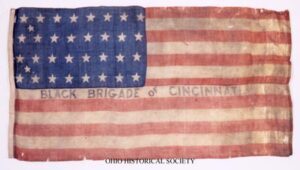
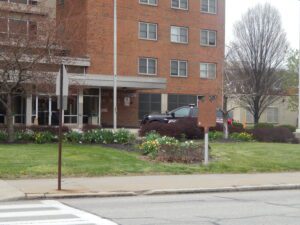
Following the success of Confederate forces in eastern Kentucky and General John Hunt Morgan’s raids there in 1862, Cincinnatians believed that Southern invasion was imminent. Anxious officials ordered Cincinnati citizens to form home guards, but black men willing to volunteer were rebuffed when they attempted to join a defense force. Instead, police serving as provost guards rounded up many and marched them by bayonet to build fortifications in Kentucky. Reacting to the shameful treatment of the blacks eager to support the Union, the commander of the Department of Ohio dispatched Major General Lewis Wallace to command the civilians and to liberate black men forced into service. (continued on other side)
John Malvin (1795-1880) was an operative on the Underground Railroad and an ardent member of anti-slavery and abolitionist causes. Born in Dumfries, Virginia of a free mother and enslaved father, Malvin was apprenticed at an early age to learn carpentry and taught himself to read and write. In 1827, he moved to Cincinnati where he became an ordained preacher and an activist in the cause of freedom. In 1831, with his wife Harriet, he moved to Cleveland where he became a charter member of the First Baptist Church, a sawmill operator, and captain and owner of the canal boat Auburn. (continued on other side)