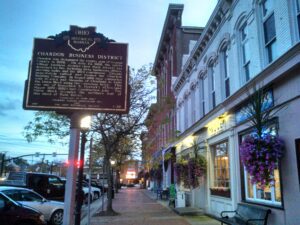
Chardon was designated the county seat of Geauga County in 1808. On July 25, 1868, the entire village business district (now Main Street) was destroyed by fire, including forty businesses, offices, meeting halls, and the 1824 courthouse. Citizens immediately rallied and formed the Chardon Building Company. In August 1868 they contracted with Herrick and Simmons of Cleveland to build the Union Block using fire-resistant brick. This was one of Rensselaer R. Herrick’s (Cleveland Mayor 1879-1882) last construction jobs. The Union Block occupies the northern half of this block of Main Street. (Continued on other side)
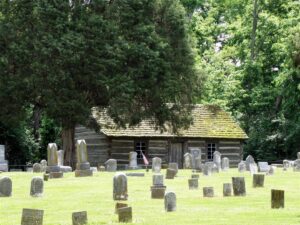
To Commemorate the first church erected in Union Township, Miami County, Ohio, this log replica was constructed in 1976 by the Union Township 4-H Clubs and the West Milton area Camp Fire Girls. The Laura Lions Club established this historic marker which stands on the site of the West Branch Quaker Burial Grounds near the location of the original church.
Its location and the tides of war established Gallipolis, then a town of some 3,000, as a point of strategic military importance to the Union upon the outbreak of the conflict in 1861. It was destined during the next four years to play a role without counterpart in Ohio. Here through this troop concentration area passed thousands of soldiers to the great campaigns. Here the traditional peacetime activity of the town, long a depot of supplies for the Kanawha Valley, was turned to military purposes for maintaining armies in the field. Here riverside warehouses held vast military stores to be transported by steamboat. Here newly-mustered troops set up Camp Carrington in a wheat field on the upper side of town. Here the women of Gallipolis helped minister to thousands of wounded and sick in an army hospital
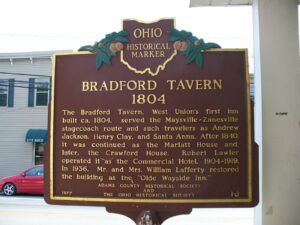
The Bradford Tavern, West Union’s first inn built ca. 1804, served the Maysville-Zanesville stagecoach route and such travelers as Andrew Jackson, Henry Clay, and Santa Anna. After 1840, it was continued as the Marlatt House and, later, the Crawford House. Robert Lawler operated it as the Commercial Hotel, 1904-1919. In 1936, Mr. and Mrs. William Lafferty restored the building as the “Olde Wayside Inn.”
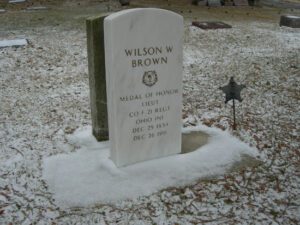
Medal of Honor winner, who is buried here. He joined the famous Andrews Raiders to wreck Confederate supply lines. The raiders captured a locomotive, “The General,” at Big Shanty, Georgia, on April 12, 1862. Brown served as the engineer and was captured after the “General” ran out of fuel. He escaped on October 16 and made his way back to Union lines after enduring great hardships.
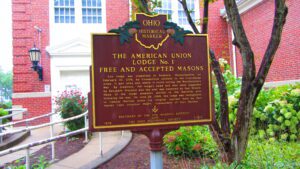
The lodge was organized in Roxbury, Massachusetts, on February 10, 1776, by Connecticut soldiers in the Continental Army. It met when and where it could during the Revolutionary War. By tradition, the lodge’s name and seal were suggested by Benjamin Franklin and the seal was engraved by Paul Revere. Many of the lodge members settled in the Marietta area following the war. On June 28, 1790, the lodge was reorganized in Campus Martius under its original warrant held by Past Master Capt. Jonathan Heart, commandant of Fort Harmer.
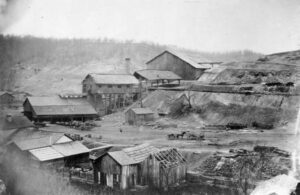
To furnish the needs of the early settlers, then to furnish ordnance for a nation at war, and finally to furnish merchant iron to the steel mills, 100 iron producing blast furnaces were built within these 1,800 square miles of the lower coal measures to become known as the Hanging Rock Region. Lawrence County, centrally located within the Region, had 23 blast furnaces constructed between 1826 and 1909.
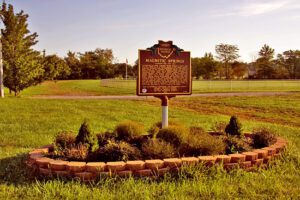
Near this site in 1879, J.E. Newhouse discovered a magnetic spring in his park, Green Bend Gardens. It was found that a knife blade dipped in the water could pick up small metal objects like a magnet. The spring became known for its curative powers and was advertised as a treatment for ailments including rheumatism, gout, insomnia, and diseases of the kidneys, bladder, and nerves. To share the health-giving water, Mr. Newhouse opened the Magnetic Bath House, which became famous for its water cures. To reach a larger market, the magnetic water was sterilized and bottled and sold under the Magnetic Springs label. Advances in medicine after World War II led to the decline in the popularity of mineral baths.