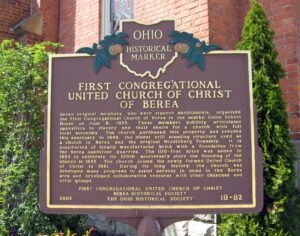
Seven original members, who were staunch abolitionists, organized the First Congregational Church of Berea in the nearby Union School House on June 9, 1855. These members publicly articulated opposition to slavery and their desire for a church with full local autonomy. The church purchased this property and erected this sanctuary in 1869, the oldest still standing structure used as a church in Berea and the original Middleburg Township. It is constructed of locally manufactured brick with a foundation from the Berea sandstone quarries. The 100-foot spire was added in 1954 to celebrate its 100th anniversary since the founding of the church in 1855. The church joined the newly formed United Church of Christ in 1961. During its long history, the church has developed many programs to assist persons in need in the Berea area and developed collaborative ventures with other churches and civic groups.
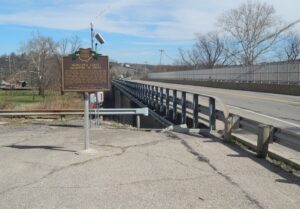
Confederate Brigadier General John Hunt Morgan’s Indiana-Ohio Raid, or Great Raid, from July 2-26, 1863 covered nearly 1,000 miles and penetrated deeper into the North than any other Confederate incursion during the Civil War. The raid was also the only significant military action of the war in Ohio. Union cavalry chased Morgan’s 2,000 cavalrymen across twenty-four Ohio counties after the troopers entered the state from Indiana. On July 13, 1863 Morgan’s main column encountered no resistance as it passed through New Haven, about five miles north from this site. (Continued on other side)
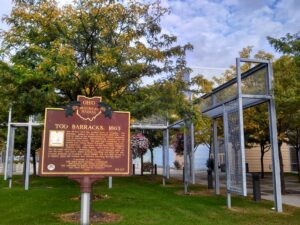
One of five Civil War military posts in Columbus, Tod Barracks, named in honor of Governor David Tod, was built in 1863 as the headquarters for military administration in central Ohio. Necessitated by Lincoln’s call for 300,000 new troops, the post was constructed in two months with United States Engineer, Captain John Tod, as supervisor. Carpenters of the 88th Ohio Volunteer Infantry from Camp Chase, three miles west, built it. Tod Barracks served as a recruiting depot, a rendezvous point for new recruits, and place where soldiers mustered-out after the war. Located adjacent to Columbus’ Union Station, the post also served as a transfer point for soldiers and officers traveling through Ohio. (continued on other side)
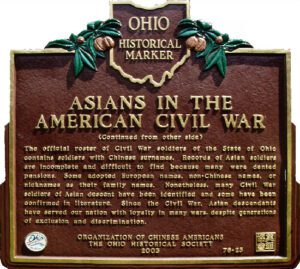
Despite exclusionary laws preventing U.S. citizenship, Asians served in the Union and Confederate armies and navies during the American Civil War (1861-1865). Many of these soldiers were denied citizenship following their services due to the anti-Asian sentiment, which culminated in the Naturalization Act of 1870 and the Chinese Exclusion Act of 1882. The exclusionary laws continued until 1943, and all restrictions on national origin or race were abolished in 1965. In April 2003, House Joint Resolution 45 was introduced to Congress to posthumously proclaim Civil War soldiers of Asian descent to be honorary citizens of the United States as recognition of their honorable services. (continued on other side)
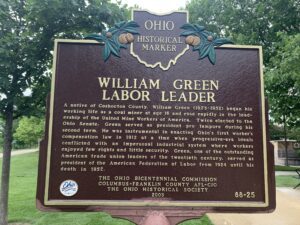
A native of Coshocton County, William Green (1870-1932) began his working life as a coal miner at age 16 and rose rapidly in the leadership of the United Mine Workers of America. Twice elected to the Ohio Senate, Green served as president pro tempore during his second term. He was instrumental in enacting Ohio’s first worker’s compensation law in 1912, at a time when progressive-era ideals conflicted with an impersonal industrial system where workers enjoyed few rights and little security. Green, one of the outstanding American trade union leaders of the twentieth century, served as president of the American Federation of Labor from 1924 until his death in 1952.
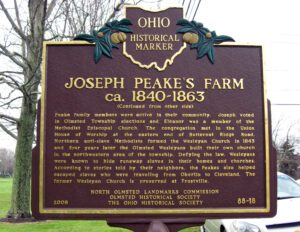
Joseph Peake was born in Pennsylvania in 1792 and came to Ohio in 1809 with his parents and brother. They were the first African Americans to settle permanently in the Cleveland area. He was the son of George Peake, a runaway slave from Maryland, who fought on the British side at the Battle of Quebec in 1759 during the French and Indian War. A man with some means and talent, George Peake invented a stone hand mill for grinding corn, a labor-saving device that endeared the Peakes to their neighbors in western Cuyahoga County. Joseph Peake and his wife Eleanor, an African American from Delaware, bought land in the 1840s on the Mastick Plank Road and built a home near this marker. [Continued on other side]
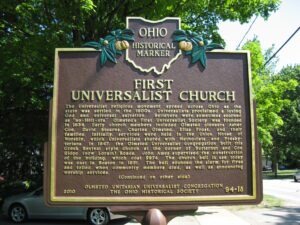
The Universalist religious movement spread across Ohio as the state was settled in the 1800s. Universalists proclaimed a loving God and universal salvation. Believers were sometimes scorned as “no-Hell-ers.” Olmsted’s First Universalist Society was founded in 1834. Early church members included Olmsted pioneers Asher Coe, David Stearns, Charles Olmsted, Elias Frost, and their families. Initially, services were held in the Union House of Worship, which Universalists shared with Methodists and Presbyterians. In 1847, the Olmsted Universalist congregation built this Greek Revival style church at the corner of Butternut and Coe Ridge (now Lorain) Roads. John Ames supervised the construction of the building, which cost $974. The church bell in use today was cast in Boston in 1851. The bell sounded the alarm for fires and tolled when community members died, as well as announcing worship services.
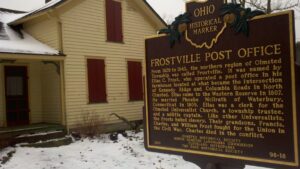
The North Olmsted Historical Society was founded in 1953 and became incorporated as a non-profit association in 1961. A year later, Frostville Museum opened in the Prechtel House. The society took on the challenge of preserving the history of the entire original township and became the Olmsted Historical Society in 1969. The Frostville Museum has grown from one house to a small village. Volunteers are dedicated to preserving the past and the present for the future. In August 2010, First Lady Michelle Obama designated the society as a Preserve America Steward. Frostville is an affiliate of the Cleveland Metroparks.