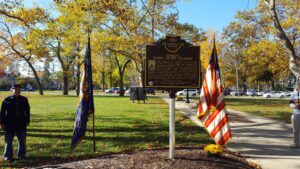
Waldschmidt Cemetery is located on land purchased from former New Jersey judge and Congressman John Cleves Symmes in 1795 by Christian Waldschmidt, one of the first settlers in the Little Miami River Valley. Waldschmidt, from Lancaster, Pennsylvania, was a veteran of the American Revolution, and he and his family are buried here. During the Civil War this area, named for Governor William Dennison, served as a training site and hospital for the Union effort. A portion of the cemetery was the temporary interment site for 349 Union soldiers and 31 Confederate prisoners of war, most of whom died at the camp hospital. On July 4, 1869, the Union soldiers were moved to Spring Grove Cemetery in Cincinnati. About the same time, the Confederate soldiers were reinterred in Chase Cemetery in Columbus, Ohio.
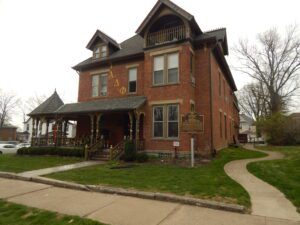
In 1833, Samuel Eells founded Alpha Delta Phi (ΑΔΦ), the first fraternity west of the Allegheny Mountains and the first fraternity at Miami University. The formation of Miami’s Alpha (founding) chapters followed in the next two decades. In 1839 Beta Theta Phi (ΒΘΠ) was founded, Miami’s first Alpha chapter. Phi Delta Theta (ΦΔΘ) was founded in 1848 and Sigma Chi (ΣΧ) in 1855, completing the Miami Triad. Miami would become home to two more Alpha chapters with the creation of the sorority Delta Zeta (ΔΖ) in 1902 and what would become Phi Kappa Tau (ΦΚΤ), in 1906. Following Miami’s precedent, approximately 800 chapters of these five “Alphas” have been formed in the United States and internationally. Sharing the title with Union College in Schenectady, New York, Miami University is known as the “Mother of Fraternities”.
Quincy Adams Gillmore, considered one of the greatest military engineers and artillerists of the Civil War, was born to Quartus Gillmore and Elizabeth Reid Gillmore at this location in 1825. He attended Norwalk Academy and taught high school in Elyria before embarking on a military career. Graduating first in his class at West Point in 1849, he entered the Corps of Engineers. In August 1861, he served in the Union’s Port Royal expedition in South Carolina and later in the reduction of Fort Pulaski, which defended the water approach to Savannah, Georgia. The fort, considered impregnable to artillery, fell to Gillmore’s rifled cannon on April 11, 1862, after a two-day bombardment. His success effectively ended the use of large masonry fortifications. (Continued on other side)
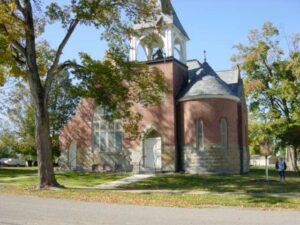
Rev. George Messenger and his congregation built the first Universalist Church on this site. It was dedicated during a state convention of Universalists in Woodstock in June 1844. In 1893, Rev. John A. Carpenter was instrumental in erecting a new building — the one before you. It was dedicated Easter Sunday, April 14, 1895. The church’s front window memorializes the men of the 66th Ohio Volunteer Infantry, recruited from Champaign County during the Civil War. Woodstock in Rush Township contributed more of its sons to the Union cause per capita than any other community in the county.
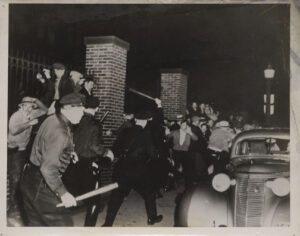
Five Depression-era strikes against many of Akron’s rubber companies culminated in a giant “sit-down” strike against Goodyear Tire and Rubber Company, the industry’s leader, in February and March of 1936. The fledgling United Rubber Workers (URW), created in September 1935, used the tactic of being at work but not working that had been pioneered by rank-and-file workers in a successful 1934 strike against the General Tire and Rubber Company. After a peaceful month-long strike, the URW won recognition from Goodyear and reached a settlement on March 22. The 1936 Akron Rubber Strike was one of the earliest successes for the Committee for Industrial Organization (CIO), sparking a wave of industrial organizing and similar strikes in 1936 and 1937. The “sit-down” strategy extended beyond the rubber industry and was instrumental in the founding of the industrial union movement in the United States.
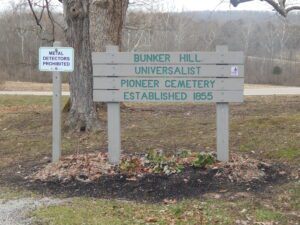
Bunker Hill Universalist Pioneer Cemetery, 5359 Reily Millville Road
Oxford
, OH
The Bunker Hill Society was organized about 1845 and fellowshipped in 1854. A frame meeting house, capable of seating 300, was dedicated in 1855. Thirty people united with the church during the 1859 Annual Meeting. The membership suffered greatly during the Civil War, many enlisting in the Union Army. Some members, Like John G. Agnew, were Peace Democrats (Copperheads). Agnew withdrew from the church on July 5, 1863 saying, “I feel the course I am and have been pursuing does not comport with the Christian character. Nor do I think that I can be better while this war lasts. I do not wish to be a reproach upon the church.” The church was re-fellowshipped in 1900. The last sermon was delivered October 23, 1910. Fire destroyed the building May 8, 1924.
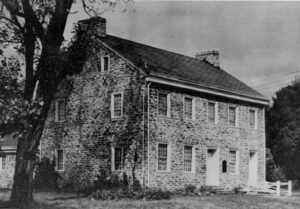
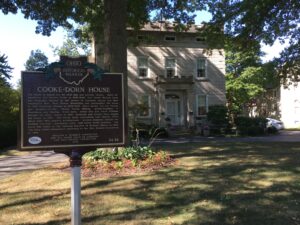
Eleutheros Cooke. The Cooke-Dorn house was the last home of attorney Eleutheros Cooke (1787-1864) who served four years in the Ohio legislature and one term in the 22nd Congress of the United States. An early proponent of railroads, Cooke received one of the first charters granted to a railroad west of the Alleghany Mountains, for the Mad River & Lake Erie line. He and wife Martha had six children, four of whom lived to adulthood. Two rose to prominence in the Civil War era. Jay was a successful banker and became known as the “financier of the Civil War” for his efforts to secure loans from Northern banks to support the Union’s war effort. Henry was appointed as the first governor of the short-lived Territory of the District of Columbia in 1871 (which was replaced in 1874).
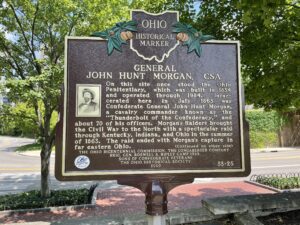
On this site once stood the Ohio Penitentiary, which was built in 1834 and operated through 1984. Incarcerated here in July 1863 was Confederate General John Hunt Morgan, a cavalry commander known as the “Thunderbolt of the Confederacy,” and about 70 of his officers. Morgan’s Raiders brought the Civil War to the North with a spectacular raid through Kentucky, Indiana, and Ohio in the summer of 1863. The raid ended with Morgan’s capture in far eastern Ohio. (continued on other side)