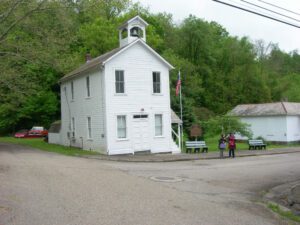
Established in 1879 by Chicago industrialist William P. Rend as a coal mining town, Rendville became a place where African Americans broke the color barrier. In 1888, Dr. Isaiah Tuppins, the first African American to receive a medical degree in Ohio, was elected Rendville’s mayor, also making him the first African American to be elected a mayor in Ohio. Richard L. Davis arrived in Rendville in 1882 and became active in the Knights of Labor. He was one of the labor organizers from the Little Cities of Black Diamonds region who helped found the United Mine Workers of America in 1890. An outstanding writer and orator, Davis was elected to UMWA’s national executive board and organized thousands of African Americans and immigrants to join the union. (continued on other side)
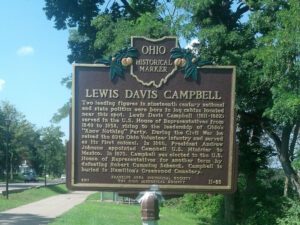
Two leading figures in nineteenth century national and state politics were born in log cabins located near this spot. Lewis Davis Campbell (1811-1882) served in the U.S. House of Representatives from 1849 to 1858, rising to the leadership of Ohio’s “Know Nothing” Party. During the Civil War he raised the 69th Ohio Volunteer Infantry and served as its first colonel. In 1866, President Andrew Johnson appointed Campbell U.S. Minister to Mexico. In 1870, Campbell was elected to the U.S. House of Representatives for another term by defeating Robert Cumming Schenck. Campbell is buried in Hamilton’s Greenwood Cemetery.
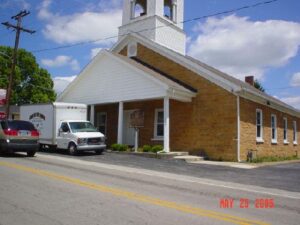
The First Presbyterian Church of West Union, built in 1810, is known as the “Church of the Governors.” Although the date is uncertain, the congregation was organized circa 1800 on Thomas Kirker’s land on Eagle Creek, about three miles from West Union. Kirker, Ohio’s second governor, was influential in organizing the congregation and raising funds for the construction of the building. Stonemason, Thomas Metcalfe, Kentucky governor from 1828-1832, was awarded the contract to build the walls for $250.00; the total construction cost was $500.00. The first three regular ministers – William Williamson, Dyer Burgess, and John P. Van Dyke – all held strong anti-slavery sentiment that was felt throughout the congregation. During the Civil War, soldiers of the 70th Ohio Volunteer Infantry, a regiment of recruits from Adams County and eastern Brown County, were said to have been temporarily quartered in the church before leaving West Union in 1861.
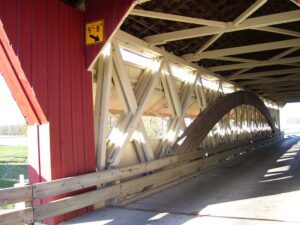
Constructed in 1873, the Bigelow Bridge spans approximately 100 feet across Little Darby Creek. Reuben Partridge built the superstructure at a cost of $12.50 per linear foot ($1,500). Bercupile & Snell built the masonry foundation at a cost of $7.00 per perch (a perch is approximately 25 cubic feet). Partridge built bridges throughout Union County and the surrounding area from 1866 until his death in 1900. The covered bridge is named for Eliphas Bigelow, an early resident of Union County, who built the nearby Bigelow House on the south side of Post Road (SR 161) in 1846. Union County Engineer employees rehabilitated the bridge from 1989 to 1991 by installing a new support system. The Partridge trusses currently carry only the weight of the original bridge. The rehabilitation project received the 1992 Engineered Timber Bridge Award from the National Forest Products Association.
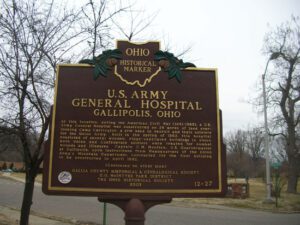
At this location, during the American Civil War (1861-1865), a U.S. Army General Hospital was constructed on 29 acres of land overlooking Camp Carrington, a site used to recruit and train soldiers for the Union Army. Built in the spring of 1862, this hospital consisted of several wooden, ridge-ventilated buildings in which both Union and Confederate soldiers were treated for combat wounds and illnesses. Captain C.M. Moulton, U.S. Quartermaster at Gallipolis, upon instructions from Headquarters of the Union Army’s Mountain Department, contracted for the first building to be constructed in April 1862. (continued on other side)
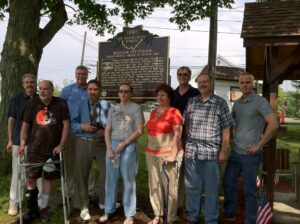
The General at Union Station in Chattanooga, Tennessee (circa 1907). Born in Knoxville in 1840 and reared at a farm in New Somerset, William Pittenger mustered into the 2nd Ohio Volunteer Infantry, under a 90-day enlistment, in 1861. He fought at the First Battle of Bull Run and was the war correspondent for the Steubenville Herald. After reenlisting, he participated in the ill-fated Andrews Raid of 1862. While attempting to disrupt enemy supply lines, the raiders stole the Confederate locomotive “The General.” After being chased north, they were captured. (Continued on other side)
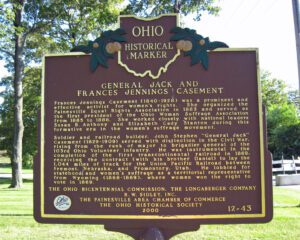
Western Reserve agriculturalist Charles Clement Jennings built the Casement House, also known as the “Jennings Place,” for his daughter Frances Jennings Casement in 1870. Designed by Charles W. Heard, son-in-law and student of Western Reserve master builder Jonathan Goldsmith, it is an excellent example of the Italianate style, featuring ornate black walnut woodwork, elaborate ceiling frescoes, and an innovative ventilation system. It remained in the Casement family until 1953. It was added to the National Register of Historic Places in 1979.
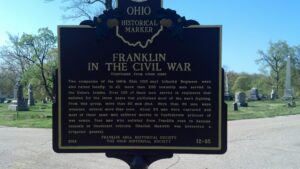
Men from Franklin Township were among the first from Ohio to leave for the war and participated in many of the conflict’s great campaigns. Individual companies of the 1st Ohio (90 day), 2nd Ohio, 75th Ohio, and 79th Ohio infantry were raised locally. Other Franklin men served in the 60th (1 year), 69th Ohio, and 93rd Ohio Infantry Regiments, the 4th Ohio Cavalry Regiment, and the 2nd Ohio Heavy Artillery Regiment. The township’s regiments served from First Bull Run in 1861 to Bentonville in 1865, participating in the battles of Perrysville, Stone’s River, Chicamauga, Chancellorsville, and Gettysburg, among many others.