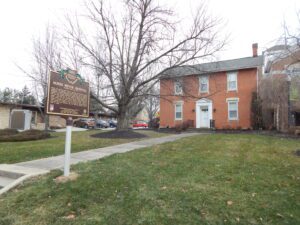
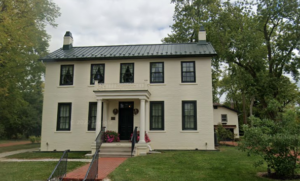
The house at this location, 110 South State Street, was the childhood home of Agnes Meyer Driscoll (1889-1971). Known as “the first lady of naval cryptology,” her career spanned from World War I to the Cold War. Driscoll attended Otterbein University before graduating from the Ohio State University, with majors in physics, math, music, and foreign languages. During World War I, she enlisted in the U.S. Navy as a chief yeoman, the highest rank possible for a woman at the time. After the war, Driscoll rose to become the chief civilian cryptanalyst for the U.S. Navy, breaking major Imperial Japanese Navy codes prior to World War II. (Continued on other side)
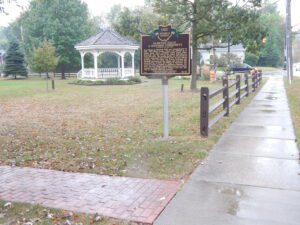
In 1795, the Connecticut Land Company auctioned twenty-five square miles of land known as Plum Creek Township. Aaron Olmsted, a sea captain, purchased almost half of the property. Although Olmsted died before ever seeing his land, in 1829, his son Charles offered to donate books to the area in exchange for changing the settlement’s name from Lenox to Olmsted. In 1815, shoemaker James Geer and his family became the first permanent American residents to settle in the southern end of the area. Geer’s farm was on what is now Columbia Road.
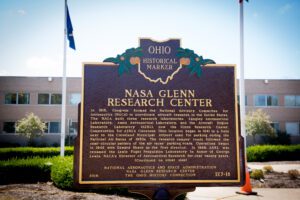
In 1915, Congress formed the National Advisory Committee for Aeronautics (NACA) to coordinate aircraft research in the United States. The NACA built three research laboratories: Langley Aeronautical Laboratory, Ames Aeronautical Laboratory, and the Aircraft Engine Research Laboratory (AERL), now the Glenn Research Center. Construction for AERL’s Cleveland, Ohio location began in 1941 in a field next to the Cleveland Municipal Airport used for parking during the National Air Races of the 1930s. The research campus’ roads followed the semi-circular pattern of the air races’ parking roads. Operations began in 1942 with Edward Sharp as the first director. In 1948, AERL was renamed the Lewis Flight Propulsion Laboratory in honor of George Lewis, NACA’s Director of Aeronautical Research for over twenty years.
Iuka Ravine, developed on land from the “Indianola Farm” that belonged to the Neil Family, is significant for its early 20th century architecture. The ravine’s natural beauty influenced architects to design homes for the upper middle class that incorporated “features of the old oak forest and glacial boulders.” Several ravine homes were designed by Frank Packard and Charles Inscho. Two classically-designed bridges built in 1912 insulated the area from traffic to create what became known during the 1920s-1950s as a “quiet professor enclave.” Iuka’s curvilinear street, one of the first in Columbus, as well as its stone walls, glacial erratics, and mature hardwoods created a “unique urban experience.” The Iuka Ravine Historic District was listed in The National Register of Historic Places in 1986 and added to the Columbus Register of Historic Properties in 1985.
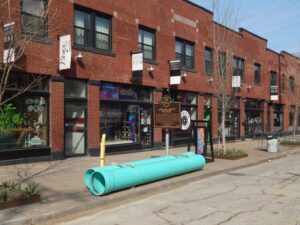
This block of W. 29th Street was home to Cleveland’s vibrant LGBT community and central to the development of the modern LGBT civil rights movement. In 1988, the Striebinger Building, at 1418 W. 29th, housed Cleveland’s Lesbian-Gay Community Services Center, which addressed the needs of the LGBT community. Cleveland’s first Pride Festival since the mid-1970s was held on the block in 1989, and in 1990 Cleveland’s first Pride Parade culminated here. During the HIV/AIDS crisis, The Living Room and ACT UP were located in the Striebinger Building and gave support to those with HIV/AIDs and provided a platform for political activism. It was on this block where many people could find their voices to “come-out” and advocate for their rights and their humanity. (Continued on other side)
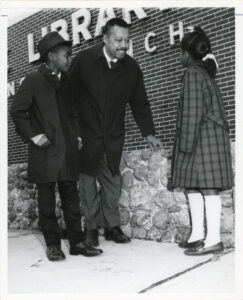
On November 19, 1968, the Columbus Metropolitan Library dedicated the first public library in the nation named after Dr. Martin Luther King Jr. After King’s assassination on April 4, 1968, the East Side Community Council requested that the new library being planned for the King-Lincoln Bronzeville community bear his name. The King family had both family and civic ties to Columbus and were honored by the tribute. More than 1,000 people gathered outside 1600 E. Long Street to hear Martin Luther King Sr. deliver the November dedication speech. Continuing the King family tradition, Martin Luther King III cut the ribbon to open a new branch building at 1487 E. Long Street on October 18, 2018. The Martin Luther King Branch was the first Columbus public library to bear an individual’s name.
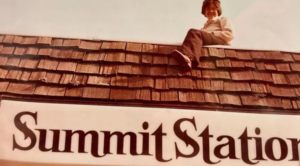
2210 Summit Street once housed one of Ohio’s longest-running lesbian bars. In 1970, a lesbian bartender at Jack’s A Go Go recognized that while Columbus had bars for gay men, it needed one geared toward lesbian clientele. Patrons knew the bar as “Jack’s,” Logan’s Off Broadway, and Summit Station. Staff welcomed women from small towns, women working in trades, women of color, butch/femme lesbians, and transgender people. Regulars recall that stepping through the door felt like finally entering a place of true belonging. Women could dance, “get together,” break up, sing karaoke, party with friends, and celebrate birthdays and holidays. Summit Station remained a safe public space, despite ongoing police harassment of its gender non-conforming regulars. A sign posted outside declared: “Ladies Night, Every Night. Men $5.” (Continued on other side)
Hugh Grant Sr. (1769-1806) owned a gristmill and land in Pittsburgh, Pennsylvania, during the 1790s. He married Catharine Barr Grant (unknown-1836) and they had 6 children: Alexander, Jacob, Isabella, Nancy, Mary, and Hugh Grant Jr. (born posthumously). In 1804 Grant purchased 450 acres of federal land at the Chillicothe land office. In 1805 he and his family moved to Jackson Township, Ohio. Uncertain of the location of his tracts, he settled his family in a log structure along the Scioto River. During the winter of 1806-1807, Grant died in a freak accident climbing a honeybee tree. Catharine Barr Grant realized they were on the wrong land and moved her family to the right property holdings where the Grant Homestead remains. She died August 17, 1836, and is buried in Union Methodist Cemetery.