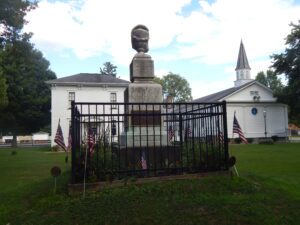
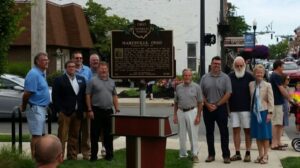
With the outbreak of the Civil War in 1861, many young men of Bristol Township enlisted in the army when President Abraham Lincoln issued his call to defend the Union cause. The death toll of some of these men at the Battle of Shiloh in Tennessee in April 1862 touched the local community as did the loss of Bristol Township lives at the Battle of Perryville in Kentucky, the Battle of Cedar Mountain in Virginia, and other theaters of war later in the year. The local citizenry responded to a plan for a lasting public memorial at the Town Park through a fund raising campaign. In 1863 the town square was transformed with a marble monument placed on an elevated mound at its center. The monument was designed by local artist Frank J. Hammond and manufactured by Myers, Uhl & Company of Cleveland at a cost of $500. [continued on other side]
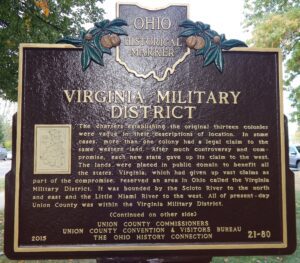
The charter establishing the original thirteen colonies were vague in their descriptions of location. In some cases, more than one colony had a legal claim to the same western land, After much controversy and compromise, each new state gave up its claim to the west. The lands were placed in public domain to benefit all the states. Virginia, which had given up vast claims as part of the compromise, reserved an area in Ohio called the Virginia Military District. It was bounded by the Scioto River to the north and east and by the Little Miami River to the west. All of present-day Union County was within the Virginia Military District. (Continued on other side)
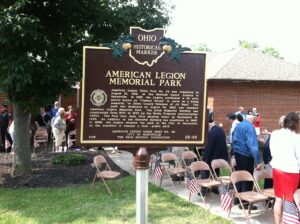
American Legion Union Post No. 79 was organized on August 21, 1919, at the National Guard Armory in Marysville. In 1927, the Legion purchased a 24 acre parcel known as “Clement Woods” to serve as a living memorial “to Union County Veterans of All Wars”. The park was dedicated on August 24, 1927, and renamed American Legion Memorial Park. The brick Memorial Building was constructed from 1937 to 1938 by the Works Progress Administration (WPA). The Post held their first meeting there on September 12, 1938. An addition to the Memorial Building was completed in 1960. In 1989, the Legion donated the park to the City of Marysville on the condition it remains a free, public park.
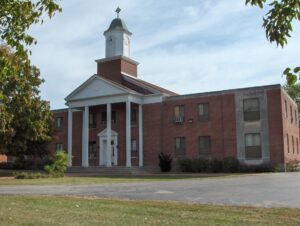
Payne Theological Seminary was originally established as Union Seminary in West Jefferson, Ohio, by the Ohio Conference of the African Methodist Church (AME) on October 18, 1844. The Cincinnati Conference of the Methodist Episcopal Church North met to establish a school for people of African descent, and in 1856, purchased Tawawa Springs, a defunct health resort, to open Wilberforce University, named for the early nineteenth century British abolitionist, William Wilberforce. In 1862 the institution closed due to low enrollment and dwindling funds. AME Bishop Daniel Alexander Payne purchased the school for $10,000, and the school was reopened in 1863 by closing the Union Seminary and merging the assets. In 1895, the department of theology separated from Wilberforce University and became Payne Theological Seminary, named in honor of Bishop Payne. Payne is the oldest, free standing African American Seminary in the United States.
Marysville, Ohio. On August 10, 1819, Samuel W. Culbertson (1780-1840), a Zanesville lawyer, established Marysville at the convergence of Mill Creek and the road connecting Delaware to Urbana. Culbertson purchased 450 acres of land on July 10, 1817 and authorized Charles Roberts to survey the village, which originally contained 96 lots. Culbertson named the village in honor of his daughter, Mary Ellen (1810-1853), who later married US Congressman, Joshua Mathiot (1800-1849). The village was originally in Delaware County, located in part of the Virginia Military District. It was land given as bounties to soldiers from Virginia after the Revolutionary War. Union County, which included Marysville, was created in 1820, and Marysville became the county seat in 1822. (Continued on other side)
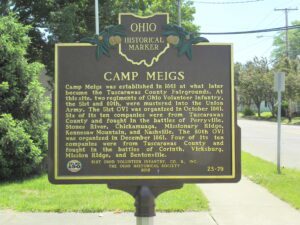
Camp Meigs was established in 1861 at what later became the Tuscarawas County Fairgrounds. At this site, two regiments of Ohio Volunteer Infantry, the 51st and 80th, were mustered into the Union Army. The 51st OVI was organized in October 1861. Six of its ten companies were from Tuscarawas County and fought in the battles of Perryville, Stones River, Chickamuaga, Missionary Ridge, Kennesaw Mountain, and Nashville. The 80th OVI was organized in December 1861. Four of its ten companies were from Tuscarawas County and fought in the battles of Corinth, Vicksburg, Mission Ridge, and Bentonville.
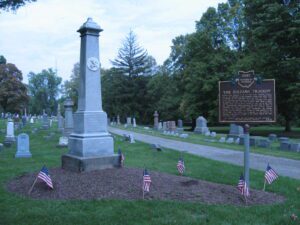
Soldiers from Company F of the 115th Ohio Volunteer Infantry died in the explosion of the steamboat Sultana seven miles north of Memphis on the Mississippi River on April 27, 1865. The Sultana reportedly carried more than 2,400 passengers–six times its capacity of 376. The vast majority were Union soldiers recently freed from Southern prisons at the end of the Civil War. Approximately 1,800 passengers and crew died in what is considered the worst maritime disaster in American history. Company F was organized in Stark, Columbiana, and Portage Counties and was mustered into service at Camp Massillon in the fall of 1862. This marker is a memorial to the soldiers of Company F who died as a result of the Sultana tragedy and other war-related causes.
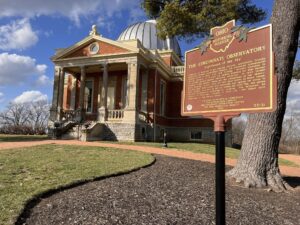
Prompted by response to his popular lectures, astronomer Ormsby MacKnight Mitchel (1809-1862) founded the Cincinnati Astronomical Society (CAS) in 1842. With CAS funding, Mitchel traveled to Munich, Bavaria, to acquire the optical elements for what became the world’s second largest refractor telescope. In 1843 former president John Quincy Adams laid the cornerstone of the observatory building, located upon the hill since known as Mount Adams. The Cincinnati Observatory was completed and opened for study in 1845. Mitchel, who died in service during the Civil War, was among the first to popularize astronomy in America. The telescope he brought to Cincinnati remains in daily use, the oldest such instrument in the United States.