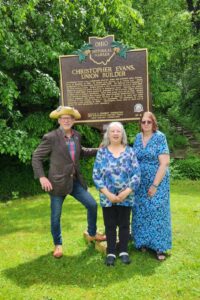
Christopher Evans was a celebrated district, state, and national union builder. Born in England in 1841, he began coal mining as a young boy. Evans immigrated to Pennsylvania around 1869-1870. By 1874 he was president of his local mining union. Evans moved to New Straitsville between 1875-1877, where he organized union meetings in Robinson’s Cave. During the miners’ strike of 1884-1885, Evans served as president of the Hocking Valley District of Ohio and its Relief Committee. After area mines were set on fire, miners were forced to abandon New Straitsville when its mines closed forever. Evans helped organize the United Mine Workers of America in 1890 and later authored a two-volume history of the movement. He remained in union leadership until retiring in 1908. Christopher Evans died in 1924 and is buried in New Straitsville Joint Cemetery.
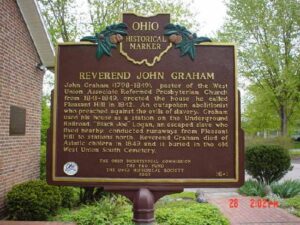
John Graham (1798-1849), pastor of the West Union Associate Reformed Presbyterian Church from 1841-1849, erected the house he called Pleasant Hill in 1842. An outspoken abolitionist who preached against the evils of slavery, Graham used his house as a station on the Underground Railroad. “Black Joe” Logan, an escaped slave who lived nearby, conducted runaways from Pleasant Hill to stations north. Reverend Graham died of Asiatic cholera in 1849 and is buried in the old West Union South Cemetery.
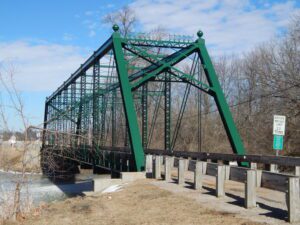
The Bridgeport Iron Bridge, often called the Streng Road Iron Bridge, was built in 1914. It replaced a wooden covered bridge built in 1869 by Reuben L. Partridge (1823-1900) and Isaac J. Grummons (1828-1921), which was damaged by the flood of 1913. The 200′ steel superstructure uses a pin-connected Pratt Through truss design and was constructed by the Central Concrete & Construction Company, Canton, Ohio, at a cost of $8,987. The original substructure abutments were constructed by John A. Maugans (1861-1933) for $3,248, but have since been replaced. In 1992 and 1993, the bridge was renovated under the leadership of County Engineer Steve A. Stolte and Assistant Engineer Jeff Stauch.
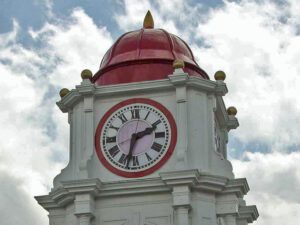
The Bellaire High School Clock Tower was erected in 1925 as the second town clock to be mounted on Bellaire’s public schools. C.W. Bates of Wheeling designed this tower, built by C.D. Keyser & Co. of Bellaire. The school building stretches 256 feet along 35th Street, and the tower rises 40 feet above the 3rd floor parapet of the roof. The clock faces are 6 feet, 7 inches in diameter. At the exterior corners of the bell room are 11 foot columns. The tower dome is painted red. E. Howard & Co. of Boston made the clock works and the McShane Bell Foundry of Baltimore cast the bell in August 1888. The BHS Alumni Association lighted the tower in 1998 to honor all “faithful and true-hearted” graduates of the school.
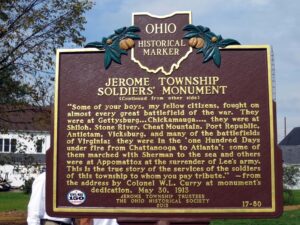
This monument was dedicated on Memorial Day of 1913 to honor the Union soldiers of the Civil War from Jerome Township. Many citizens, school children, and Civil War veterans attended the dedication as Col. W.L. Curry, who fought at Chickamauga, spoke to the crowd. The zinc monument contains the names of 400 soldiers of the township. The shaft is just over 21 feet high. Placed inside was a time capsule containing a number of historical documents including 60 photographs of Civil War veterans. Donations from a grateful community and a bequest from R.L. Woodburn, a Civil War veteran and Ohio legislator funded the monument.
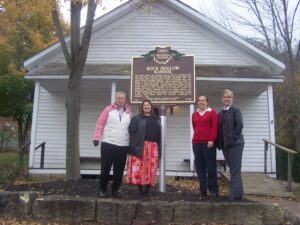
Rock Hollow School was originally built in 1877 in a wooded ravine two miles south of Ringgold, Union Township, and housed classes for fifty-seven years. The first class was held in November 1877, with John D. Davis of Ringgold teaching. Grades one through eight were taught in this one-room building, with an enrollment average of twenty to twenty-five pupils. The school closed in 1934 and sold in 1937 to Hettie Woodward, a former student and teacher at Rock Hollow School. In 1980, the heirs of the late Hettie Woodward donated the school to the Morgan County Historical Society for preservation. Fearing vandalism due to its remote location, the historical society relocated the building to its present site in Malta in 1991. The building was disassembled and rebuilt in exact original condition. Rock Hollow School was officially rededicated on November 1, 1992.
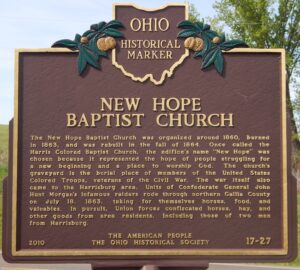
The New Hope Baptist Church was organized around 1860, burned in 1863, and was rebuilt in the fall of 1864. Once called the Harris Colored Baptist Church, the edifice’s name “New Hope” was chosen because it represented the hope of people struggling for a new beginning and a place to worship God. The church’s graveyard is the burial place of members of the United States Colored Troops, veterans of the Civil War. The war itself also came to the Harrisburg area. Units of Confederate general John Hunt Morgan’s infamous raiders rode through northern Gallia County on July 18, 1863, taking for themselves horses, food, and valuables. In pursuit, Union forces confiscated horses, hay, and other goods from area residents, including those of two men from Harrisburg.
NE corner of S. Main Street and Zoar Road / Bayou Street
South Lebanon
, OH
Deerfield was laid out around 1795 and in 1802 Major Benjamin Stites, his son Benjamin, Jr., and John Gano officially recorded the village’s plat. A part of the great tide of Americans moving into the Northwest Territory (and Ohio after 1803), Deerfield’s early inhabitants included Revolutionary war veteran Ephraim Kibbey as well as Andrew Lytle, Nathan Kelly, William Snook, and War of 1812 veteran David Sutton. Deerfield was so called because it was a settlement in Deerfield Township, Hamilton County in the 1790s. (Continued on other side)