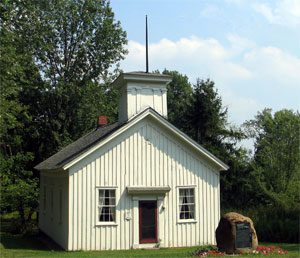
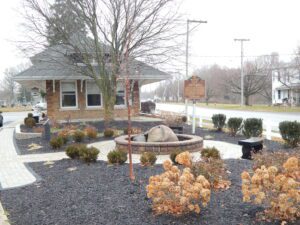
Called the “Cradle of Equal Suffrage” and “Free Speech Chapel,” Union Chapel was to be “…open and free for all denominations, but to be monopolized by no one or to the exclusion of anyone.” Built in 1858 or 1859 on land donated by Anson Matthews, the chapel reputedly exists in response to incident triggered by James A. Garfield, then principal of the Western Reserve Eclectic Institute (now Hiram College) and later president of the United States. He was scheduled to speak at the Congregationists’ “Brick Church” in December 1857. Because of the supposed controversial nature of Garfield’s speech, however, the invitation was withdrawn. (Continued on other side)
Company E of the 30th Ohio Volunteer Infantry was the only full infantry company formed in Jerome Township. Capt. Elijah Warner organized the unit in the village of Jerome and it was mustered into the Union Army at Camp Chase in Columbus on August 29, 1861. A total of 102 men from the township fought in the regiment throughout the war, while approximately 25% of the total population of the Jerome Township served. Company E performed outstanding service, participating in the Antietam, Vicksburg, and Atlanta Campaigns, Sherman’s March to the Sea and the March through the Carolinas, and the in the Grand Review in Washington, D.C. Of the 102 Jerome Township men in Company E, 32 perished during the war. The regiment was mustered out of service August 13, 1865.
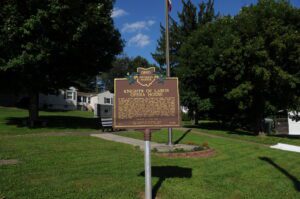
In 1869 a secret organization, The Knights of Labor, was founded in Philadelphia. The K.O.L. promoted an ideal society based on bettering life for others with the slogans, “labor was the first capital” and “an injury to one is the concern of all.” Shawnee’s Local Assembly #169 Knights of Labor was organized in 1876, and quickly became a powerful voice for labor in Ohio. National labor leader, William T. Lewis, later Labor Commissioner of Ohio, taught free grammer classes at night for the miners. Lewis initiated “The Ohio Plan,” the first free empployment bureaus in the United States. William H. Bailey, later head of National District Assembly #135 of Miners and T.L. Lewis, President of the United Mine Workers in 1910, also started their careers here. Meetings involving these leaders led to the formation of the United Mine Workers in 1890. (Continued on other side)
Congress established the United States Military District in 1796 by an act to provide bounty land for Revolutionary War officers and soldiers. District lands consisted of 2.6 million acres in twelve Ohio counties, including Delaware County. The Union Land Company, organized by James Kilbourne of Connecticut in 1806, was formed to purchase Military District land. Kilbourne purchased 4,000 acres in southeast Liberty Township, Delaware County for $7,000, and, in turn, sold the land to 26 Union Land Company members for $2.00 per acre. Five members were from the Case family, and they purchased 950 acres–Ambrose, George, Jonathan, Seth, and Silas. George and Seth were Revolutionary War veterans who did not claim their bounty lands. George purchased lot 11, a part of which is in northwest Highbanks Park today, and Seth purchased 300 acres north of this site. By 1849 the Case family owned over 1,000 acres.
On March 20, 1868, The Ohio General Assembly passed a revision to the Ohio Revised Code allowing for a municipality and a township to join together in purchasing land for a shared cemetery. On April 24, 1868, the Washington Township Trustees passed a resolution creating Forest Hill Union Cemetery. This cemetery was to be shared with the City of Piqua and became the first mutual cemetery between a municipality and a township in Ohio.
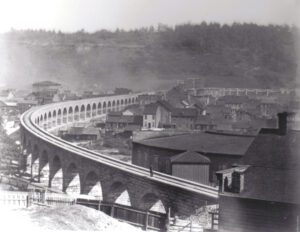
Construction of this Great Stone Viaduct began in 1870 at Union Street as an Ohio approach to the railroad bridge spanning the Ohio River. It was completed to Rose Hill in April 1871, and the entire bridge span connecting Ohio to West Virginia, of which the Viaduct is a part, was opened to rail traffic on June 21, 1871. Jointly constructed by the Baltimore & Ohio Railroad and the Central Ohio Railroad, its sandstone piers rise in varying heights 10 to 20 feet above the streets, from which are placed 43 stone arches supported by 37 ring stones (18 on each side of a keystone) intended to symbolize a united Union consisting of 37 states. Placed on the National Register of Historic Places in 1976, this Ohio River crossing became known as the “Great Shortline to the West.”
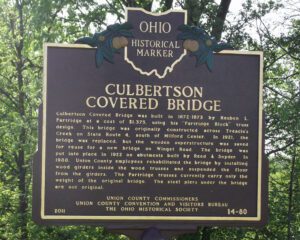
Culbertson Covered Bridge was built in 1872-1873 by Reuben L. Partridge at a cost of $1,375, using his “Partridge Block” truss design. This bridge was originally constructed across Treacle’s Creek on State Route 4, south of Milford Center. In 1921, the bridge was replaced, but the wooden superstructure was saved for reuse for a new bridge on Winget Road. The bridge was put into place in 1922 on abutments built by Reed & Snyder. In 1988, Union County employees rehabilitated the bridge by installing wood girders inside the wood trusses and suspended the floor from the girders. The Partridge trusses currently carry only the weight of the original bridge. The steel piers under the bridge are not original.
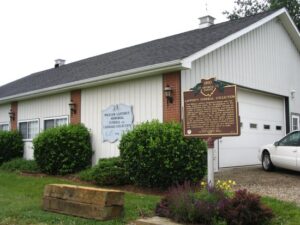
The William Lafferty Memorial Funeral and Carriage Collection shows the development of the funeral business since the mid-1800s through an exhibit of caskets, funeral clothing, and hearses collected and preserved by James William Lafferty (1912 – 1987). William was a member the fourth generation of Laffertys to serve West Union and Adams County. Characteristic of the early history of the profession, William Voris (W.V.) Lafferty (1830-1922) founded the business in 1848 to meet the demand for caskets, which he, as a furniture and cabinetmaker, was often asked to build. (Continued on other side)