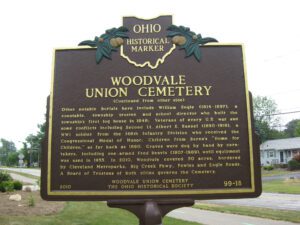
Woodvale Cemetery was established in the mid-1800s, in Middleburgh Township, Ohio. The oldest marked grave holds Fred G. Klink (1835-1858), whose family donated a half acre of land for burials. In 1876, Frank M. Stearns (1832-1911) suggested the unnamed cemetery be called Woodvale, after the wooded vale beside it. In 1908, a fire destroyed the caretaker’s house and many cemetery records. Woodvale became a non-profit, union cemetery in 1931, owned by Berea and the Village of Middleburg Hts. and covering 35 acres at 7535 Engle Road. Pioneer families buried here: Fowles, Kraft, Lovejoy, Sprague, and Stearns. Also buried here: John Baldwin (1799-1884) founder of Baldwin University and James Wallace (1878-1953) founder of German Wallace College (merged in 1913 to become Baldwin Wallace College) (Continued other side)
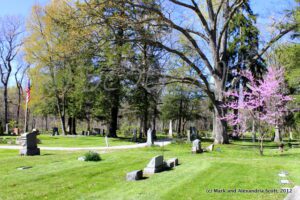
The northward course of the west branch of Rocky River forms a boundary for this cemetery, which lies above the river valley. Old trees convey stateliness and solemnity to these seven acres, often called “Turkey Foot” because turkeys roosted in the trees. Settlers from New England are buried here and include descendants of William Bradford, second governor of the Plymouth Colony. Julie Carter Northrop, granddaughter of one of Cleveland’s early settlers, Lorenzo Carter, is buried here. Veterans of six wars are honored here. The Daughters of the American Revolution recorded the cemetery’s tombstone engravings and cenotaphs in 1961. (Continued on other side)
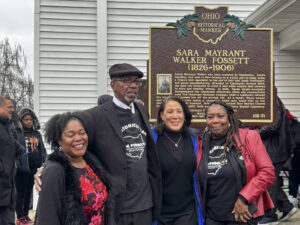
Sarah Mayrant Walker was born enslaved in Charleston, South Carolina, and sent to New Orleans as a young girl to study under a French hair specialist in the art of hair and scalp treatment, and goods manufacturing. Brought to Cincinnati around 1840, she used her networks to build a hair salon empire that catered to elite and wealthy women. In 1859, Sarah single-handedly desegregated the Cincinnati streetcars when she successfully sued The Passenger Railroad Company after a conductor refused her passage and pushed her off the moving car. As a result, Black women and children could ride inside a streetcar while men could ride on the platform. She and her husband, Peter Fossett, founded First Baptist Church of Cumminsville circa 1870. Both are buried in the Union Baptist Cemetery.
United Colored American Cemetery is among the earliest in situ African American cemeteries in Hamilton County. The 11.6 acres in Madisonville were purchased by the United Colored American Association (UCAA) after the legislated closure of their earlier Avondale cemetery. Many Avondale burials and headstones were moved prior to the new cemetery’s dedication on May 30, 1883. Designed by Adolph Strauch, United Colored American Cemetery features the looping roads and picturesque elements typical of his designs at Spring Grove and Eden Park. After the dissolution of the UCAA, Cincinnati mayor Charles P. Taft asked Union Baptist Church to take ownership and maintenance of the cemetery. Union Baptist assumed ownership in 1968 and burials continued until 2019. United Colored American Cemetery was listed on the National Register of Historic Places in 2022.
NE of the intersection of W Broad Street and Marconi Blvd, along the Scioto River
Columbus
, OH
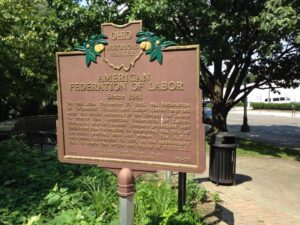
One this site, December 10, 1886, the Federation of Organized Trades and Labor Union merged with the trade unionists of the Knights of Labor to create the American Federation of Labor. Delegates elected Samuel Gompers president and dedicated the Federation to improving the life of America’s working men and women. The A.F.L. recognizes November 15, 1881, as its anniversary date to honor the origin and legacy of F.O.T.L.U.
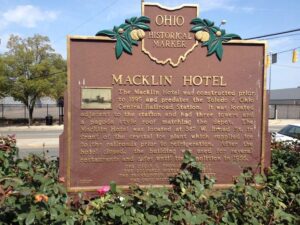
The only remaining Columbus railroad station, The Toledo & Ohio Central (T&OC) Railroad Station was constructed in 1895 and was the departure point for William McKinley when he left for Washington D.C to be sworn in as president. Designed by noted Columbus architects Joseph Warren Yost & Frank L. Packard, the pagoda style roof and tower have become Columbus icons. By 1900, the T&OC was purchased by the rival Hocking Valley Railroad and in 1911 the tracks were elevated above Broad Street. Later the New York Central Railroad gained control and used the station until 1930 when passenger service was transferred to Union Station in Columbus. Restored after the 1913 Flood and major fires in 1910 and 1975, the station was headquarters for the Central Ohio Volunteers of American from 1930 to 2003. The building was placed on the National Register of Historic Places in 1973.
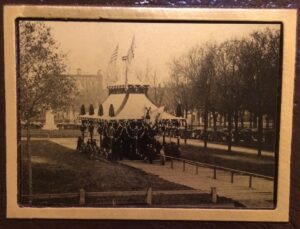
Abraham Lincoln visted Cleveland twice; once in life and the other in death. The first visit was on February 15-16, 1861, while in route to his presidential inauguration. The second, more solem visit was on April 28, 1865. Cleveland was one of twelve citiels to host a scheduled public viewing of the assassinated president’s remains. In addition to local officials, Lincoln’s cortege included a military escort of then current and former Union officers who were veterans of the Civil War. These officers would form the early membership of the organization known as the Military Order of the Loyal Legion of the United States. (continued on other side)
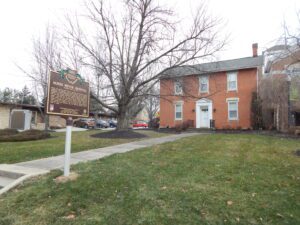
The house at this location, 110 South State Street, was the childhood home of Agnes Meyer Driscoll (1889-1971). Known as “the first lady of naval cryptology,” her career spanned from World War I to the Cold War. Driscoll attended Otterbein University before graduating from the Ohio State University, with majors in physics, math, music, and foreign languages. During World War I, she enlisted in the U.S. Navy as a chief yeoman, the highest rank possible for a woman at the time. After the war, Driscoll rose to become the chief civilian cryptanalyst for the U.S. Navy, breaking major Imperial Japanese Navy codes prior to World War II. (Continued on other side)