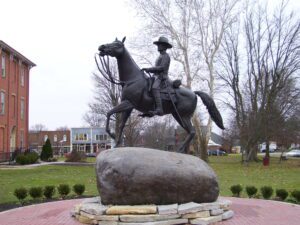
W.S. Rosecrans, soldier, engineer, architect and inventor, was born in Kingston Township in 1819. After graduation from West Point in 1842, he served in the Engineering Corps then taught at West Point. As a civilian, he engineered a river lock system and perfected lamp oil. During the Civil War, Rosecrans commanded Union Armies of the Ohio, the Cumberland, and the Missouri, and developed a popular war-time ambulance. “Old Rosy” led his troops to victory at Iuka, Corinth, Stones River and Tullahoma. He helped raise $789,000 for soldiers’ relief and designed St. Joseph’s Cathedral in Columbus. He later served as Minister to Mexico, Registrar to the U.S. Treasury and as a Congressman from California. He died in 1898 and is buried in Arlington National Cemetery. “Stand by your flag and country, my men!”- Rosecrans at the Battle of Stones River, October 4, 1862
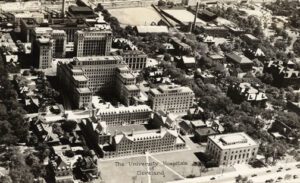
Named for the streetcar turnaround once located at Euclid Avenue and East 107th Street, University Circle is a 600-acre district that is home to many of Cleveland’s major cultural, educational, medical, and service institutions. The area was first settled in 1799 by tavernkeeper Nathaniel Doan and became known as Doan’s Corners. In 1882, Western Reserve College moved here from Hudson, followed in 1885 by the Case School of Applied Science from downtown Cleveland. These two colleges federated in 1967 to become Case Western Reserve University. (continued on other side)
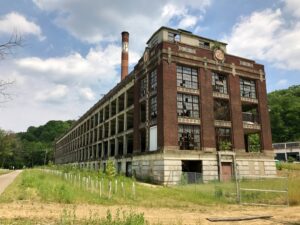
The Peters Cartridge Company was once a major employer in the region, providing munitions for Allied forces during World Wars I and II. Organized in 1887, it was the first ammunition company to produce machine-loaded shotgun shells. After an explosion in 1890 that killed 12, the factory was rebuilt at this site. By 1916, brick and reinforced concrete buildings had replaced wood structures and a taller shot tower had been erected. Sister company to the King Powder Company across the Little Miami River, 3,000 men and women at Peters produced 1,500,000 cartridges per day in 1917 to supply munitions during WWI. In 1934, Remington Arms bought the company, enlarged it, and then sold it in 1944. The shot tower and smoke stack stand as a reminder that Peters was once the leader in ammunition production.
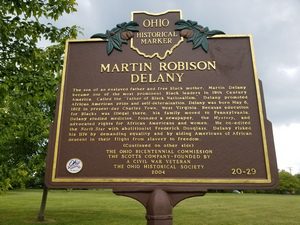
The son of an enslaved father and free Black mother, Martin Delany became one of the most prominent Black leaders in 19th Century America. Called the “Father of Black Nationalism,” Delany promoted African American pride and self-determination. Delany was born May 6, 1812 in present-day Charles Town, West Virginia. Because education for Blacks was illegal there, his family moved to Pennsylvania. Delany studied medicine, founded a newspaper, the “Mystery,” and advocated rights for African Americans and women. He co-edited the “North Star” with abolitionist Frederick Douglass. Delany risked his life by demanding equality and by aiding Americans of African descent in their fight from slavery to freedom. (Continued on other side)
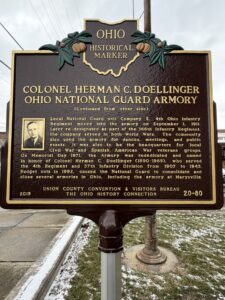
The Marysville Ohio National Guard Armory was the first such armory constructed in the state after the recognition of the Guard in 1909. The new armory and others like it were built in response to federalization of National Guard units after the passage of the Militia Act of 1903. Armory buildings served as the headquarters for local companies and provided drill rooms and arsenals for the storage of military equipment and supplies. Architect Charles Insco Williams designed Marysville’s armory and it was built by James Laughlin, both of Dayton, Ohio. Marysville contractor George W. Fox provided the brickwork for the structure. Construction began in 1910 and was completed in 1911 at a cost of $19,886. (Continued on other side)
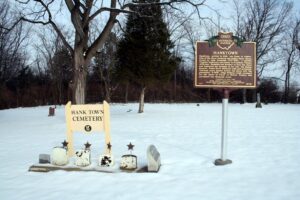
Hanktown, settled in 1846, was home to eighty-nine of the three hundred and eighty-three slaves, owned by John Randolph (1773-1833), a wealthy Virginian landowner and cousin to President Thomas Jefferson. Randolph had decided to free the slaves and indicated the decision in his will. His family, however, found three different wills and protested. Thirteen years passed before the slaves left the plantation. In 1846, Judge William Leigh arranged for the slaves to travel to Mercer County and purchased two thousand acres. (Continued on other side)
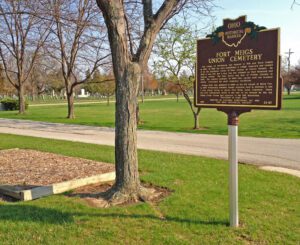
The village of Perrysburg was founded in 1816 and Wood County in 1820. In 1822 the town established a village cemetery and located it on the southwest corner of West Indiana at Cherry Streets. By 1848 it was full and a new one was created on West Boundary and Indiana Avenue. The first burial was that of William Cassady in 1849. The cholera epidemic of 1854 that caused over one hundred deaths, overloaded the small cemetery workforce. Potters Field was designed in 1868 on the NW corner of Block Two. In 1877 Perrysburg Township bought adjacent land in sections K and L and joined forces to create Fort Meigs Union Cemetery. There are nine underground vaults in the side of the terrace by the old Ewing Creek stream bed adjacent to the 1912 mausoleum.
Frances Dana (Barker) Gage was born on October 12, 1808, in Marietta. She married James L. Gage in 1829 and they raised eight children, including four sons who served with Union forces during the Civil War. Throughout much of her life, Frances was deeply involved with the Temperance and Anti-Slavery movements and Women’s Rights issues. Presiding over the Women’s Rights Convention in Akron in 1851, she invited Sojourner Truth to give her famous “Ain’t I a Woman” speech. The Gage family moved in 1853 to St. Louis, the western extension of the Mason-Dixon Line, where her life was threatened whenever she spoke out against slavery. During the Civil War, she traveled south to aid Union soldiers and teach freed slaves. Though crippled and permanently disabled by a stroke, she continued to lecture on social issues until 1867. Frances Dana Gage died on November 10, 1884, in Greenwich, Connecticut.