

, OH
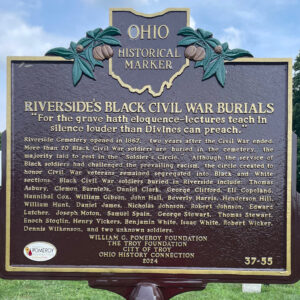
Black soldiers played a major role in the Civil War and more than 5,000 free Black Ohioans served in Union forces. While prejudice marginalized the Black man’s ability to serve early in the war, an 1862 Act of Congress authorized their admission into the Union Army and Navy. President Abraham Lincoln’s 1863 Emancipation Proclamation welcomed all freed men to join the fight. About 300 Black Ohioans joined the 54th and 55th Massachusetts (Colored) Volunteers – the first all-Black regiments raised in the North. Although offered $13 per month, the new recruits had to wait eighteen months to receive equal pay. In June 1863, Ohio’s Governor David Tod authorized a regiment of Black soldiers. The 127th Ohio Volunteer Infantry (OVI), the state’s first Black regiment, became known as the 5th U.S. Colored Troops (USCT).
, OH
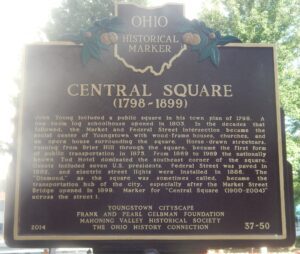
John Young included a public square in his town plan of 1798. A one-room log schoolhouse opened in 1803. In the decades that followed, the Market and Federal Street intersection became the social center of Youngstown with wood-frame houses, churches, and an opera house surrounding the square. Horse-drawn streetcars, running from Brier Hill through the square, became the first form of public transportation in 1875. From 1869 to 1969 the nationally known Tod Hotel dominated the southeast corner of the square. Guests included seven U.S. presidents. Federal Street was paved in 1882, and electric street lights were installed in 1886. The “Diamond,” as the square was sometimes called, became the transportation hub of the city, especially after the Market Street Bridge opened in 1899. Marker for “Central Square (1900-2004)” across the street.
, OH
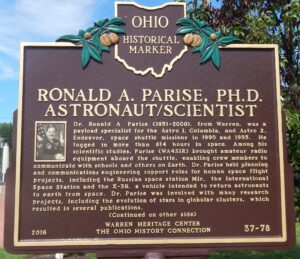
Dr. Ronald A. Parise (1951-2008), from Warren, was a payload specialist for the Astro 1, Columbia, and Astro 2, Endeavour, space shuttle missions in 1990 and 1995. He logged in more than 614 hours in space. Among his scientific studies, Parise (WA4SIR) brought amateur radio equipment aboard the shuttle, enabling crew members to communicate with schools and others on Earth. Dr. Parise held planning and communications engineering support roles for human space flight projects, including the Russian space station Mir, the International Space Station and the X-38, a vehicle intended to return astronauts to earth from space. Dr. Parise was involved with many research projects, including the evolution of stars in globular clusters, which resulted in several publications. (Continued on other side)
, OH
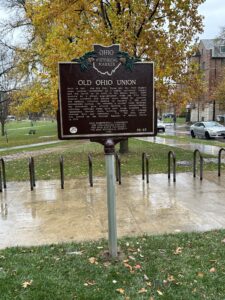
Built in 1910, the old Ohio Union was the first student union building constructed on a public university campus and the fourth to be built in the United States. Made possible by a direct appropriation from the 77th Ohio General Assembly and private funds raised by students, the building officially opened on January 11, 1911 with considerable fanfare. By erecting a student union building, the university gave official sanction to extracurricular activities. Although there have been seven additions, this Jacobethan Revival style building retains its original exterior form and character. The “Old Ohio Union” was placed on the National Register of Historic Places in 1979.
, OH
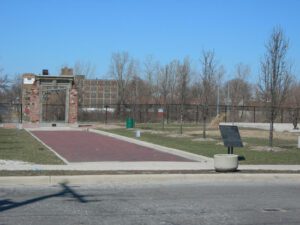
In 1934, workers at the Electric Auto-Lite Company and other automotive-related manufacturers secretly organized the Automobile Workers Federal Union Local 18384, American Federation of Labor (AFL), which became the United Auto Workers (UAW) Local 12. Anti-unionism, broken pledges by management, and abuse of workers had festered locally for generations. Workers bitterly resented the fact that management took advantage of the Depression’s high unemployment to decrease wages. In February, workers struck at Auto-Lite, Bingham Stamping, Logan Gear, and Spicer Manufacturing Company. When management refused to negotiate in good faith, the workers, including a large number of women, struck the Auto-Lite in mid-April. Auto-Lite management secured a court order limiting the number of strikers to twenty-five. The strike appeared to be lost until the Lucas County Unemployed League organized fierce resistance to the court injunction as the crowd around the plant grew to ten thousand. (continued on other side)
, OH
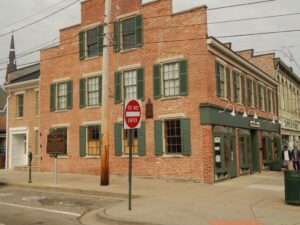
Thomas Cowan Bell, James Parks Caldwell, Daniel William Cooper, Isaac M. Jordan, William Lewis Lockwood, Benjamin Piatt Runkle, and Franklin Howard Scobey met in a second floor room of this building to found Sigma Chi (ΣΧ) in early 1855. All but Lockwood had been members of Delta Kappa Epsilon (ΔΚΕ) but left over a disagreement as to who should be elected poet of Erodelphian, one of Miami University’s literary societies. Runkle and Caldwell, who lived here, designed Sigma Chi’s badge, the White Cross. Reflecting the ideals of Friendship, Justice, and Learning, the Brothers donned the badge and established Sigma Chi on Commencement Day, June 28, 1855. The founding of Sigma Chi completed the Miami Triad, which includes Alpha (founding) chapters of Beta Theta Pi (ΒΘΠ, 1839) and Phi Delta Theta (ΔΘ, 1848). Miami University and Union College in Schenectady, New York are known as the “Mother of Fraternities.” (Continued on other side)
, OH
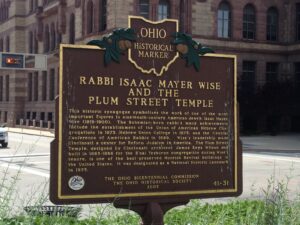
This historic synagogue symbolizes the work of one of the most important figures in nineteenth-century American Jewry, Isaac Mayer Wise (1819-1900). The Bohemian-born rabbi’s many achievements include the establishment of the Union of American Hebrew Congregations in 1873, Hebrew Union College in 1875, and the Central Conference of American Rabbis in 1889. Wise’s leadership made Cincinnati a center for Reform Judaism in America. The Plum Street Temple, designed by Cincinnati architect James Keys Wilson and built in 1865-1866 for the B’nai Yeshurun congregation during Wise’s tenure, is one of the best-preserved Moorish Revival buildings in the United States. It was designated as a National Historic Landmark in 1975.
, OH
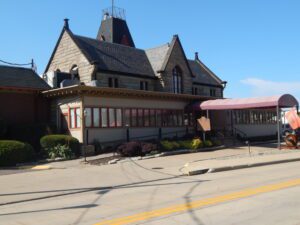
The Berea Union Depot, a significant hub in the railroad networks of northeast Ohio from the time of its construction in 1876 until its closing in 1958, is an unusual, but well-designed example of Victorian Gothic Architecture. With the development of an expanding stone quarry industry in the area, Berea and its railroad facilities grew rapidly and by the early 1870s developers and townspeople alike called for construction of a new passenger and freight station. When this Berea sandstone station was completed and then dedicated on May 3, 1876, the Cleveland Plain Dealer called the building “the finest facility outside the big cities.” From 1958 until 1980, the building remained closed until it began a second life, restored as a restaurant and gathering place.