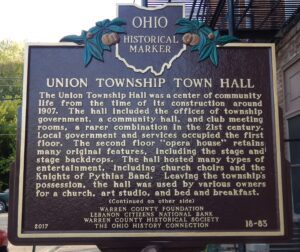
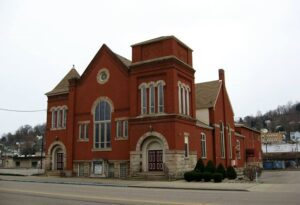
The Union Township Hall was a center of community life from the time of its construction around 1907. The hall included the offices of township government, a community hall, and club meeting rooms, a rarer combination in the 21st century. Local government and services occupied the first floor. The second floor “opera house” retains many original features, including the stage and stage backdrops. The hall hosted many types of entertainment, including church choirs and the Knights of Pythias Band. Leaving the township’s possession, the hall was used by various owners for a church, art studio, and bed and breakfast.(Continued on other side)
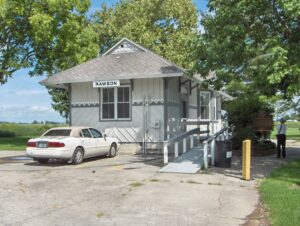
The original town plat of Rawson was filed on February 3, 1855, consisting of fifty-five lots in sections 13 and 14 of Union Township, Hancock County on the Frederick Keller and George J. Kelly farms. Several residential and business structures were built in anticipation of completion of a railroad rumored to pass from Fremont through the “Rawson” area on its way to the western boundary of Ohio. Farmers Keller and Kelly named their village Rawson after L.Q. Rawson, President of the railroad company, hoping that the name would encourage him to build through their area. Financial troubles delayed construction causing a standstill in Rawson. Seventeen years later the first locomotive arrived in Rawson, spurring new construction. At that time the railroad was called the Lake Erie and Louisville; in 1879 it was changed to the Lake Erie and Western and in 1922 became part of the Nickel Plate Railroad. (Continued on other side)
801 E. Pete Rose Way, Bicentennial Commons at Sawyer Point
Cincinnati
, OH
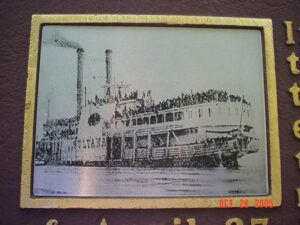
In 1862, less than a mile upriver from this marker, the John Lithoberry Shipyard in Cincinnati constructed the Sultana, a 260-foot, wooden steam transport. At the end of the Civil War, the U.S. Government contracted the Sultana to transport recently freed Federal prisoners north from Confederate stockades. During the night of April 27, 1865, while carrying over 2,300 Union soldiers – over six times its capacity of 376 passengers – a steam boiler aboard the Sultana exploded. The ship erupted in a massive fireball and sank in the cold, flood-swollen Mississippi River ten miles north of Memphis, Tennessee. Over 1,700 individuals died – some 200 more than those lost aboard the Titanic in 1912 – in what remains the worst maritime disaster in American history. Of the total casualties, Ohio lost the most of any state, with 791 dead. Indiana lost 491 persons, with Kentucky suffering 194 dead. It is estimated that, of the Ohio casualties, over fifty were Cincinnatians.
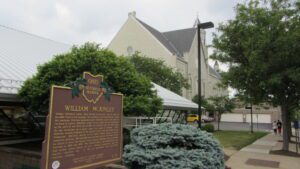
William McKinley’s house, once located at this site, was the scene of his 1896 front porch campaign for President of the United States. During the campaign McKinley addressed about 750,000 people who came to his home in Canton. McKinley’s public service began when he volunteered at the start of the Civil War in 1861 as a private with the Union Army. He was discharged as a major after four years of service. Later McKinley became President of the Canton Y.M.C.A. and the Stark County Prosecutor. McKinley served in the United States House of Representatives between 1877 and 1891 and was then elected Governor of Ohio. He helped to found the Canton Public Library. McKinley won presidential elections in 1896 and 1900. His administration was characterized by high tariffs, money backed by gold, national prosperity, and the Spanish-American War. In 1901 an anarchist shot and killed President McKinley.
Cornelius D. Battelle was born July 13, 1807 in Washington County, Ohio. He entered the Methodist Episcopal Church on October 30, 1825 and the Pittsburgh Methodist Conference in 1833. He was assigned pastoral circuit duties in rural eastern Ohio and the small river settlement of “Belle Aire” where he delivered his first sermon in a warehouse during the winter of 1838. He established the first Methodist class of eleven members in 1839 and rallied subscriptions to build the first church in the community. He served the Ohio Conference for 64 years before his death on July 2, 1897.
St. John’s Evangelical Lutheran Church was organized in 1838 by German Lutheran immigrants, primarily from Bavaria and Hesse-Darmstadt, who located in this vicinity in the 1830s. The congregation, called Neudettelsau, erected a second log church in 1843 centrally located in the “German Settlement”. A congregational split in 1846 resulted in the conservative members building a separate brick church a half mile away. This church in 1847 became one of the 12 charter members of the Lutheran Church-Missouri Synod. Growing membership required a larger brick church built on this site in 1860. In 1878 the two St. John’s congregations in the settlement reunited.
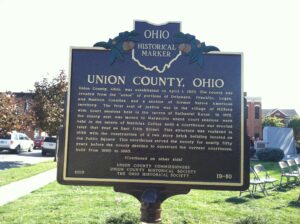
Union County, Ohio, was established on April 1, 1820. The county was created from the “union” of portions of Delaware, Franklin, Logan, and Madison Counties, and a section of former Native American territory. The first seat of justice was in the village of Milford with court sessions held in the tavern of Nathaniel Kazar. In 1822, the county seat was moved to Marysville where court sessions were held in the tavern of Matthias Collins until a courthouse was erected later that year on East Fifth Street. This structure was replaced in 1838 with the construction of a two story brick building located on the Public Square. This courthouse served the county for nearly fifty years before the county decided to construct the current courthouse, built from 1880 to 1883.
The Adams County Fairgrounds, established at this site in October 1853, on seven acres of land donated by Judge George Collings, was converted to a Civil War training camp named in honor of General Thomas Hamer, a Mexican War hero, of Georgetown, Ohio. The old stone Courthouse was made into a hospital to serve the camp. The 70th Ohio Volunteer infantry, organized in October 1861, trained on the old fairgrounds until Christmas day 1861, when it marched from Camp Hamer to Ripley. The 70th participated in the battles of Shiloh, Tennessee; Atlanta, Georgia; the siege at Vicksburg, Mississippi, and Sherman’s March to the Sea.