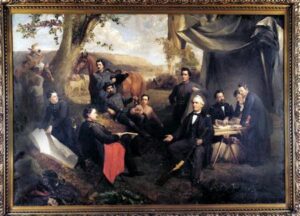
Major Daniel McCook of Carrollton and his 9 sons and their cousins, the 5 sons of Dr. John McCook of Steubenville, won popular acclaim for their outstanding service in the United States Army and Navy. “Tribe of Dan” Maj. Daniel: mortally wounded at Buffington Island. Maj. Latimer: a surgeon. Brig. Gen. George: early regimental commander. Midshipman John: died at sea. Brig Gen. Robert: murdered by guerrillas. Maj. Gen. Alexander: commander of the 20th Corps. Brig. Gen. Daniel Jr. mortally wounded at Kenesaw Mt. Maj. Gen. Edwin: served under Grant and Sherman. Pvt. Charles: killed at Bull Run. Col. John: seriously wounded in Virginia.
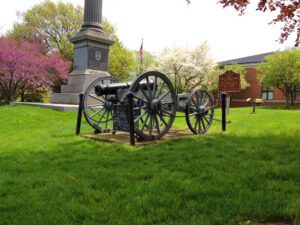
War of 1812. Victoriously defended by Major George Croghan. Battle of Fort Stephenson. August 2, 1813. Built on this spot 1812-1813 and named for Col. Mills Stephenson, one of its builders.
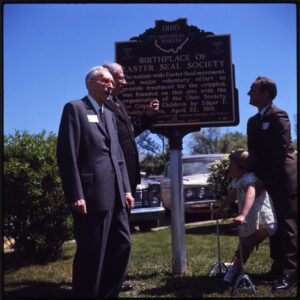
The nation-wide Easter Seal movement, first major voluntary effort to provide treatment for the crippled, was founded on this site with the organization of the Ohio Society for Crippled Children by Edgar F. (Daddy) Allen, April 22, 1919.
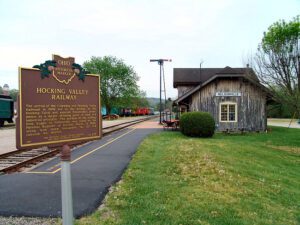
The arrival of the Columbus and Hocking Valley Railroad in 1869 led to the decline of the Hocking Canal and assured Nelsonville’s prominence as a major shipping point of coal and industrial products. The portion of the railway from Logan in Nelsonville was listed on the National Register of Historic Places in 1988, along with steam locomotive #33 and caboose #90704.
Constitution Park-Just N of Intersection of OH 725 and US 42
Spring Valley
, OH
In 1779 John Bowman’s forces followed the east bank to Glady Run, then north to the Indian village of Old Chillicothe. In 1780 and 1782 militia commanded by George Rogers Clark, and guided by Simon Kenton and Daniel Boone, crossed the river and camped two miles north of Caesar’s Creek, then marched on the villages near Springfield, Piqua, and Bellefontaine.
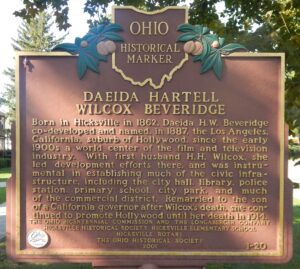
Born in Hicksville in 1862, Daeida H.W. Beveridge co-developed and named, in 1887, the Los Angeles, California, suburb of Hollywood, since the early 1900s a world center of the film and television industry. With first husband H.H. Wilcox, she led development efforts there, and was instrumental in establishing much of the civic infrastructure, including the city hall, library, police station, primary school, city park, and much of the commercial district. Remarried to the son of a California governor after Wilcox’s death, she continued to promote Hollywood until her death in 1914.
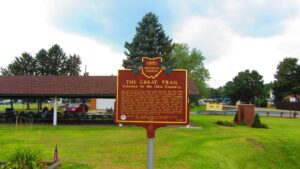
The ancient trail that passed near this spot was the major overland route entering the Ohio Country from the east through the 1700s. Also known as the Tuscarawas Path, the Great Trail was used by Native Americans, European explorers, fur traders, missionaries, military expeditions, land agents-and settlers after Ohio became a state. In January 1761, during the French and Indian War, Major Robert Rogers and thirty-eight rangers passed en route to Fort Pitt after taking Fort Detroit from the French. In 1764, during “Pontiac’s Conspiracy,” Colonel Henry Bouquet crossed here with an army of 1,500 men on his way to Goshachgunk (Coshocton), where he treated with the Delaware and freed captives. During the American Revolution, the Continental Army under General Lachlan McIntosh camped here for two days in November 1778.
Ervin George Bailey, who was born in Damascus, Ohio, invented the revolutionary “Bailey Boiler Meter,” a major contribution to the science of automation and the efficient burning of fuels. In 1916, he founded the Bailey Meter Company of Wickliffe, Ohio – a world supplier of industrial instrumentation and controls. Considered the “Dean of Combustion Engineers,” Mr. Bailey held more than 100 patents in the fields of meters, automatic controls, furnaces, boilers, and fuel burning equipment.