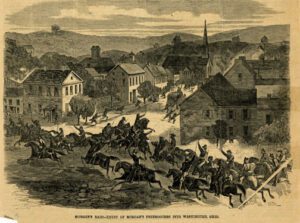
General John Hunt Morgan led a force of 2,000 Confederate calvalrymen into Meigs County during a raid north of the Ohio River. More than 50,000 Union troops and militia pursued Morgan across Ohio. Colonel Basil Duke wrote that while passing near Pomeroy on July 18, 1863, there was a continual fight for nearly five miles through a ravine. Led by Colonel J.W. Grisby and the 6th Kentucky, with Major T.C. Webber and the 2nd Kentucky in the rear, the Confederate calvarymen fought local militia who felled trees and fired upon the calvarymen from the hills and roads. After suffering losses at Buffington Island, Morgan surrendered eight days later near West Point in Columbiana County. The surrender field was the northernmost point ever reached by Confederate forces during the Civil War.
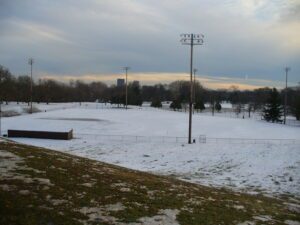
On October 3, 1920 the first game matching two professional teams of the American Professional Football Association, a league that would become the National Football League (NFL), was held on this field within Triangle Park. In that game, the Dayton Triangles defeated the Columbus Panhandles 14-0. The Triangle’s Lou Partlow scored the first touchdown and George “Hobby” Kinderdine kicked the first extra point. Three factories founded by Dayton businessmen Edward Deeds and Charles Kettering sponsored the Dayton Triangles team. The factories were the Dayton Engineering Laboratories Company (DELCO), Dayton Metal Products Company (D.M.P.Co.), and Domestic Engineering Company (DECO), later call Delco-Light. They formed an industrial triangle of plants in downtown Dayton.
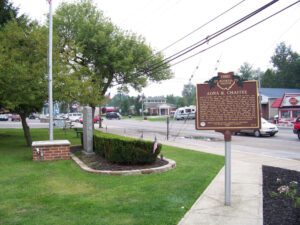
Adna R. Chaffee was born in Orwell on April 14, 1842, and grew up on the family farm. He left home in 1861 to pursue a career in the military, enlisting first in the 6th U.S. Cavalry for service in the Civil War. Distinguishing himself in many battles, including Gettysburg, Chaffee rose to the rank of 1st Lieutenant. He then fought in the Indian Wars of the West from 1867-1888, assisting in the capture of Geronimo and being promoted to the rank of Major. He also saw action in the Spanish American War, the Boxer Rebellion in China, and the Philippine Insurrection. On January 9, 1904, Chaffee was promoted to Lt. General and became Chief of Staff of the U.S. Army, the first to achieve this office without attending West Point. He retired in 1906. He died in 1914 and was buried in Arlington National Cemetery with the highest military honors.
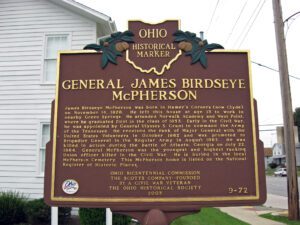
James Birdseye McPherson was born in Hamer’s Corners (now Clyde) on November 14, 1828. He left this house at age 13 to work in nearby Green Springs. He attended Norwalk Academy and West Point, where he graduated first in the class of 1853. Early in the Civil War, he was appointed by General Ulysses S. Grant to command the Army of the Tennessee. He received the rank of Major General with the United States Volunteers in October 1862 and was promoted to Brigadier General in the Regular Army in August 1863. He was killed in action during the battle of Atlanta, Georgia on July 22, 1864. General McPherson was the youngest and highest ranking Union officer killed in the Civil War. He is buried in the local McPherson Cemetery. This McPherson home is listed on the National Register of Historic Places.
Morgan County was created in 1817 from parts of Washington, Muskingum, and Guernsey counties, with McConnelsville established as the seat of government. The first courthouse, a square brick structure, was built here in 1820. Its foundation stones form part of the wall surrounding the lawn. The present courthouse building was completed in 1858 at a cost of $10,000. This Greek Revival-style structure has had several major renovations since. The clock tower was added in 1886, and the building was enlarged and modernized in 1960.
SW Corner of Sunbury Square near S. Columbus St & E. Granville St.
Sunbury
, OH
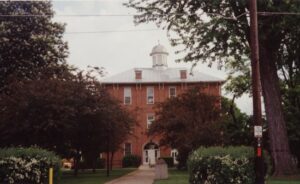
When Sunbury was platted in 1816, a town square was set aside for public use with the intention of constructing a town hall on the site. The first two stories of the Town Hall were built, as a school, in 1868 for $5,000. The Masons added the third story for $1,500 and occupied it for 91 years, until a lodge was constructed. Since 1868, the Town Hall has served Sunbury as a village office building, jail, fire station, and community library. Church services as well as Farmer’s Institutes were held in the building, and at one time it housed a bank. In 2002, the Town Hall was renovated for use as a community room and village offices.
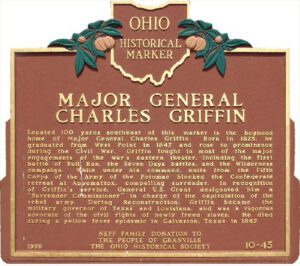
Located 100 yards southeast of this marker is the boyhood home of Major General Charles Griffin. Born in 1825, he graduated from West Point in 1847 and rose to prominence during the Civil War. Griffin fought in most of the major engagements of the war’s eastern theater, including the first battle of Bull Run, the Seven Days battles, and the Wilderness campaign. While under his command, units from the Fifth Corps of the Army of the Potomac blocked the Confederate retreat at Appomattox, compelling surrender. In recognition of Griffin’s service, General U.S. Grant designated him a “Surrender Commissioner” in charge of the capitulation of the rebel army. During Reconstruction, Griffin became the military governor of Texas and Louisiana, and was a vigorous advocate of the civil rights of newly freed slaves. He died during a yellow fever epidemic in Galveston, Texas in 1867.
The township of Kinsman was purchased by John Kinsman of Lisbon, Connecticut, in 1799 from the Connecticut Land Company. Kinsman has been the home of many notable citizens, some of whom include: Philip P. Bliss (1838-1876) and James McGrannahan (1840-1907) were hymn composers and religious musical directors for the nationally-known evangelical Dwight L. Moody Revival Meetings held in Kinsman for thirty years in the late 1800s. Clarence Darrow (1857-1938) was a famous labor and criminal lawyer who grew up in Farmdale and in the “octagon house” in Kinsman. Darrow in probably best known for his work as a defense attorney in the Scopes Trial. (continued on reverse side)